Passport fee revision and evolution of Passport Seva Project
Source:Indian Express ↗
Why It Matters
The development showcases a practical application of e-governance and the BOOT public-private partnership model in radically improving a critical citizen service. It highlights the balance between ensuring accessible public services and recovering the technological and administrative costs of modernizing infrastructure, such as introducing biometric e-passports.
Summary
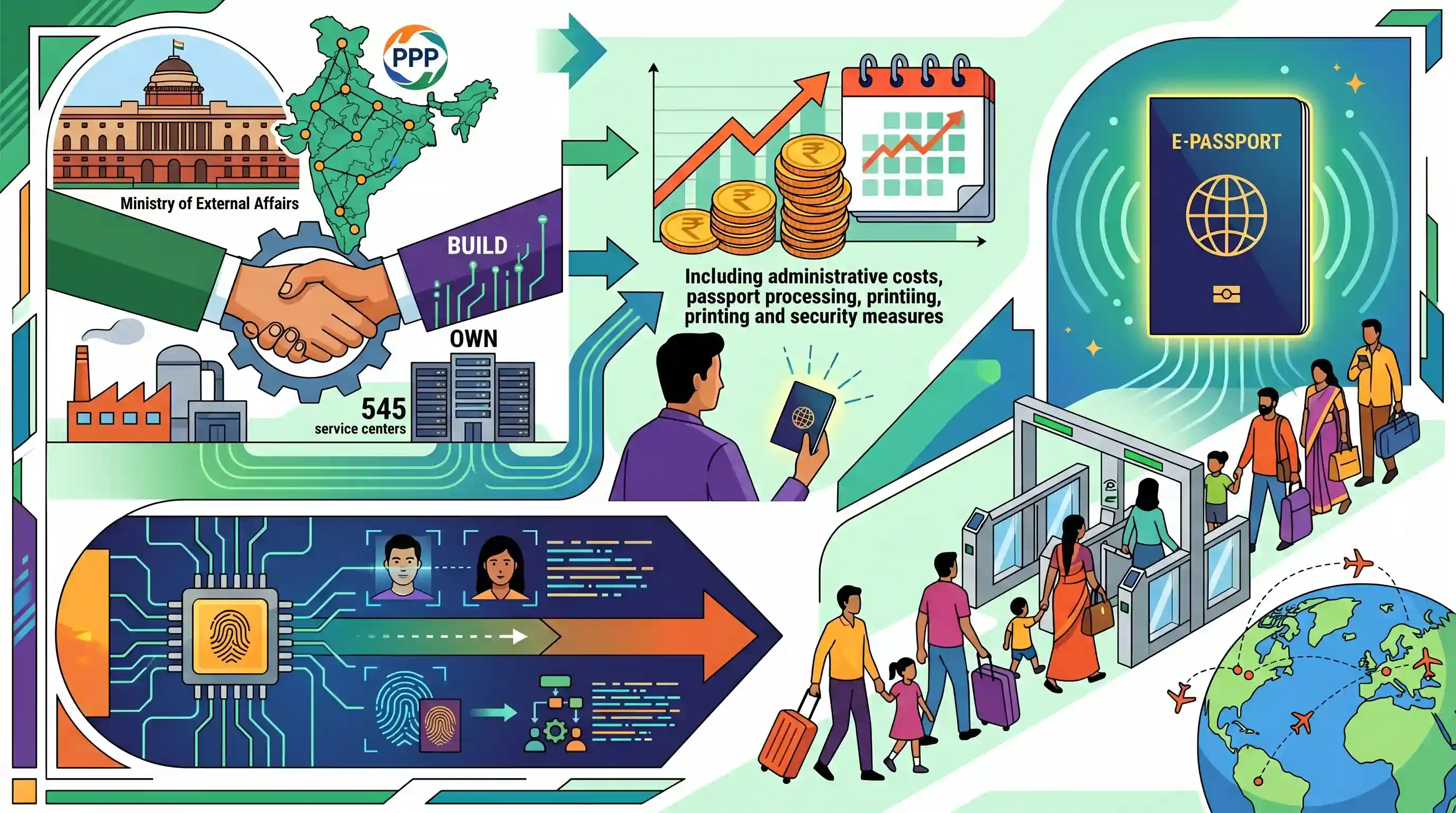
The Ministry of External Affairs announced an upcoming hike in passport and related service fees starting July 1, marking the first major increase since 2012. The hike is attributed to rising administrative costs associated with passport processing, printing, and enhanced security measures. The article highlights the success of the Passport Seva Project (PSP), a flagship e-governance initiative utilizing a Build-Own-Operate-Transfer (BOOT) public-private partnership with Tata Consultancy Services (TCS) to drastically expand the network of processing centres to 545 locations. The changes occur as the government transitions toward e-passports featuring biometric microchips, with all legacy passports slated for replacement by 2035 to facilitate smoother global immigration for Indian citizens and the diaspora.
Key Points
- Effective July 1, the Ministry of External Affairs is increasing passport application and related service fees for the first time since 2012, with standard booklet fees rising from Rs 1,500 to Rs 2,000.
- The hike is designed to align application fees with the escalating administrative, printing, and security costs associated with processing modern passports.
- The Passport Seva Project (PSP), implemented as a Build-Own-Operate-Transfer (BOOT) public-private partnership with TCS, has successfully expanded physical infrastructure from 77 to 545 processing centres while streamlining delivery.
- The government is actively rolling out advanced e-passports embedded with secure biometric chips, aiming to replace all legacy booklets by 2035 and align with global aviation and immigration standards.
Important Terms
Passport Seva Project (PSP)

A flagship Mission Mode Project under the National e-Governance Plan, implemented by the MEA to modernize passport issuance through a digitally integrated, high-speed ecosystem.
UPSC context
GS Paper 2: Governance/E-governance. Tests understanding of digital transformation in administrative reforms and efficient public service delivery.
E-Passport
A modern travel document containing an embedded RFID microchip that securely stores the holder’s biometric and demographic data to facilitate faster immigration and prevent identity theft.
UPSC context
GS Paper 3: Science & Technology/Security. Relevant for technology-led security measures and International Civil Aviation Organization (ICAO) compliance.
Build-Own-Operate-Transfer (BOOT) Model
A Public-Private Partnership (PPP) model where a private entity finances, builds, and operates an asset for a fixed period before transferring ownership to the government.
UPSC context
GS Paper 3: Investment Models. Evaluates knowledge of infrastructure financing and the division of risks between public and private partners.
Mission Mode Project (MMP)
A specialized project within India’s National e-Governance Plan (NeGP) focusing on a specific sector of governance to deliver measurable, time-bound improvements in public service.
UPSC context
GS Paper 2: Governance. Essential for understanding the structural framework of India’s digital governance initiatives.
Ministry of External Affairs (MEA)
The Union Ministry responsible for formulating India’s foreign policy and managing diplomatic relations, including the sovereign function of issuing passports and providing consular services.
UPSC context
GS Paper 2: International Relations. Tests institutional knowledge regarding India’s foreign engagement and assistance to the Indian diaspora.
Prelims Trap
"Under the Passport Seva Project, the private partner is responsible for the final verification and issuance of passports."
In PSP's BOOT model, the private entity manages front-end infrastructure and technology, but sovereign functions like police verification and final issuance strictly remain with the government (MEA).
Static Concepts Connected
How does the BOOT PPP model differ from the EPC model?
- BOOT Model: Private sector builds, owns, and operates the facility for a concession period to recover costs before transferring ownership back to the government.
- EPC Model: Engineering, Procurement, Construction. The government fully funds the project; the private sector simply builds it and hands it over immediately.
- Risk Sharing: BOOT shifts significant financial, operational, and maintenance risks to the private partner, whereas EPC keeps financial and operational risks entirely with the government.
What characterizes Government-to-Citizen (G2C) e-governance models?
- Core Objective: Focuses on delivering public services directly to citizens via accessible digital platforms (e.g., Passport Seva, Bhoomi, e-District).
- Key Benefits: Reduces bureaucratic red tape, minimizes corruption through disintermediation, and enhances transparency in service delivery.
- Sovereign vs Interface: Governments are increasingly retaining core sovereign decisions while outsourcing the front-end technological and administrative interfaces to private partners.
Cross-Topic Patterns
PPPs shifting to digital infrastructure
While usually associated with physical infrastructure (NHAI highways), successful models like Passport Seva show PPPs effectively expanding into digital governance and citizen service delivery.
ICAO standards and global governance
The shift to RFID e-passports highlights the role of specialized UN agencies (like ICAO) in mandating global biometric and cybersecurity standards that dictate national policies.

Expect a prelims question contrasting BOOT with HAM/EPC models, using digital infra like Passport Seva or BharatNet as the case study.
Linked PYQs · 5
Linked PYQs · 5
- 2023MainsGS2
e-governance, as a critical tool of governance, has ushered in effectiveness, transparency and accountability in governments. What inadequacies hamper the enhancement of these features ?
- 2025MainsGS2
e-governance projects have a built-in bias towards technology and back-end integration than user-centric designs. Examine.
- 2022MainsGS3
Why is Public Private Partnership (PPP) required in infrastructural projects ? Examine the role of PPP model in the redevelopment of Railway Stations in India.
- 2013MainsGS3
Adoption of PPP model for infrastructure development of the country has not been free of criticism. Critically discuss pros and cons of the model.
- 2023MainsGS2
Indian diaspora has scaled new heights in the West. Describe its economic and political benefits for India.
