Kashmir Parties Criticize Government Takeover of Banned Group Schools
Source:The Hindu ↗
Why It Matters
It highlights the delicate political landscape and administrative challenges in Jammu & Kashmir post-Article 370, specifically the tension between addressing internal security concerns regarding banned organizations and the democratic integration of their associated civil institutions under an elected state government.
Summary
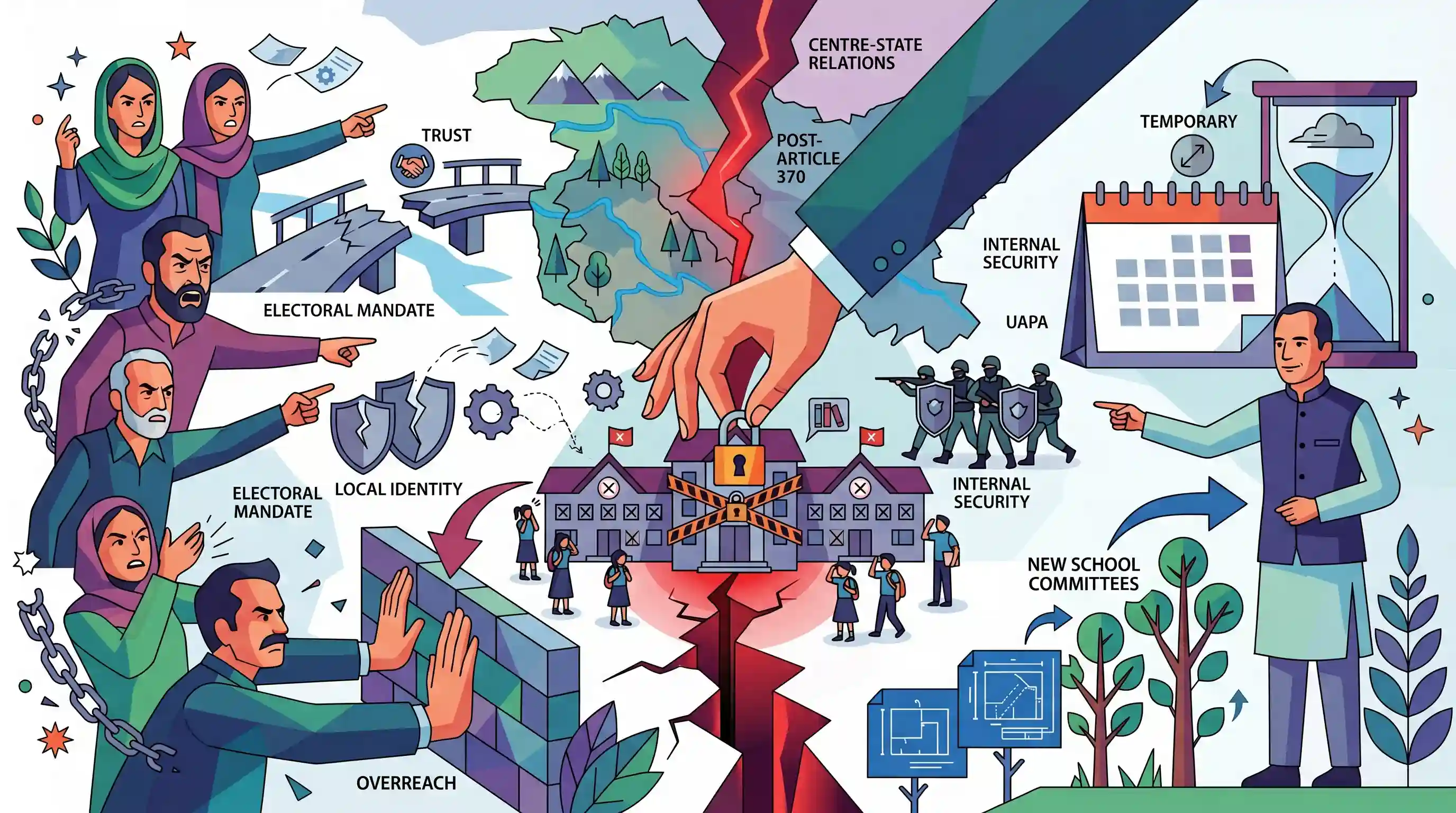
Political parties in Jammu and Kashmir, including the PDP, Peoples' Conference, and Apni Party, have sharply criticized the newly elected National Conference (NC) government for taking over the management of 215 schools affiliated with the banned Jamaat-e-Islami (JeI). Critics describe the takeover as a betrayal of the electoral mandate and an administrative overreach that threatens local educational institutions and cultural identity. While some argue the action undermines the democratic integration of JeI-aligned individuals post-Article 370, the J&K Education Minister clarified that the government's management is a temporary measure pending the formation of new school committees.
Key Points
- The J&K government, led by the National Conference (NC), took over the management of 215 schools affiliated with the banned Jamaat-e-Islami (JeI).
- Opposition parties, including the PDP and Peoples' Conference, strongly condemned the move, viewing it as an administrative overreach and an attack on J&K's local institutions and culture.
- Critics noted that the elected government is enforcing actions against the Falah-e-Aam Trust (FAT) schools that even the LG administration refrained from executing after banning JeI in 2019.
- Political leaders argued that such moves act as knee-jerk reactions that suppress JeI-aligned individuals seeking integration into the mainstream post-Article 370.
- J&K Education Minister Sakina Itoo clarified the takeover is temporary and intended to manage the schools only until new management committees are formed.
Important Terms
Article 370

A temporary constitutional provision (revoked in 2019) that granted special status and internal autonomy to Jammu and Kashmir, including a separate constitution and flag.
UPSC context
GS II: Federalism and Constitution. Tests understanding of asymmetric federalism and the legal implications of its abrogation.
Jamaat-e-Islami (JeI) Jammu & Kashmir
A socio-religious-political organization in Jammu and Kashmir banned under the UAPA for its alleged involvement in anti-national, secessionist, and terror-linked activities.
UPSC context
GS III: Internal Security. Tests awareness of challenges to domestic stability and the role of extremist organizations.
Falah-e-Aam Trust (FAT)
The educational wing of the banned Jamaat-e-Islami J&K, established in 1972 to run a network of schools currently undergoing government-led administrative takeovers.
UPSC context
GS II: Governance. Relevant for issues concerning state regulation of non-state educational institutions in sensitive regions.
Unlawful Activities (Prevention) Act (UAPA)
India's primary anti-terror legislation providing the legal framework to declare organizations as "unlawful associations" to protect national sovereignty and integrity.
UPSC context
GS III: Security Laws. Tests knowledge of legal mechanisms for countering radicalization and secessionist threats.
National Conference (NC)
A major regional political party in Jammu and Kashmir, currently leading the elected government under Chief Minister Omar Abdullah.
UPSC context
GS II: Political Parties. Important for understanding regional political dynamics and their impact on local governance.
Justice and Development Front (JDF)
A political front formed by former members of the banned Jamaat-e-Islami to participate in the democratic process following the abrogation of Article 370.
UPSC context
GS II: Political Integration. Tests understanding of the transition of banned entities into democratic processes.
Peoples Democratic Party (PDP)
A significant regional political party in J&K, led by Mehbooba Mufti, which advocates for regional autonomy and self-rule through dialogue.
UPSC context
GS II: Regionalism. Relevant for analyzing political opposition and democratic dissent in sensitive border regions.
Prelims Trap
State governments have the independent power to declare an entity an 'Unlawful Association' under the UAPA.
Under Section 3 of the UAPA, 1967, only the Central Government can declare an organization an 'Unlawful Association'. States/UTs merely enforce associated property restrictions.
Static Concepts Connected
How does the UAPA restrict properties of declared Unlawful Associations?
- Central Notification: The Central Government must first notify the organization as an 'Unlawful Association' under Section 3 of the UAPA.
- Property Restrictions: Section 8 empowers the Centre to notify and prohibit the use of any place or property associated with the unlawful association's activities.
- Tribunal Review: Bans and associated property seizures are not arbitrary; they are subject to review by a UAPA Tribunal headed by a High Court judge.
What are the limitations on minority educational rights under Article 30?
- Right Not Absolute: Article 30(1) guarantees the right to establish and administer institutions, but the Supreme Court clarifies that the right to administer does not include the right to 'maladminister'.
- Reasonable Restrictions: The State can impose reasonable regulations ensuring academic excellence, health, sanitation, and strict adherence to national security and public order.
- State Takeover: The government can temporarily take over management if an institution violates laws, engages in anti-national activities, or completely fails its administrative duties.
Cross-Topic Patterns
Counter-radicalisation vs Article 30
The seizure of JeI-linked schools links internal security (dismantling separatist ecosystems) with constitutional law (the limits of Article 30 minority rights when national security is invoked).
Asymmetric federalism in J&K
Shows the complex administrative overlap under the J&K Reorganization Act: while Education is handled by the elected assembly, the UAPA/security directives driving this takeover originate from the Centre-appointed LG.

Expect a 2026 prelims question mixing UAPA Section 8 property seizure provisions with limitations on Article 30 minority education rights.
Linked PYQs · 2
Linked PYQs · 2
- 2025MainsGS2
Discuss the nature of Jammu and Kashmir Legislative Assembly after the Jammu and Kashmir Reorganization Act, 2019. Briefly describe the powers and functions of the Assembly of the Union Territory of Jammu and Kashmir.
- 2019MainsGS3
Indian Government has recently strengthened the anti-terrorism laws by amending the Unlawful Activities (Prevention) Act (UAPA), 1967 and the NIA Act. Analyze the changes in the context of prevailing security environment while discussing the scope and reasons for opposing the UAPA by human rights organizations.
