Particulate pollution surges across Indo-Gangetic Plain over decade
Source:Indian Express ↗
Why It Matters
Provides crucial empirical data on the changing nature of India's air pollution crisis, highlighting the shift from dust to biomass/industrial sources, the geographical transport of pollutants to the Himalayas, and the policy gaps in the NCAP. This is highly relevant for GS-3 Environment answers on air quality management and GS-1 Geography answers on regional environmental impacts.
Summary
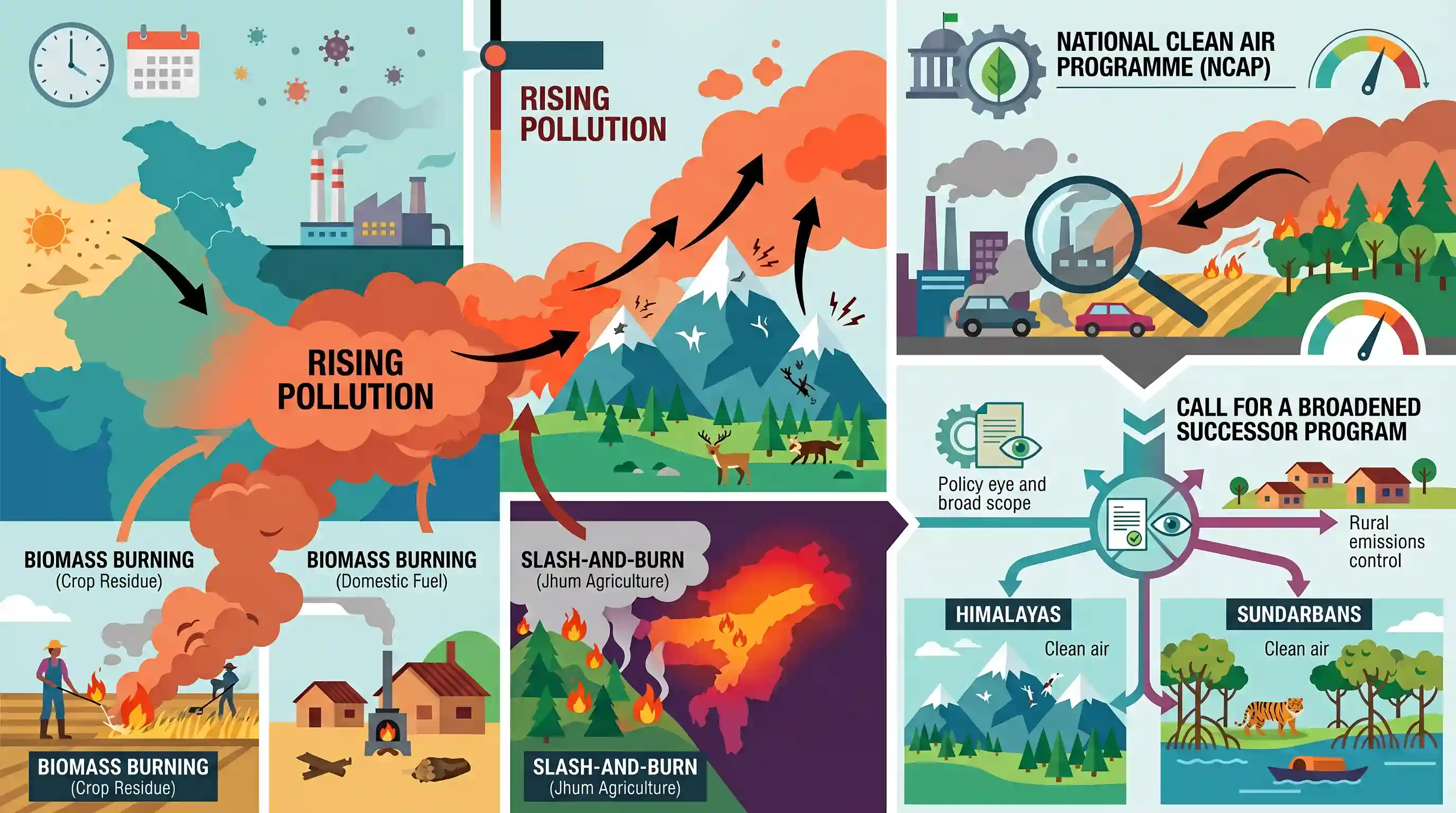
A recent study by the Bose Institute reveals that particulate matter pollution has risen by over 20% across the Indo-Gangetic Plain (IGP) over the last decade, with pollution plumes now reaching the ecologically sensitive Himalayas. While natural dust pollution has declined in the western IGP, biomass burning—including crop residue and domestic fuel—along with slash-and-burn (Jhum) agriculture, has become a dominant driver. This shift has pushed Northeast India into a 'highly polluted' classification. Although the National Clean Air Programme (NCAP) has helped reduce overall particulate levels in some areas, it has struggled to mitigate biomass-driven pollution. Researchers argue that NCAP's successor must broaden its scope beyond urban centers to address rural emissions and protect sensitive ecosystems like the Himalayas and the Sundarbans.
Key Points
- Particulate matter pollution across the Indo-Gangetic Plain (IGP) increased by over 20% in the 2010s compared to the 2000s, according to Bose Institute research using NASA satellite data.
- The eastern IGP (Bihar, southern West Bengal, and Bangladesh) emerged as a persistent aerosol hotspot with high aerosol optical depth.
- Biomass burning (including crop residue) and slash-and-burn (Jhum) agriculture have become primary drivers of pollution, particularly increasing organic carbon and sulphate components in Northeast India by nearly 50%.
- Pollution is exhibiting strong inter-regional transport, with emissions from the upper/middle IGP (Punjab, Haryana) reaching the western Himalayas, and lower IGP emissions reaching the eastern Himalayas.
- While the National Clean Air Programme (NCAP) led to some improvements in overall particulate levels, it failed to significantly curb biomass burning pollution.
- Future clean air policies need to expand beyond the 131 non-attainment cities to cover rural emissions and ecologically sensitive regions like the Himalayas and Sundarbans.
Important Terms
National Clean Air Programme (NCAP)

A flagship national strategy launched in 2019 to reduce particulate matter (PM2.5 and PM10) concentrations by 20–30% (later revised to 40% by 2026) in 131 "non-attainment" cities.
UPSC context
GS III (Environment). Tests air quality governance, institutional frameworks (CPCB), and the "non-attainment city" concept in pollution management.
Particulate Matter (PM)
Microscopic solid or liquid particles suspended in the atmosphere. PM2.5 and PM10 are primary health hazards; PM2.5 is small enough to penetrate the lung barrier and enter the bloodstream.
UPSC context
GS III (Environment/Health). Tests scientific understanding of pollutants, health impacts, and National Ambient Air Quality Standards (NAAQS).
Indo-Gangetic Plain (IGP)
A vast, fertile region across North and East India. It is a global pollution hotspot due to high population density and mountains that trap winter pollutants.
UPSC context
GS I (Geography) and GS III (Environment). Critical for studying regional "airshed" management and meteorological factors in pollution.
Jhum Cultivation
A traditional shifting/slash-and-burn agriculture practiced in Northeast India. While culturally significant, it involves burning biomass, which contributes to regional air pollution and deforestation.
UPSC context
GS III (Agriculture/Environment). Relevant for sustainable farming debates, tribal livelihoods, and drivers of regional aerosol loading.
Biomass Burning
The combustion of organic materials like crop residue and wood. It is a major source of carbonaceous aerosols (like black carbon) and rural air pollution.
UPSC context
GS III (Environment). Tests understanding of non-industrial pollution sources and their impact on ecologically sensitive zones like the Himalayas.
Bose Institute
Established in 1917 by polymath J.C. Bose, it is India’s first interdisciplinary research center and a premier public institute for biological and environmental sciences.
UPSC context
GS III (Science & Technology). Significant for the history of modern Indian science and its contributions to climate and pollution research.
Prelims Trap
NCAP is a pan-India statutory mandate covering both rural and urban areas equally to reduce PM levels.
NCAP is a non-statutory framework primarily targeting 131 urban 'non-attainment' cities, which is why rural biomass burning largely escapes its mandate.
Static Concepts Connected
What is Aerosol Optical Depth (AOD) and its climate impact?
- Definition: AOD measures the extinction of solar beams by aerosols (dust, smoke). A high AOD indicates hazy, heavily polluted air blocking sunlight.
- Climate Impact: Aerosols absorb or scatter sunlight, altering Earth's albedo, influencing cloud microphysics, and disrupting regional monsoon rainfall patterns.
- Glacial Melt: Black carbon aerosols settling on snow reduce surface albedo, absorbing more heat and accelerating the melting of sensitive Himalayan glaciers.
What are the core parameters of the National Clean Air Programme (NCAP)?
- Target: Aims for a 40% reduction in particulate matter (PM2.5 and PM10) concentrations by 2026, using 2017 as the base year.
- Scope: Targets 131 'non-attainment cities' that consistently failed to meet National Ambient Air Quality Standards (NAAQS) between 2011 and 2015.
- Strategy: Relies on city-specific action plans, currently lacking a regional 'airshed' approach to tackle trans-boundary rural pollution like biomass burning.
Cross-Topic Patterns
Airshed Management + Inter-State Coordination
Pollution transport from the IGP to the Himalayas exposes the limits of city-centric NCAP. It necessitates an 'airshed' approach and cooperative federalism for regional environmental governance.
Jhum Cultivation + Glacial Retreat
The shift of Northeast India to a highly polluted zone links traditional slash-and-burn agriculture directly to black carbon deposition and subsequent eastern Himalayan glacier melting.

Expect a 2026 question linking Himalayan glacier retreat with organic carbon/aerosols from IGP biomass burning and NCAP's city limits.
Linked PYQs · 2
Linked PYQs · 2
- 2020MainsGS3
What are the key features of the National Clean Air Programme (NCAP) initiated by the Government of India?
- 2021MainsGS3
Describe the key points of the revised Global Air Quality Guidelines (AQGs) recently released by the World Health Organisation (WHO). How are these different from its last update in 2005? What changes in India's National Clean Air Programme are required to achieve these revised standards?
