Particularly Vulnerable Tribal Groups Census and Welfare Schemes
Source:Indian Express ↗
ఇది ఎందుకు ముఖ్యం
PVTGs represent the most marginalized subset of India's tribal population. Understanding data collection and census processes regarding PVTGs is vital for evaluating welfare interventions like PM-JANMAN, assessing social justice frameworks, and ensuring inclusive human resource development as queried in UPSC GS2 and Prelims.
సారాంశం
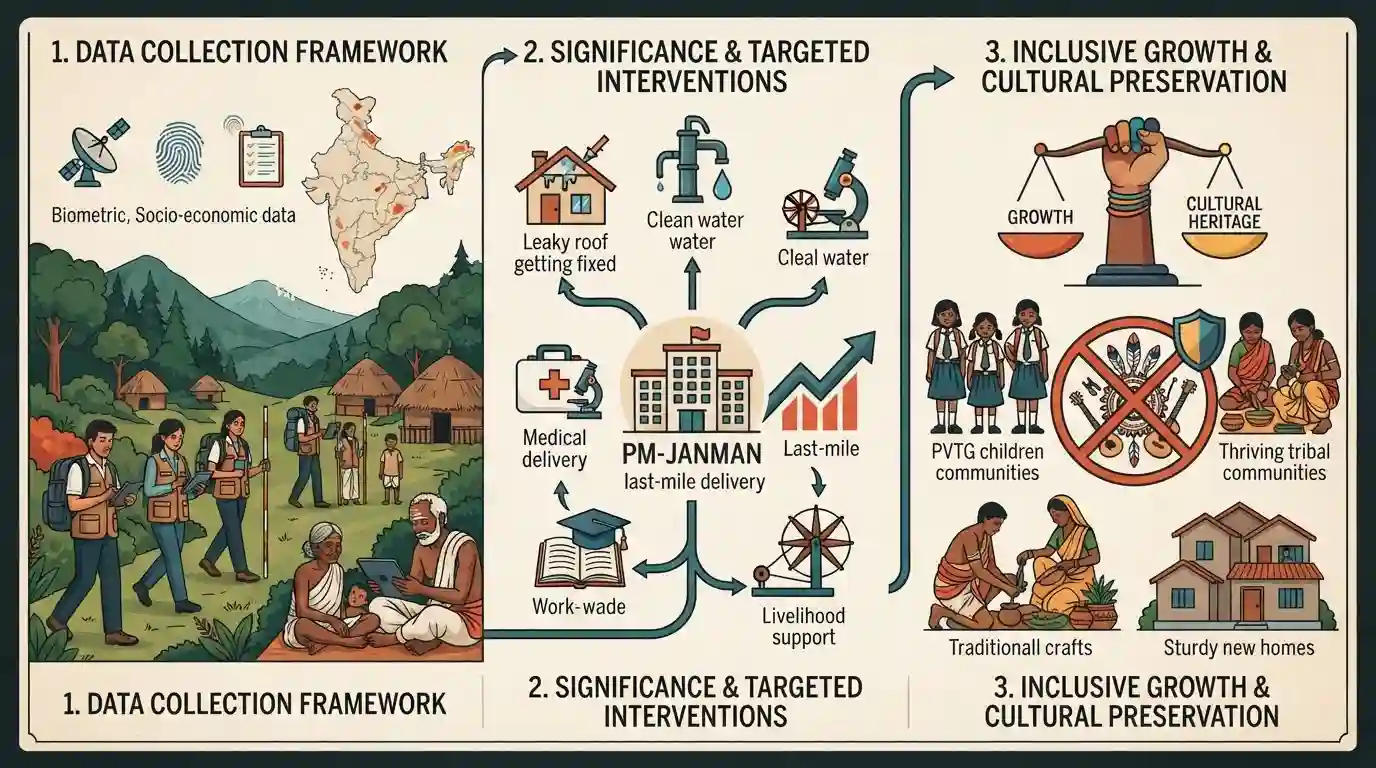
The article discusses the framework, significance, and modalities surrounding the census or survey data collection for Particularly Vulnerable Tribal Groups (PVTGs) in India. PVTGs represent the most marginalized and vulnerable segments among Scheduled Tribes, facing critical development deficits. The process of mapping and enumerating them is vital for the effective implementation of dedicated welfare measures, such as the PM-JANMAN scheme, ensuring last-mile delivery of basic infrastructure, healthcare, education, and livelihood support while safeguarding their unique cultural identities.
ముఖ్య అంశాలు
- Particularly Vulnerable Tribal Groups (PVTGs) are a sub-classification of Scheduled Tribes characterized by more vulnerable features such as declining or stagnant population, pre-agricultural level of technology, and extremely low literacy.
- There are 75 officially recognized PVTGs spread across 18 States and one Union Territory (Andaman and Nicobar Islands).
- A census or specific survey focusing on PVTGs is crucial for targeted policy formulation, saturation of welfare schemes (such as PM-JANMAN), and addressing systemic marginalization.
- Accurate demographic and socio-economic data collection for PVTGs faces administrative challenges due to remote habitations, nomadic lifestyles, and cultural protection considerations.
ముఖ్యమైన పదాలు
PM-JANMAN

A central government scheme launched to saturate Particularly Vulnerable Tribal Groups (PVTGs) households with basic amenities like housing, clean water, healthcare, and education.
UPSC context
GS Paper II (Government Policies & Interventions, Vulnerable Sections). Tests the candidate's knowledge of targeted welfare schemes for marginalized tribes.
Ministry of Tribal Affairs
The apex central ministry responsible for formulating and implementing policies, programs, and schemes for the socio-economic development of Scheduled Tribes in India.
UPSC context
GS Paper II (Constitutional Bodies & Government Ministries). Important for understanding institutional frameworks governing tribal welfare and administration.
Particularly Vulnerable Tribal Groups (PVTGs)
A sub-category of Scheduled Tribes identified by primitive traits, geographical isolation, low literacy, and stagnant populations, requiring special affirmative action.
UPSC context
GS Paper II & Paper I (Social Justice, Vulnerable Sections, Indian Society). Tests understanding of tribal vulnerabilities, inclusion, and welfare challenges.
అనుసంధానమైన స్థిర భావనలు
What are the criteria and constitutional provisions for Particularly Vulnerable Tribal Groups (PVTGs) in India?
- Identification Criteria: Identified on four criteria: pre-agricultural level of technology, stagnant/declining population, extremely low literacy, and subsistence economy.
- Nomenclature Evolution: Originally created as Primitive Tribal Groups (PTGs) in 1975 by the central government, later renamed PVTGs in 2006.
- Constitutional Status: The Constitution does not define PVTGs separately; they are a sub-category within the Scheduled Tribes (ST) framework under Article 342.
అంతర-అంశ నమూనాలు
PM-JANMAN and Aspirational Districts convergence
The targeted saturation approach under PM-JANMAN for PVTGs parallels the Aspirational Districts Programme, shifting focus from fund allocation to outcome-based saturation in backward regions.
PVTG Enumeration and Forest Rights Act
Enumerating semi-nomadic and remote PVTGs requires aligning administrative census machinery with FRA 2006 community forest rights and Fifth/Sixth Schedule autonomy.

Expect a statement-based prelims question on PVTG criteria (declining population, pre-agricultural tech) vs official constitutional definitions.
అనుసంధాన PYQలు · 1
అనుసంధాన PYQలు · 1
- 2019PrelimsGS1
Consider the following statements about Particularly Vulnerable Tribal Groups (PVTGs) in India : 1. PVTGs reside in 18 States and one Union Territory. 2. A stagnant or declining population is one of the criteria for determining PVTG status. 3. There are 95 PVTGS officially notified in the country so far. 4. Irular and Konda Reddi tribes are included in the list of PVTGs. Which of the statements given above are correct?
