Pakistan Opposition Protest Draws Partial Shutdown in Balochistan
Source:The Hindu ↗
Why It Matters
Political instability, democratic deficits, and insurgencies in Pakistan directly impact regional stability in South Asia. Understanding Pakistan's internal dynamics, including the Balochistan insurgency and civil-military relations, is crucial for assessing India's neighborhood policies and border security strategies.
Summary
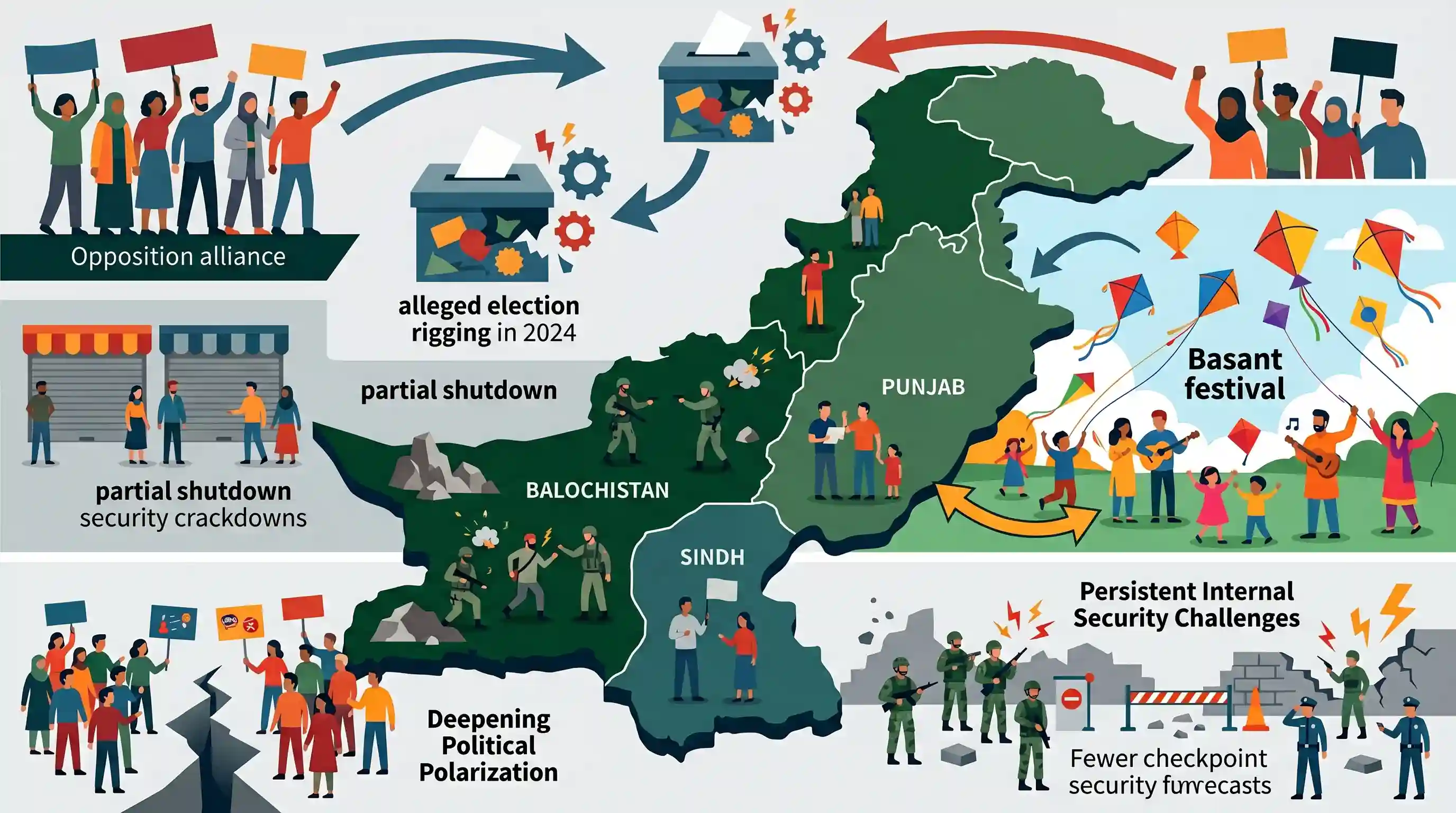
A nationwide strike called by Pakistan's opposition alliance, Tehreek-e-Tahaffuz-e-Aain Pakistan (TTAP), to protest alleged rigging in the 2024 elections saw a mixed response across the country. While Balochistan experienced a partial shutdown amidst ongoing security crackdowns against insurgents, provinces like Punjab, Sindh, and Khyber Pakhtunkhwa saw lukewarm participation. The Punjab government countered the protest by organizing a Basant festival, diverting public attention. The developments highlight Pakistan's deepening political polarization and persistent internal security challenges.
Key Points
- The Tehreek-e-Tahaffuz-e-Aain Pakistan (TTAP), an opposition coalition including Imran Khan\'s PTI, called for a nationwide strike to protest alleged rigging in the February 2024 general elections.
- The strike call received a lukewarm response in Khyber Pakhtunkhwa, Punjab, and Sindh, but led to a partial shutdown in Balochistan.
- In Punjab, the protest was eclipsed by the government-backed three-day Basant festival, which kept the public engaged despite PTI\'s calls for a silent agitation.
- Balochistan has recently experienced intense violence, with over 200 terrorists killed in security operations following multiple terror attacks.
- The situation underscores ongoing political instability, electoral controversies, and internal security challenges in Pakistan, particularly the restive Balochistan region.
Important Terms
Tehreek-e-Tahaffuz-e-Aain Pakistan (TTAP)

An opposition alliance in Pakistan, translating to 'Movement for the Protection of the Constitution.' It is led by PTI and seeks to challenge the 2024 election results through nationwide protests.
UPSC context
GS Paper II (Neighborhood Relations); tests knowledge of political instability and institutional crises in India's immediate neighborhood.
Balochistan
Pakistan's largest, resource-rich province, home to the strategic Gwadar Port. It faces a chronic separatist insurgency and remains a flashpoint for India-Pakistan relations and China's CPEC project.
UPSC context
GS Paper II & III; crucial for analyzing regional security, cross-border terrorism, and the geopolitical impact of Chinese infrastructure.
Pakistan Tehreek-e-Insaf (PTI)
A major political party founded by Imran Khan. Despite winning the most seats as independents in 2024, it remains in opposition, alleging systematic election rigging by the military-backed establishment.
UPSC context
GS Paper II; important for understanding the role of populist leadership and civilian-military friction in South Asian politics.
Pakistan Muslim League-Nawaz (PML-N)
A center-right party currently leading Pakistan's coalition government. Associated with the Sharif dynasty, it prioritizes infrastructure development but faces challenges from economic crises and political polarization.
UPSC context
GS Paper II; relevant for assessing the continuity of civilian administration and potential bilateral engagement with India.
Pakistan Peoples Party (PPP)
A center-left, dynasty-led party (Bhutto-Zardari family) and a key partner in the current ruling coalition. It has a strong power base in Sindh and historically advocates for federalism.
UPSC context
GS Paper II; tests understanding of the political landscape and democratic structures of a key South Asian neighbor.
Jamiat Ulema-e-Islam (F)
A major religious-political party led by Maulana Fazlur Rahman. It represents Deobandi interests and often acts as a kingmaker in coalition politics in Balochistan and Khyber Pakhtunkhwa.
UPSC context
GS Paper II; examines the influence of religious-political actors on the state's internal stability and neighborhood policies.
Prelims Trap
Balochistan province shares a direct land border with the Indian states of Gujarat and Rajasthan.
Balochistan borders Iran, Afghanistan, and the Arabian Sea. Only Pakistan's Sindh and Punjab provinces, along with Gilgit-Baltistan/PoK, share land borders with India.
Static Concepts Connected
Why is Balochistan strategically significant in South Asian geopolitics?
- Geographic buffer: Shares critical, volatile land borders with Iran and Afghanistan.
- Maritime access: Houses the China-operated Gwadar port on the Arabian Sea coast, crucial for the CPEC.
- Resource wealth: It is Pakistan's largest and most resource-rich province, containing vast reserves of natural gas and minerals.
How does CPEC intersect with internal security challenges in Pakistan?
- Ethno-nationalist resentment: Locals perceive CPEC as an extractive project by the federal government and China, fueling alienation and insurgency.
- Targeting assets: Groups like the Balochistan Liberation Army (BLA) frequently launch asymmetric attacks on Chinese nationals and infrastructure.
Cross-Topic Patterns
Internal unrest driving LoC volatility
Historically, the Pakistani establishment deflects severe domestic political crises by escalating cross-border terrorism and ceasefire violations along the LoC to rally anti-India nationalist sentiment.
Basant festival and shared cultural history
The use of the Basant kite-flying festival to distract protesters highlights the enduring cultural heritage of undivided Punjab, which historically flourished under Mughal and Sikh patronage.

Expect a GS-2/GS-3 mains question linking Balochistan's ethno-nationalist insurgency to CPEC's viability and India's strategic security.
Linked PYQs · 3
Linked PYQs · 3
- 2016MainsGS2
Increasing cross-border terrorist attacks in India and growing interference in the internal affairs of several member-states by Pakistan are not conducive for the future of SAARC (South Asian Association for Regional Cooperation)." Explain with suitable examples.
- 2020MainsGS3
Analyze internal security threats and transborder crimes along Myanmar, Bangladesh and Pakistan borders including Line of Control (LoC). Also discuss the role played by various security forces in this regard.
- 2015MainsGS2
Terrorist activities and mutual distrust have clouded India-Pakistan relations. To what extent the use of soft power like sports and cultural exchanges could help generate goodwill between the two countries? Discuss with suitable examples.
