Analysis of Market Distortions from Partial FDI in E-Commerce
Source:The Hindu ↗
ఇది ఎందుకు ముఖ్యం
This article highlights the economic trade-offs of partial liberalization and protective regulations. It introduces quantitative data regarding Anti-Competitive Market Distortions (ACMDs) and the concept of 'competition-policy drift,' which are highly valuable for answering Mains GS Paper III questions on economic growth, industrial policies, and investment models.
సారాంశం
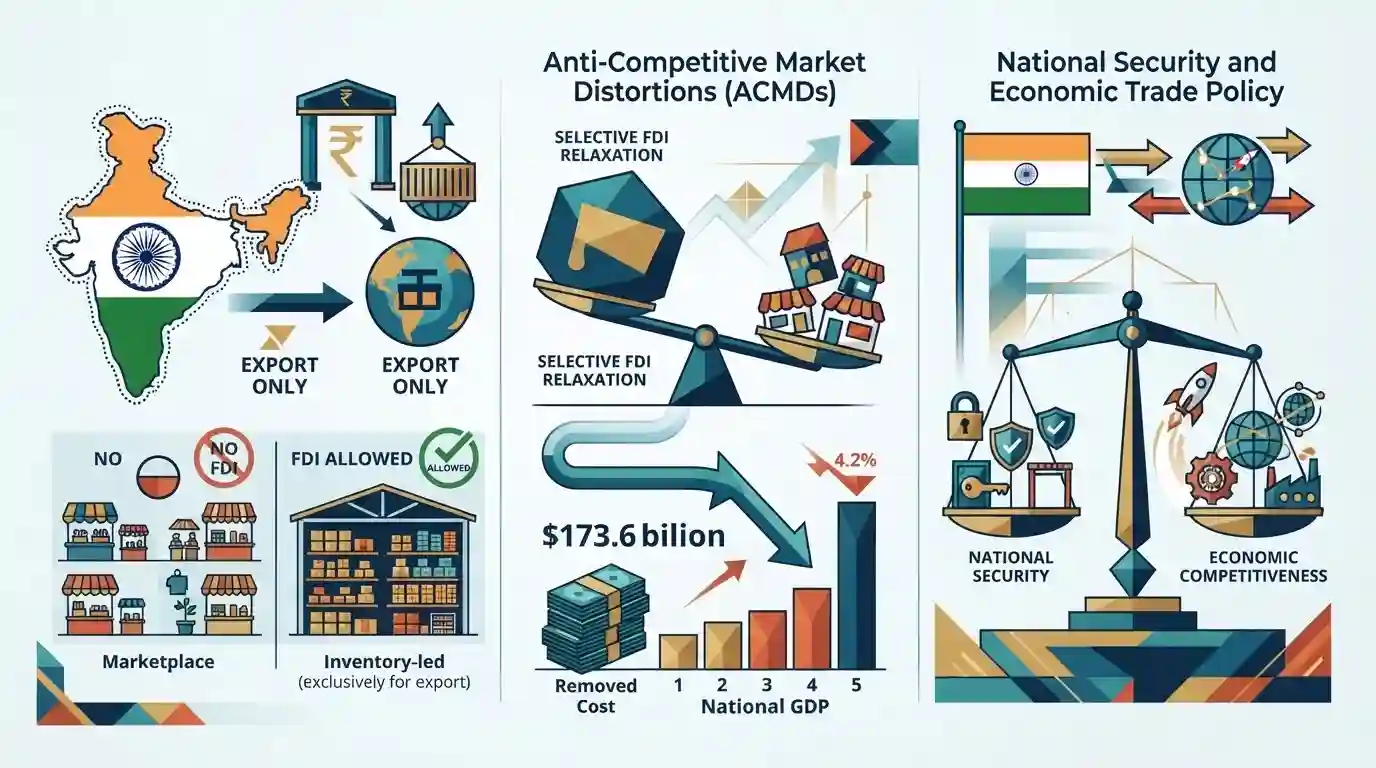
The article examines criticisms surrounding India's partial relaxation of FDI rules in e-commerce, specifically the July 2025 change allowing FDI in inventory-led models exclusively for export. Experts from the Competere Foundation and the Centre for Trade and Investment Law (CTIL) argue that selective investment relaxations distort competition. Their joint report estimates that Anti-Competitive Market Distortions (ACMDs) and competition-policy drift could cost the Indian economy $173.6 billion (4.2% of GDP) over five years. The article also highlights the need to balance legitimate national security measures with economic competitiveness.
ముఖ్య అంశాలు
- In July 2025, the Indian government eased FDI rules in e-commerce, allowing foreign investment in companies with their own inventory, provided the inventory is intended exclusively for export. Previously, FDI in inventory-based e-commerce models was prohibited.
- Shanker Singham, President of the Competere Foundation, criticized this partial opening as 'almost worse' than a blanket ban because it selectively benefits specific business models, distorting competition and creating an uneven playing field.
- A joint report by CTIL and the Competere Foundation estimates that India\'s Anti-Competitive Market Distortions (ACMDs) could cause an economic loss of $173.6 billion over five years (approximately 4.2% of GDP).
- The projected economic loss is divided into foreign-investment restrictions (accounting for $127.2 billion) and 'competition-policy drift'—excessive regulatory requirements (accounting for $46.4 billion).
- These market distortions and policy drifts negatively impact India by reducing productivity, limiting inward investment, weakening market contestability, and slowing down technology diffusion.
- While national security measures (such as FDI restrictions on land-border-sharing countries and app bans) are legitimate regulatory objectives, the report recommends achieving these goals in the 'least anti-competitive manner possible' to minimize domestic economic drag.
ముఖ్యమైన పదాలు
Foreign Direct Investment (FDI) Policy in E-commerce

India allows 100% FDI in the marketplace e-commerce model but prohibits it for domestic inventory-based retail. A 2026 amendment permits foreign-owned platforms to use the inventory model exclusively for exporting domestically manufactured goods.
UPSC context
GS3 (Indian Economy). Crucial for evaluating investment models, MSME protection, export promotion, and global retail regulation.
Marketplace vs. Inventory E-Commerce Models
In the marketplace model, the platform acts purely as a facilitator between independent buyers and sellers. In the inventory-based model, the e-commerce entity owns and directly sells the goods to consumers.
UPSC context
GS3 (Economy). Fundamental for understanding India's FDI regulations, digital competition laws, and the protection of domestic MSMEs.
Anti-Competitive Market Distortions (ACMDs)
Government-imposed policies, regulations, or state-sponsored monopolies that disrupt free trade and property rights. They artificially skew market competition, favoring specific private or domestic interests over others and undermining overall economic efficiency.
UPSC context
GS2/3 (International Relations/Economy). Relevant for understanding non-tariff barriers, WTO negotiations, and global trade reform debates.
Centre for Trade and Investment Law (CTIL)
A research organization established in 2016 by the Ministry of Commerce and Industry at IIFT. It provides the Indian government with expert legal analysis on international trade, investment law, WTO disputes, and FTA negotiations.
UPSC context
GS2 (Government Policies). Important for India's institutional capacity building in global trade negotiations and economic diplomacy.
Competere Foundation for Trade and Competition Policy
A non-profit think tank focused on international trade and competition policy. It utilizes frameworks like the ACMD model to advocate for open trade, competitive markets, and the reduction of regulatory distortions globally.
UPSC context
GS2/3 (International Institutions/Economy). Relevant as an international body influencing global economic policy, trade liberalization, and regulatory reform.
ప్రిలిమ్స్ ఉచ్చు
FDI in inventory-based e-commerce is completely prohibited in India under all circumstances.
The July 2025 amendment relaxed this rule, permitting FDI in inventory-led e-commerce models exclusively for export-bound inventory.
అనుసంధానమైన స్థిర భావనలు
Distinction between marketplace and inventory e-commerce models under FDI
- Marketplace model: The platform acts purely as an intermediary facilitating transactions; 100% FDI is permitted under the automatic route.
- Inventory model: The e-commerce entity owns and manages the goods sold directly to buyers; FDI is generally prohibited for domestic sales.
- Ownership restriction: FDI-funded marketplace entities are legally barred from exercising ownership or control over the inventory sold on their platforms.
What is the mandate of 'Press Note 3 (2020)'?
- Border-sharing rule: Requires prior government approval for any FDI originating from countries sharing a land border with India.
- Beneficial ownership: Applies if the beneficial owner of the investment is a citizen or resident of any border-sharing nation (like China).
- Security objective: Designed to prevent opportunistic acquisitions and protect domestic security interests during economic vulnerabilities.
అంతర-అంశ నమూనాలు
E-commerce FDI vs Consumer Protection
FDI norms preventing platform ownership of inventory conflict with consumer-protection rules that try to hold marketplace platforms liable for seller defaults.
National security vs Economic contestability
Geographic FDI restrictions (like Press Note 3) safeguard sovereignty but introduce market entry barriers, showing the trade-off between national security and competitive market contestability.

Questions testing the distinction between marketplace and inventory models, including the latest export-only exceptions, are highly probable.
అనుసంధాన PYQలు · 3
అనుసంధాన PYQలు · 3
- 2022PrelimsGS1
With reference to foreign-owned e-commerce firms operating in India, which of the following statements is/are correct? 1. They can sell their own goods in addition to offering their platforms as market-places. 2. The degree to which they can own big sellers on their platforms is limited. Select the correct answer using the code given below:
- 2013MainsGS3
Discuss the impact of FDI entry into Multi-trade retail sector on supply chain management in commodity trade pattern of the economy.
- 2016MainsGS3
Justify the need for FDI for the development of the Indian economy. Why there is gap between MOUs signed and actual FDIs? Suggest remedial steps to be taken for increasing actual FDIs in India.
