Partial Crop Residue Burning Challenge in Air Pollution Mitigation
Source:Indian Express ↗
આ શા માટે મહત્વનું છે
It directly connects to GS3 syllabus topics on environmental pollution, monitoring challenges, and sustainable agricultural practices in the Indo-Gangetic plains.
સારાંશ
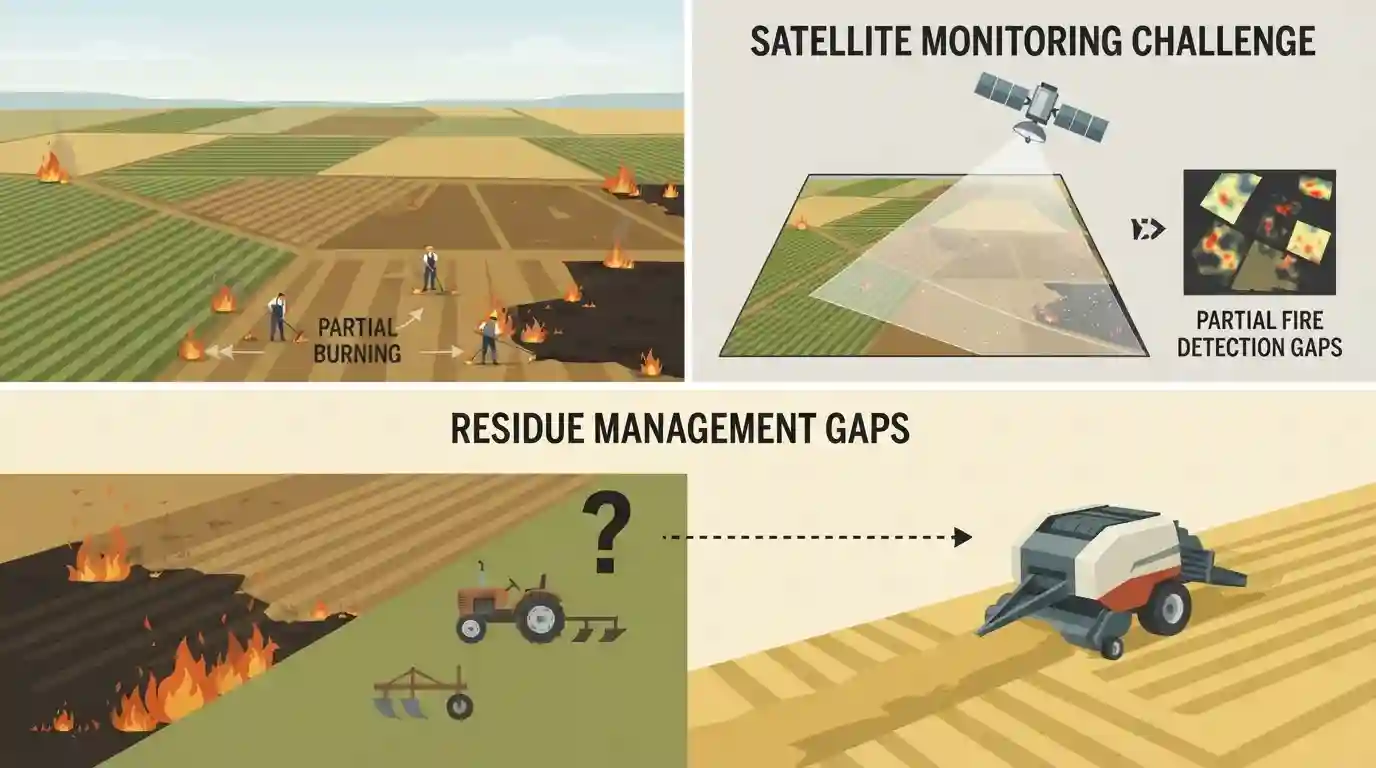
A recent study points out that 'partial burning' of crop residue—where fields are only partially torched—remains a persistent challenge in mitigating farm fire pollution affecting Delhi-NCR. This practice undermines accurate satellite monitoring and points to gaps in current residue management strategies.
મુખ્ય મુદ્દા
- A study highlights that 'partial burning' of crop residue continues to be a major hurdle in tackling farm fire pollution in northern India.
- Partial burning occurs when only a portion of the residue is burned or ignition is incomplete, making satellite detection difficult and distorting official estimation of farm fires.
- Stubble burning remains a primary seasonal contributor to severe air pollution episodes in Delhi-NCR during the winter months.
- Effective management requires moving beyond mere punitive measures to address the socio-economic and operational constraints faced by farmers regarding crop residue management machinery.
મહત્વપૂર્ણ શબ્દો
National Clean Air Programme

A nationwide strategy launched by the Ministry of Environment, Forest and Climate Change (MoEFCC) to reduce particulate matter pollution in Indian cities and improve air quality governance.
UPSC context
UPSC GS Paper III: Environment, Pollution, and Degradation. Tests knowledge of national environmental policy initiatives and air quality targets.
પ્રિલિમ્સ ટ્રેપ
Satellite monitoring provides an accurate, complete, and real-time census of all farm fire incidents across northern India.
Aspirants often assume polar-orbiting satellites capture all farm fires accurately in real-time, missing the temporal window limitation.
સંલગ્ન સ્થિર ખ્યાલો
What are the primary in-situ and ex-situ crop residue management technologies promoted in India?
- In-situ Machinery: In-situ management incorporates residue into soil using machinery like Happy Seeder, Super Seeder, Smart Seeder, and Mulcher without burning.
- Ex-situ Uses: Ex-situ management involves removing residue from the field for industrial use, such as biomass power plants, bio-ethanol production, and packaging material.
- Pusa Decomposer: Decomposer application involves spraying microbial bio-enzymes to rapidly accelerate the decomposition of stubble directly in the fields.
આંતર-વિષય પેટર્ન
Remote Sensing Gaps Across Environmental Sectors
Satellite remote sensing limitations in tracking stubble burning mirror challenges in estimating forest fires and illegal mining under GS-3 Environment and Governance.
In-situ Stubble Management vs. Fiscal Subsidies
The economic viability of Happy Seeders and Super Seeders links agricultural subsidy design (GS-3 Agriculture) directly to air quality management in urban airsheds.

Expect a statement-based question linking satellite remote sensing limitations (polar vs. geostationary) to underreporting of stubble burning.
સંલગ્ન PYQ · 2
સંલગ્ન PYQ · 2
- 2020MainsGS3
What are the major factors responsible for making rice-wheat system a success? In spite of this success how has this system become bane in India?
- 2020MainsGS3
What are the key features of the National Clean Air Programme (NCAP) initiated by the Government of India?
