Parliamentary Standing Committees and Opposition Representation
Source:Indian Express ↗
ఇది ఎందుకు ముఖ్యం
Parliamentary standing committees are the backbone of legislative scrutiny and bipartisan consensus. Disputes over leadership allocations reflect broader tensions in federal parliamentary democracy regarding opposition representation and executive accountability.
సారాంశం
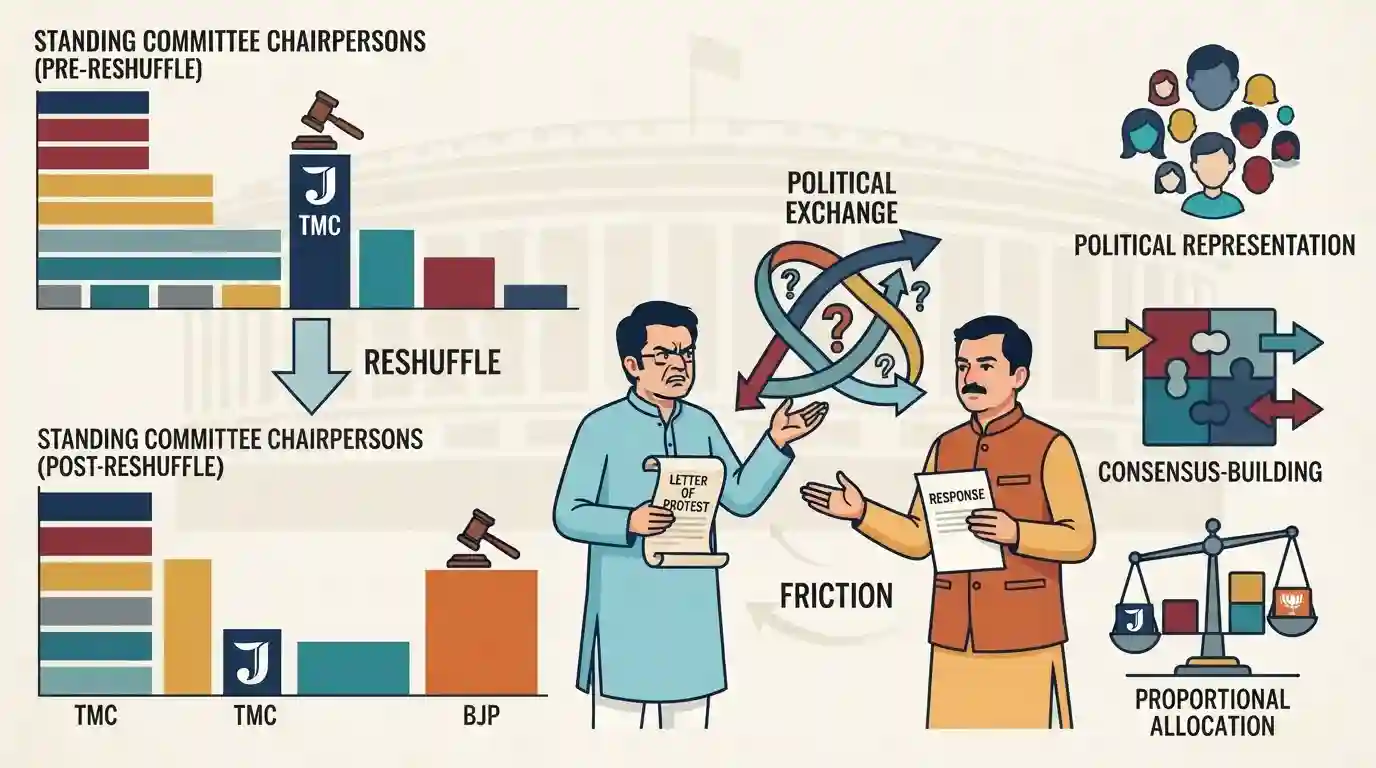
The recent reshuffle of Parliamentary Standing Committees led to the Trinamool Congress (TMC) losing its chairperson berths, sparking a political exchange marked by a letter of protest from TMC leader Derek O'Brien and a response from BJP leader Sudhanshu Trivedi. This highlights the ongoing friction surrounding political representation, consensus-building, and proportional allocation of leadership positions in crucial parliamentary panels.
ముఖ్య అంశాలు
- The Trinamool Congress (TMC) has lost chairperson berths in the parliamentary standing committees following a reshuffle.
- TMC leader Derek O Brien raised concerns through a letter questioning the criteria or rationale behind the allocation of chairperson positions.
- The distribution of chairperson posts in Department-Related Standing Committees (DRSCs) among opposition and ruling parties involves proportional representation principles and inter-party negotiations.
- Such institutional allocations often spark political debates regarding opposition voice and legislative oversight efficacy.
ముఖ్యమైన పదాలు
Parliamentary Standing Committees

Permanent panels constituted periodically to scrutinize bills, budgets, and policies in detail, ensuring legislative oversight and executive accountability away from noisy floor debates.
UPSC context
UPSC Mains Paper II: Indian Polity – Structure, functioning, and conduct of business in Parliament and parliamentary privileges.
Rajya Sabha
The upper house of India's bicameral Parliament, representing the states and Union Territories, where proportional representation shapes committee allocations.
UPSC context
UPSC Mains Paper II: Structure and functioning of the Parliament, federal dynamics, and representation of states.
Trinamool Congress
A recognized national political party in India, functioning as a key opposition stakeholder in Parliament and state legislatures.
UPSC context
UPSC Mains Paper II: Political parties, pressure groups, and their role in the democratic and parliamentary framework.
అనుసంధానమైన స్థిర భావనలు
What are the structural features and composition rules of Department-Related Standing Committees (DRSCs) in the Indian Parliament?
- Total Count: There are 24 DRSCs in total: 16 under Lok Sabha and 8 under Rajya Sabha.
- Composition: Each committee has 31 members—21 from Lok Sabha and 10 from Rajya Sabha, chosen via proportional representation.
- Ministerial Bar: Ministers are strictly barred from becoming members of DRSCs to ensure unbiased legislative oversight of ministries.
- Chairperson Appointment: Chairpersons are appointed by the Lok Sabha Speaker or Rajya Sabha Chairman from the respective committee members.
అంతర-అంశ నమూనాలు
Standing Committees vs Federal Representation
Disputes over committee chairmanships highlight the friction between majority rule in the Lok Sabha and proportional consensus in Rajya Sabha panel allocations.

Expect statement-based prelims on DRSCs: total number, composition (Lok Sabha vs Rajya Sabha ratio), and minister bar.
అనుసంధాన PYQలు · 4
అనుసంధాన PYQలు · 4
- 2019PrelimsGS1
In India, which of the following review the independent regulators in sectors like telecommunications, insurance, electricity, etc.? 1. Ad Hoc Committees set up by the Parliament 2. Parliamentary Department Related Standing Committees 3. Finance Commission 4. Financial Sector Legislative Reforms Commission 5. NITI Aayog Select the correct answer using the code given below.
- 2018MainsGS2
Why do you think the committees are considered to be useful for parliamentary work? Discuss, in this context, the role of the Estimates Committee.
- 2023MainsGS2
Explain the structure of the Parliamentary Committee system. How far have the financial committees helped in the institutionalisation of Indian Parliament?
- 2021MainsGS2
Do Department-related Parliamentary Standing Committees keep the administration on its toes and inspire reverence for parliamentary control? Evaluate the working of such committees with suitable examples.
