Parliamentary Standing Committee Mandate and Jurisdiction
Source:The Hindu ↗
Why It Matters
It provides a practical example of the functioning and jurisdictional boundaries of Department-Related Parliamentary Standing Committees (DRSCs), a highly recurring theme in GS2 Polity. It also touches on J&K's internal security and border dynamics relevant to GS3.
Summary
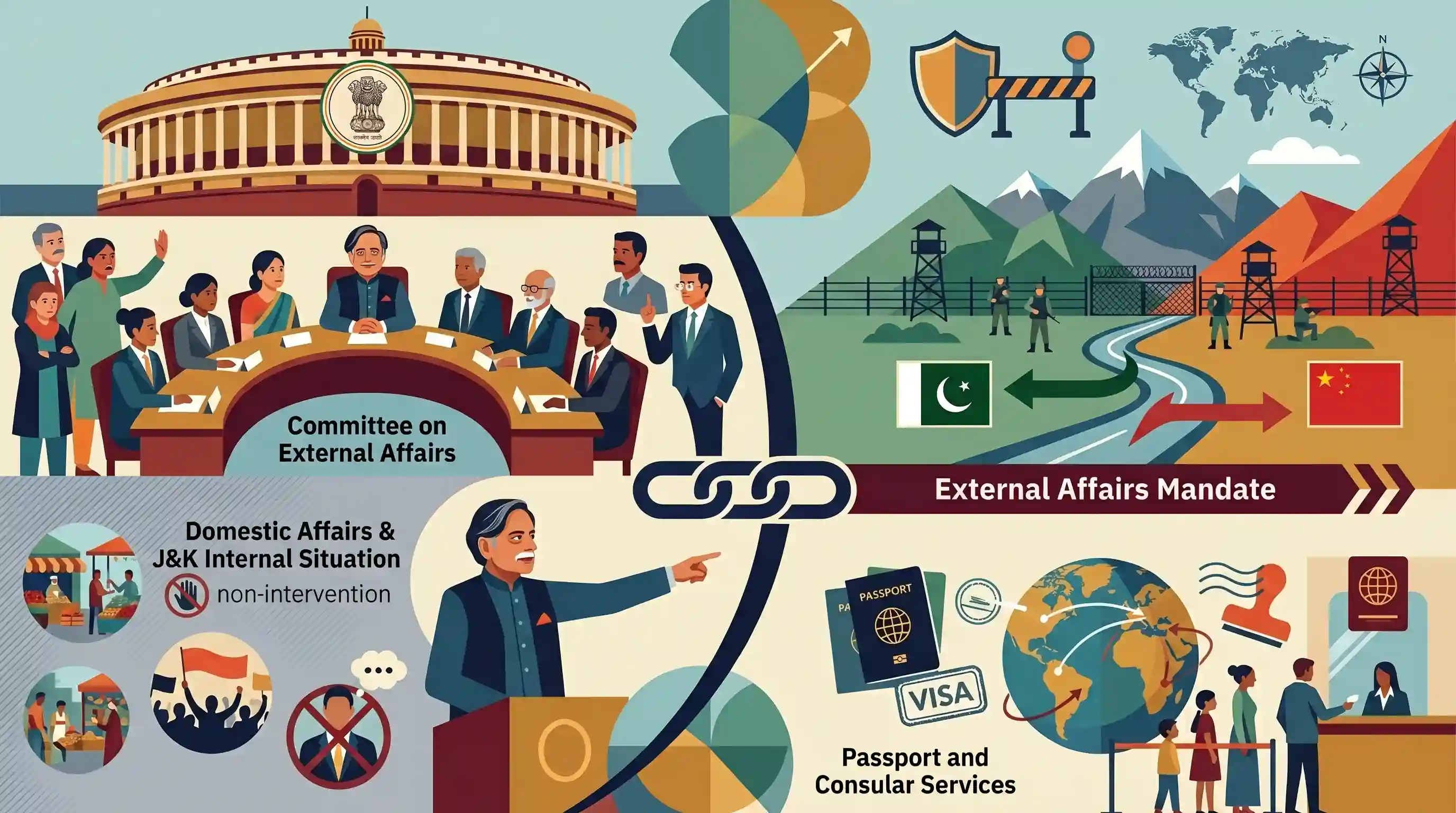
The Parliamentary Standing Committee on External Affairs, chaired by Congress MP Shashi Tharoor, recently visited Jammu and Kashmir. Following backlash from his own party over remarks praising the region's progress toward "normalcy," Tharoor clarified that the committee's mandate is strictly limited to external affairs. The panel's agenda focused on passport and consular services, as well as border security issues involving Pakistan and China, rather than evaluating J&K's internal political or domestic situation. The visit highlights the specific jurisdictional boundaries of Parliamentary Standing Committees and touches upon the broader geopolitical importance of India's border regions.
Key Points
- The Parliamentary Standing Committee on External Affairs, led by Shashi Tharoor, visited Jammu and Kashmir to review matters strictly under its jurisdiction, such as border security and passport services.
- Tharoor clarified the committee's mandate does not include assessing J&K's internal domestic or political situation, reflecting the strict jurisdictional limits of Department-Related Parliamentary Standing Committees (DRSCs).
- Remarks made by Tharoor commending the progress towards 'normalcy' in the region following a meeting with LG Manoj Sinha drew criticism from within his own party.
- The committee's agenda includes interactions with the Army regarding the Sino-Indian and India-Pakistan borders, alongside a scheduled visit to Ladakh.
Important Terms
Parliamentary Standing Committee on External Affairs

A permanent panel of 31 MPs (21 Lok Sabha, 10 Rajya Sabha) providing legislative oversight of India's foreign policy, international treaties, and the Ministry of External Affairs.
UPSC context
GS Paper II: Parliament and State Legislatures—structure, functioning, and conduct of business; also essential for International Relations oversight.
Departmentally Related Standing Committees (DRSCs)
A system of 24 specialized committees that ensure executive accountability by scrutinizing specific ministries' budgets (Demands for Grants), bills, and national policy documents.
UPSC context
GS Paper II: Indian Constitution—Parliamentary oversight mechanisms and the principle of separation of powers.
Committee Jurisdiction
The defined scope of a committee's authority. For instance, the External Affairs committee focuses on foreign relations and passports, while internal security falls under the Home Affairs committee.
UPSC context
GS Paper II: Governance and Separation of Powers; tests understanding of the division of labor within legislative committees.
Normalcy (in J&K)
The transition of J&K toward stability following the 2019 abrogation of Article 370, measured by indicators like reduced stone-pelting, increased tourism, and restored administrative/political processes.
UPSC context
GS Paper III: Internal Security; evaluates the socio-political impact of constitutional changes in sensitive border regions.
Ministry of External Affairs (MEA)
The nodal ministry responsible for India's diplomatic relations, passport services (CPV Division), and representing India at international forums like the United Nations.
UPSC context
GS Paper II: International Relations; tests knowledge of the administrative machinery behind India's foreign policy.
Border Management
The administrative and strategic supervision of India's frontiers. External Affairs handles diplomatic aspects with neighbors, while the Ministry of Home Affairs manages physical security and infrastructure.
UPSC context
GS Paper III: Security challenges and their management in border areas; distinguishes between diplomatic and internal security mandates.
Prelims Trap
The External Affairs Parliamentary Committee evaluates the deployment of internal border security forces in J&K.
Deployment and operational review of border guarding forces (like BSF/ITBP) fall strictly under the Ministry of Home Affairs. MEA handles border diplomacy.
Static Concepts Connected
What are the composition and membership rules for Department-Related Standing Committees (DRSCs)?
- Composition: Each committee has 31 members (21 from Lok Sabha, 10 from Rajya Sabha) nominated by their respective presiding officers.
- Ministerial Bar: A Minister cannot be nominated as a member. If a member becomes a Minister, they immediately vacate their committee seat.
- Tenure: The committees are reconstituted annually, giving members a standard term of one year.
How is border management jurisdiction divided between Union ministries?
- Home Affairs (MHA): Oversees the actual deployment of Central Armed Police Forces (BSF, ITBP, SSB) and manages internal border infrastructure.
- External Affairs (MEA): Manages diplomatic negotiations regarding the LoC/LAC, bilateral treaties, and international border delineations.
- Passports and Visas: Administered entirely by the MEA under Entry 19 of the Union List (Seventh Schedule).
Cross-Topic Patterns
DRSC boundaries and Executive Accountability
Strict compartmentalization of DRSCs ensures focused executive accountability. Mixing mandates (e.g., an MEA committee evaluating an MHA subject like UT normalcy) violates parliamentary procedural rules.
Internal Security vs. Border Diplomacy
Assessing 'Winning Hearts and Minds' (WHAM) in J&K is a domestic governance (MHA) metric, fundamentally distinct from the external geopolitics and border diplomacy managed by the MEA.

Expect a 2026 polity question pairing DRSC jurisdictional limits with specific Union List entries (e.g., Passports vs Border Security).
Linked PYQs · 4
Linked PYQs · 4
- 2021MainsGS2
Do Department-related Parliamentary Standing Committees keep the administration on its toes and inspire reverence for parliamentary control? Evaluate the working of such committees with suitable examples.
- 2023MainsGS2
Explain the structure of the Parliamentary Committee system. How far have the financial committees helped in the institutionalisation of Indian Parliament?
- 2019PrelimsGS1
In India, which of the following review the independent regulators in sectors like telecommunications, insurance, electricity, etc.? 1. Ad Hoc Committees set up by the Parliament 2. Parliamentary Department Related Standing Committees 3. Finance Commission 4. Financial Sector Legislative Reforms Commission 5. NITI Aayog Select the correct answer using the code given below.
- 2023MainsGS3
Winning of 'Hearts and Minds' in terrorism-affected areas is an essential step in restoring the trust of the population. Discuss the measures adopted by the Government in this respect as part of the conflict resolution in Jammu and Kashmir.
