Parliamentary Panel Recommendation on Urban Infrastructure Assessment
Source:The Hindu ↗
Why It Matters
As India transitions toward developed nation status by 2047, managing rapid urbanization requires moving beyond piecemeal schemes to a comprehensive, long-term strategy. This article exposes the policy vacuum in long-term urban infrastructure assessment and is critical for GS1 (Urbanization), GS2 (Governance/Parliamentary Committees), and GS3 (Infrastructure).
Summary
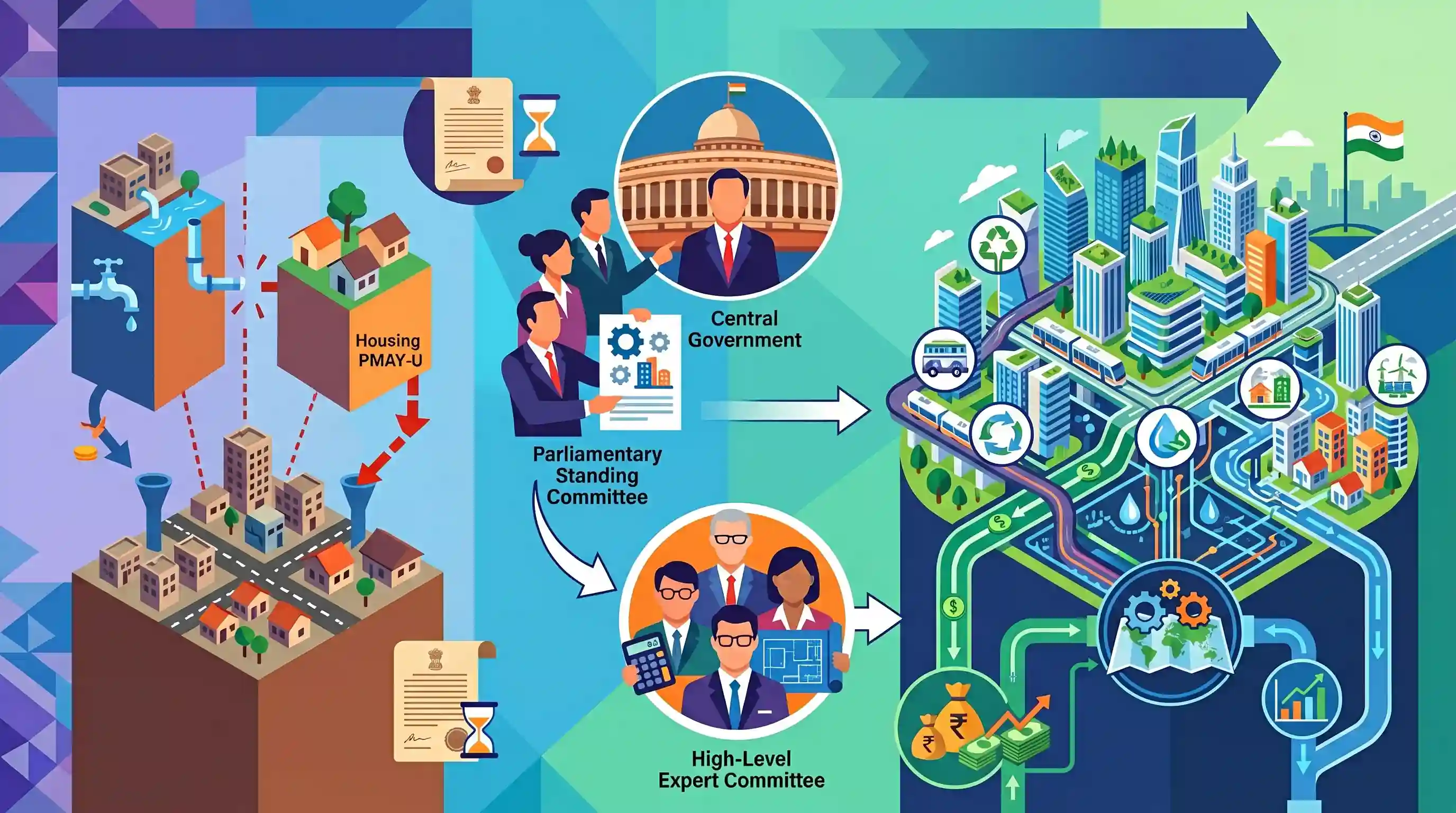
A Parliamentary Standing Committee on Housing and Urban Affairs has urged the Central Government to establish a High-Level Expert Committee to assess India’s long-term urban infrastructure, financing, and governance requirements up to 2047. The panel cautioned that existing urban programs like AMRUT 2.0 and PMAY-U 2.0 are overly sector-specific, and the lack of an integrated strategic framework could result in fragmented planning and financial bottlenecks. This recommendation addresses a critical policy gap, as the last comprehensive national assessment—conducted by the High Powered Expert Committee (HPEC) in 2011—only projected urban demands up to 2031.
Key Points
- A Parliamentary Standing Committee has recommended the formation of a High-Level Expert Committee to comprehensively evaluate India\'s urban infrastructure, financing, and governance needs up to 2047.
- The panel highlighted that current flagship missions such as AMRUT 2.0, SBM-U 2.0, and PMAY-U 2.0 are largely scheme-driven and sector-specific, lacking an integrated, long-term strategic framework.
- The absence of a holistic roadmap could lead to fragmented urban planning, inefficient resource allocation, and future financing stress across metropolitan, Tier-II, and Tier-III cities.
- The last comprehensive national urban assessment was conducted by the High Powered Expert Committee (HPEC) in 2011, which only projected demands up to 2031, leaving a policy vacuum for post-2030 requirements.
- A 2022 joint report by NITI Aayog and the Asian Development Bank emphasized the strong correlation between urbanization and GDP growth, reinforcing the urgency for a forward-looking roadmap.
Important Terms
Parliamentary Standing Committee on Housing and Urban Affairs

A permanent departmental body of Parliament that oversees the Ministry of Housing and Urban Affairs, scrutinizing its budgetary demands, legislative bills, and policy implementation to ensure executive accountability.
UPSC context
GS II (Polity); tests understanding of legislative oversight mechanisms and the role of specialized committees in ensuring executive accountability.
AMRUT 2.0
A flagship mission launched in 2021 aiming for universal water supply in all statutory towns and 100% sewerage coverage in 500 cities, focusing on water security and circular economy.
UPSC context
GS III (Infrastructure); GS II (Schemes); tests knowledge of urban service delivery, water management, and sustainable development goals.
PMAY-U 2.0
A second-phase housing scheme (2024–2029) providing financial assistance to construct, purchase, or rent one crore houses for urban poor and middle-class families to achieve "Housing for All."
UPSC context
GS II (Welfare Schemes); GS III (Infrastructure); essential for questions on urban poverty, housing shortages, and inclusive planning.
High Powered Expert Committee (HPEC)
A 2011 committee chaired by Isher Judge Ahluwalia that provided the first comprehensive national assessment of India’s urban infrastructure investment requirements and governance reforms through 2031.
UPSC context
GS III (Urbanization); provides foundational data and policy frameworks cited in mains answers regarding the fiscal challenges of urbanization.
Swachh Bharat Mission-Urban 2.0 (SBM-U 2.0)
The second phase of the sanitation mission focusing on making all Indian cities "Garbage Free" through 100% waste processing, remediation of legacy dumpsites, and used-water management.
UPSC context
GS III (Environment/Infrastructure); tests awareness of solid waste management, urban sanitation standards, and the ODF+ transition.
PM e-Bus Seva
A scheme to deploy 10,000 electric buses on a public-private partnership model in 169 cities to augment city bus services and promote green urban mobility infrastructure.
UPSC context
GS III (Infrastructure/Environment); relevant for topics on sustainable transport, air pollution mitigation, and electric vehicle adoption.
Prelims Trap
The 2011 High Powered Expert Committee (HPEC) mapped India's long-term urban infrastructure needs up to 2047.
The 2011 HPEC (Isher Judge Ahluwalia) only projected urban demands up to 2031. The 2047 roadmap is currently just a recommendation by a Parliamentary Panel, not an existing committee or executed policy.
Static Concepts Connected
What are the primary sources of revenue for Urban Local Bodies (ULBs)?
- Tax Revenue: Property tax (the largest internal source), professional tax, and entertainment tax.
- Non-Tax Revenue: User charges for water and sanitation, building permission fees, and leasing of municipal properties.
- Grants & Devolution: Statutory devolution and grants-in-aid from the Central Finance Commission and respective State Finance Commissions (SFCs).
- Market Borrowing: Raising capital from markets through municipal bonds, which is strictly subject to state government approval.
What is the structure of Departmentally Related Standing Committees (DRSCs)?
- Composition: They consist of 31 members: 21 from the Lok Sabha (nominated by the Speaker) and 10 from the Rajya Sabha (nominated by the Chairman).
- Core Mandate: To secure executive accountability by examining demands for grants, considering bills, and evaluating the long-term policies of ministries.
- Advisory Nature: Their recommendations are persuasive and carry significant weight, but they are not legally binding on the government.
Cross-Topic Patterns
Municipal Bonds & 15th FC Grants
The panel's concern over financial bottlenecks aligns with the 15th Finance Commission's conditions, which explicitly link Urban Local Body (ULB) grants to notified property tax floor rates and timely audited accounts.
Siloed Schemes vs. Integrated Planning
UPSC frequently tests the 'siloed approach' of governance. Criticizing flagship missions like AMRUT and PMAY as overly 'sector-specific' provides excellent critical evaluation fodder for GS2 (Governance) and GS3 (Infrastructure) answers.

Expect a GS2/GS3 Mains question in 2026 linking the stagnation of ULB finances to the fragmented, scheme-based approach of urban missions.
Linked PYQs · 4
Linked PYQs · 4
- 2025MainsGS1
How does smart city in India, address the issues of urban poverty and distributive justice?
- 2016MainsGS1
With a brief background of quality of urban life in India, introduce the objectives and strategy of the 'Smart City Programme'.
- 2021MainsGS2
Do Department-related Parliamentary Standing Committees keep the administration on its toes and inspire reverence for parliamentary control? Evaluate the working of such committees with suitable examples.
- 2024MainsGS2
Analyse the role of local bodies in providing good governance at local level and bring out the pros and cons merging the rural local bodies with the urban local bodies.
