Simultaneous Elections Economic Impact and Parliamentary Panel Review
Source:The Hindu ↗
Why It Matters
The article bridges the political and economic dimensions of 'One Nation, One Election,' offering critical talking points for GS-2 (Electoral Reforms, Federalism) and GS-3 (Macroeconomic Impact of elections). It provides concrete data estimates (1.5% GDP boost) and legal counterarguments (unfettered ECI powers) that are invaluable for Mains answers.
Summary
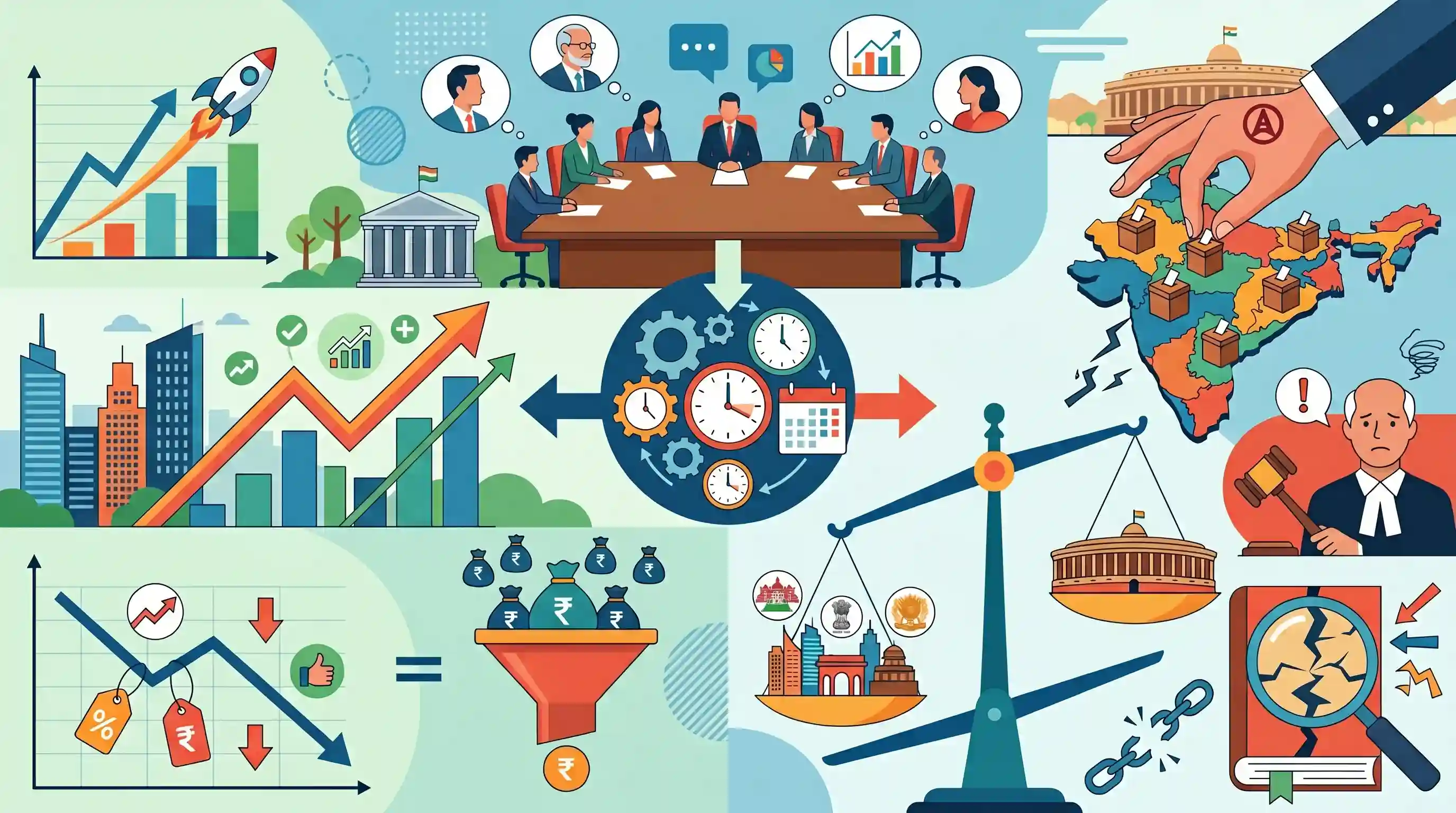
The Joint Parliamentary Committee (JPC) examining the 'One Nation, One Election' (ONOE) bills has invited prominent economists, including Montek Singh Ahluwalia and Arvind Panagariya, to discuss the economic implications of simultaneous elections. Proponents argue that synchronizing national and state elections could boost India's real GDP growth by 1.5% and lower inflation by 1.1% by eliminating massive, recurring election expenditures and policy disruptions. Conversely, the proposed constitutional amendments face scrutiny over democratic and federal concerns, with critics like former Chief Justice Sanjiv Khanna warning that they grant excessive powers to the Election Commission of India.
Key Points
- The Joint Parliamentary Committee (JPC) is seeking inputs from prominent economists to evaluate the macroeconomic impact of simultaneous elections.
- Advocates of 'One Nation, One Election' claim the move could increase India's real GDP growth by 1.5% and reduce inflation by 1.1% by preventing recurring election costs.
- Simultaneous elections are argued to limit policy paralysis caused by the frequent enforcement of the Model Code of Conduct.
- Critics, including former Chief Justice Sanjiv Khanna, have raised constitutional concerns, arguing the proposed bills grant the Election Commission of India unfettered powers, potentially undermining federalism.
Important Terms
One Nation, One Election (ONOE)

A proposal to synchronize elections for Lok Sabha and all State Legislative Assemblies to reduce expenditure, administrative burden, and policy disruptions caused by frequent election cycles and the Model Code of Conduct.
UPSC context
GS II: Electoral Reforms. Tests understanding of federalism, constitutional amendments (Article 368), and governance efficiency vs. democratic accountability.
Constitution (129th Amendment) Bill, 2024
The legislative vehicle for ONOE, proposing Article 82A to mandate simultaneous polls and amending Articles 83 and 172 to align the tenures of Parliament and State Assemblies.
UPSC context
GS II: Parliament and State Legislatures. Evaluates knowledge of specific constitutional amendments and their impact on India\'s federal structure.
Joint Parliamentary Committee (JPC)
An ad-hoc committee comprising members from both Lok Sabha and Rajya Sabha, constituted to conduct detailed scrutiny of specific bills or subjects through expert consultations and stakeholder engagement.
UPSC context
GS II: Parliamentary Committees. Tests understanding of legislative oversight mechanisms and the role of committees in the law-making process.
Election Commission of India (ECI)
An autonomous constitutional authority (Article 324) responsible for administering election processes in India. The ONOE bill proposes expanded discretionary powers for the ECI to recommend postponing assembly elections.
UPSC context
GS II: Appointment to various Constitutional posts, powers, functions and responsibilities. Tests knowledge of institutional independence and executive-judiciary-ECI dynamics.
Basic Structure Doctrine
A judicial principle stating that Parliament cannot use its amending power to alter the core features of the Constitution. Critics argue ONOE may violate federalism, a basic structure component.
UPSC context
GS II: Indian Constitution—historical underpinnings, evolution, features, amendments, significant provisions and basic structure. Critical for analyzing the judicial review of ONOE.
Ram Nath Kovind Committee
The High-Level Committee (HLC) that submitted the foundational report recommending simultaneous polls in two phases, starting with Lok Sabha and State Assemblies, followed by local bodies.
UPSC context
GS II: Important aspects of governance, transparency and accountability. Significant for tracing the policy evolution of ONOE.
Prelims Trap
A State Assembly elected mid-cycle under the ONOE framework will serve a fresh five-year term.
Under the proposed Constitution (129th Amendment) Bill, a mid-term elected House will only serve the remaining "unexpired term" of the synchronous cycle, not a fresh five years.
Static Concepts Connected
How are powers divided for preparing electoral rolls currently?
- ECI Mandate: Under Article 324, the ECI prepares and oversees electoral rolls for Parliament and State Legislative Assemblies.
- SEC Mandate: Under Articles 243K and 243ZA, State Election Commissions (SECs) prepare electoral rolls for Panchayats and Municipalities.
- Constitutional Disconnect: Currently, states are not constitutionally bound to adopt the ECI's electoral roll for local elections. A unified roll requires amending Article 325.
What is the Model Code of Conduct (MCC) and its statutory backing?
- Origin & Nature: It is a consensus-based set of guidelines issued by the ECI for political parties and candidates, tracing its origins to Kerala's 1960 assembly elections.
- Statutory Backing: The MCC itself is not legally enforceable under any specific statute, though certain electoral offenses within it are punishable under the IPC and RPA, 1951.
Cross-Topic Patterns
Electoral Economics & Fiscal Drag
Frequent invocation of the MCC halts capital expenditure and delays welfare rollouts. Macroeconomists are now modeling this administrative pause as a measurable fiscal drag on GDP and inflation.
Article 356 Bypass & Federalism
Empowering the ECI to delay state polls creates fears of indirect central control, linking electoral reforms to federal friction and the potential circumvention of Article 356 (President's Rule) safeguards.

ONOE's "unexpired term" clause (Article 82A) and the constitutional mechanics of a single electoral roll will be high-yield in 2026 Prelims.
Linked PYQs · 3
Linked PYQs · 3
- 2024MainsGS2
Examine the need for electoral reforms as suggested by various committees with particular reference to "one nation one election" principle.
- 2017MainsGS2
Simultaneous election to the Lok Sabha and the State Assemblies will limit the amount of time and money spent in electioneering but it will reduce the government's accountability to the people." Discuss.
- 2017PrelimsGS1
Consider the following statements: 1. The Election Commission of India is a five-member body. 2. Union Ministry of Home Affairs decides the election schedule for the conduct of both general elections and bye-elections. 3. Election Commission resolves the disputes relating to splits/mergers of recognised political parties. Which of the statements given above is/are correct?
