Parliamentary Winter Session Schedule and Constitutional Functionaries
Source:The Hindu ↗
Why It Matters
Highlights the practical challenges of Parliamentary functioning, the role of the Opposition in raising accountability, the declining productivity of legislative sessions, and the constitutional mechanisms for the removal of constitutional functionaries like the Vice-President and High Court judges.
Summary
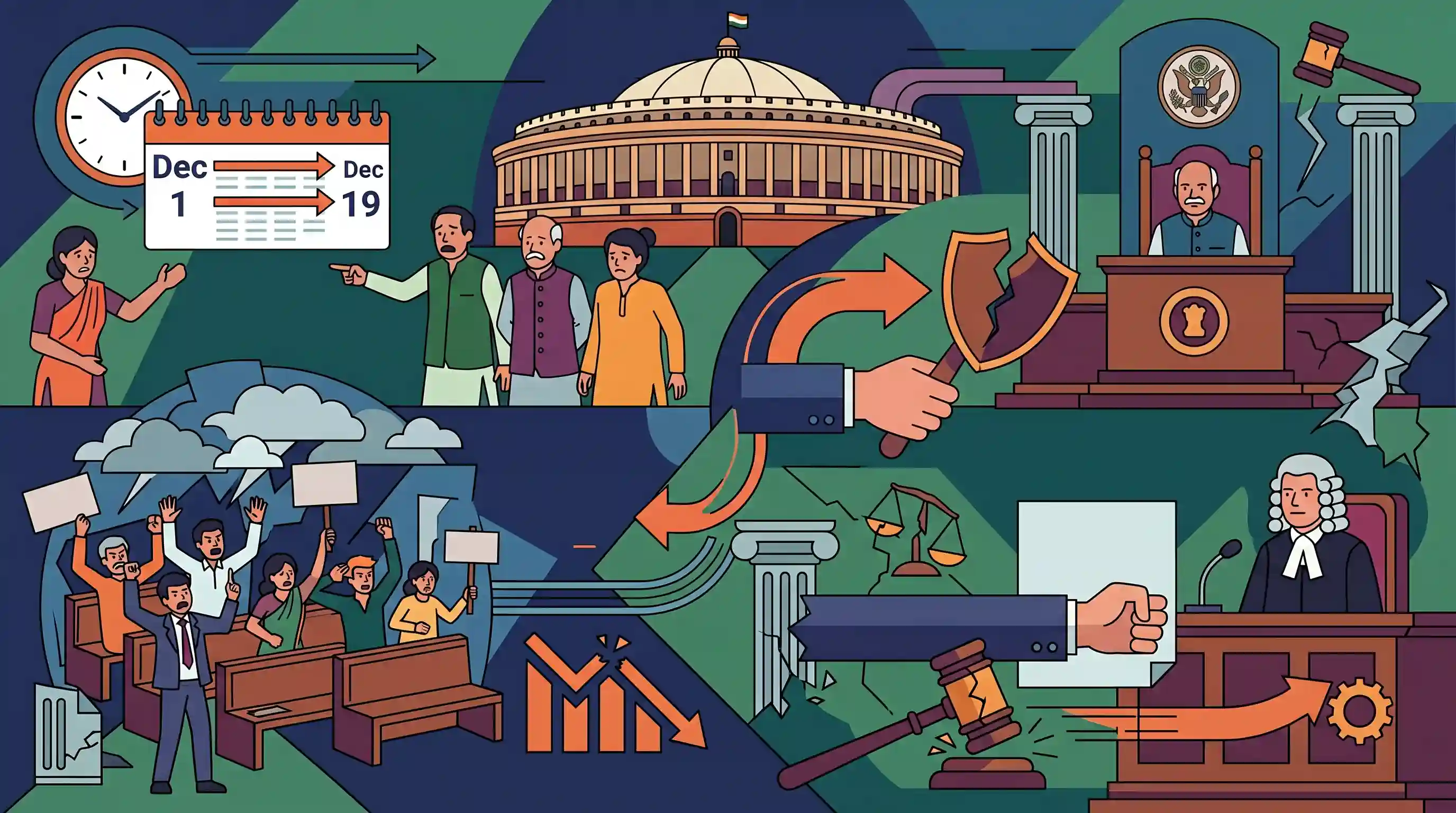
The Winter Session of Parliament will take place from December 1 to 19, a schedule criticized by the Opposition as delayed and truncated. The announcement follows a highly disruptive Monsoon Session characterized by record low productivity and intense protests over issues like 'Operation Sindoor'. The previous Winter Session was also notable for unprecedented constitutional events, including a no-confidence motion against Vice-President Jagdeep Dhankhar and an impeachment notice against a sitting Allahabad High Court judge.
Key Points
- The 2025 Winter Session of Parliament is scheduled from December 1 to December 19, comprising 15 sittings.
- The Opposition has criticized the government for delaying and truncating the session, noting it began earlier the previous year.
- The preceding Monsoon Session concluded with record low productivity due to persistent Opposition disruptions over 'Operation Sindoor' and a revision exercise in Bihar.
- The previous year's Winter Session was marked by an unprecedented no-confidence motion against the Vice-President and an impeachment notice for an Allahabad High Court judge.
Important Terms
Operation Sindoor

A 2025 tri-service military operation targeting terror infrastructure in Pakistan and PoJK after the Pahalgam attack; a major subject of parliamentary debate on national security and foreign policy.
UPSC context
GS Paper II/III: Security challenges and their management, and the role of Parliament in discussing national security and defense operations.
Special Intensive Revision (SIR) exercise
A comprehensive Election Commission process to update electoral rolls. In the 2025 sessions, it faced scrutiny over alleged malpractices, impacting debates on electoral reforms and democratic integrity.
UPSC context
GS Paper II: Salient features of the Representation of People's Act and the conduct of free and fair elections.
Article 67(b)
The constitutional provision for removing the Vice-President. It requires a 14-day notice and a resolution passed by a majority of Rajya Sabha members, subsequently agreed to by the Lok Sabha.
UPSC context
GS Paper II: Constitutional posts, their powers, and the procedural safeguards/processes for the removal of high-ranking officials.
Judges (Inquiry) Act, 1968
A 1968 law prescribing the procedure for the investigation and proof of misbehavior or incapacity of a judge. It requires signatures from 50 Rajya Sabha or 100 Lok Sabha members.
UPSC context
GS Paper II: Structure, organization, and functioning of the Judiciary; specifically the removal process for High Court and Supreme Court judges.
Adjournment Sine Die
Termination of a parliamentary sitting without naming a specific date for the next meeting. This typically marks the end of a session before prorogation by the President.
UPSC context
GS Paper II: Parliament and State Legislatures — conduct of business, terminology, and presiding officers' powers.
Parliamentary Productivity
A metric representing the ratio of actual hours worked by Parliament to the total hours scheduled. High productivity (e.g., 111-121% in Winter 2025) indicates efficient legislative business despite disruptions.
UPSC context
GS Paper II: Functioning of Parliament, issues arising from disruptions, and the efficiency of the legislative process.
Prelims Trap
A resolution to remove the Vice-President requires a special majority in both Houses of Parliament.
The Constitution requires an "effective majority" in the Rajya Sabha and a "simple majority" in the Lok Sabha. A 2/3rd special majority is not required.
Static Concepts Connected
What is the constitutional procedure to remove the Vice-President of India?
- Exclusive origin: A removal resolution can only be introduced in the Rajya Sabha, and it requires 14 days of advance notice.
- Rajya Sabha passage: It must be passed by an effective majority, which means a majority of all the then members of the House, excluding vacancies.
- Lok Sabha consent: The resolution must be agreed to by the Lok Sabha with a simple majority (majority of members present and voting).
- No explicit grounds: Unlike the President's removal for "violation of the Constitution", no specific grounds for removing a Vice-President are mentioned in the Constitution.
Who has the authority to convene Parliament sessions in India?
- Constitutional limit: Article 85 mandates that the maximum gap between two consecutive sessions of Parliament cannot exceed six months.
- CCPA decision: The Cabinet Committee on Parliamentary Affairs (CCPA) practically decides and recommends the exact dates and duration of the sessions.
- Presidential summons: The President formally issues the summons for Parliament, acting on the binding advice of the Council of Ministers (via CCPA).
- No fixed calendar: India lacks a fixed parliamentary calendar. The three sessions (Budget, Monsoon, Winter) are held entirely by convention, not constitutional decree.
Cross-Topic Patterns
Judicial removal & parliamentary oversight
Impeachment notices against sitting HC judges frequently test the delicate balance between legislative accountability mechanisms (Judges Inquiry Act, 1968) and the core constitutional feature of judicial independence.
Bypassing Question Hour accountability
Continuous disruptions leading to truncated sessions directly erode executive accountability, as vital deliberative tools like Question Hour and robust parliamentary committee scrutiny are bypassed.

Expect a 2026 Prelims multi-statement question contrasting the removal majorities and initiation procedures for the VP vs. High Court Judges.
Linked PYQs · 2
Linked PYQs · 2
- 2019MainsGS2
Individual Parliamentarian's role as the national law maker is on a decline, which in turn, has adversely impacted the quality of debates and their outcome. Discuss.
- 2004PrelimsGS1
The resolution for removing the Vice-president of India can be moved in the:
