Viksit Bharat Shiksha Adhishthan Bill Refers Higher Education Reform
Source:The Hindu ↗
Why It Matters
The creation of a single higher education commission is a monumental reform stemming from the National Education Policy (NEP) 2020. It addresses GS2 themes covering the structural overhaul of educational regulatory bodies and provides a practical example of the parliamentary legislative process (referral to a Joint Committee).
Summary
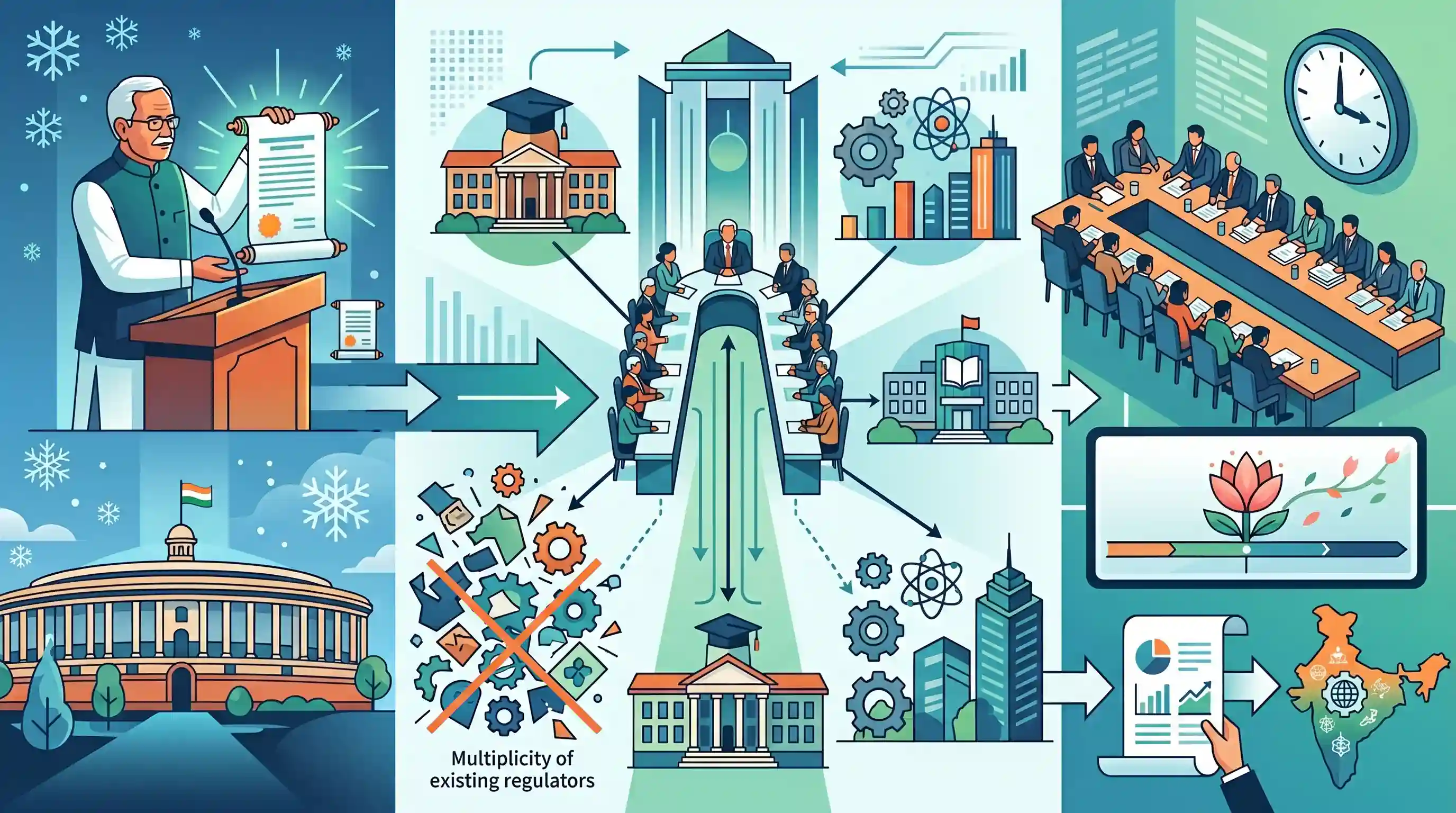
During the 2025 Winter Session, Union Education Minister Dharmendra Pradhan introduced the 'Viksit Bharat Shiksha Adhishthan Bill', which has been referred to a Joint Committee of Parliament by the Lok Sabha. The proposed legislation aims to overhaul India's higher education regulatory framework by establishing a single 13-member overarching higher education commission. This new body, headed by a President-appointed chairperson, will replace the existing multiplicity of regulators. It will regulate central universities, colleges, and prestigious institutes of national importance like IITs, NITs, and IIMs. The 31-member Joint Committee is mandated to submit its report during the 2026 Budget Session.
Key Points
- The Lok Sabha passed a resolution to refer the Viksit Bharat Shiksha Adhishthan Bill to a Joint Committee of Parliament.
- The Joint Committee will consist of 31 members (21 from the Lok Sabha and 10 from the Rajya Sabha) and must submit its report by the first part of the 2026 Budget Session.
- The Bill aims to establish a 13-member apex body, headed by a President-appointed chairperson, to regulate higher education in India.
- This new commission will end the multiplicity of regulators, establishing an overarching framework for central universities, colleges, and institutes of national importance such as IITs, IIMs, and NITs.
Important Terms
Viksit Bharat Shiksha Adhishthan Bill, 2025

A 2025 legislation introduced to overhaul higher education regulation by creating a unified 13-member apex body, subsuming existing regulators like the UGC, AICTE, and NCTE.
UPSC context
GS Paper II (Governance) and GS Paper III (Human Resources). Essential for discussing structural reforms in India's education sector.
Higher Education Commission of India (HECI)
The proposed single overarching regulatory body for higher education in India (excluding medical and legal), intended to provide "light but tight" regulation as envisioned by NEP 2020.
UPSC context
GS Paper II. Focuses on the transition from fragmented to unified regulation in the social sector.
Joint Committee of Parliament (JPC)
An ad-hoc parliamentary committee comprising members from both Houses, formed to scrutinize complex bills and conduct stakeholder consultations before they are put to vote.
UPSC context
GS Paper II (Parliament and State Legislatures). Tests understanding of the law-making process and legislative scrutiny.
Institutes of National Importance (INI)
A category of premiere public institutions (like IITs, IIMs, and NITs) established by Acts of Parliament, enjoying special status, direct funding, and high functional autonomy.
UPSC context
GS Paper II (Education). Important for understanding the hierarchy and governance of India's elite educational institutions.
National Education Policy 2020 (NEP 2020)
The comprehensive policy framework launched in 2020 that guides the restructuring of India's education system, including the move toward a single regulator.
UPSC context
GS Paper II and III. The primary policy driver behind all current educational legislative changes.
Entry 66 of the Union List
A provision in the Seventh Schedule of the Constitution giving the Central Government power to coordinate and determine standards in higher education and research institutions.
UPSC context
GS Paper II (Constitutional provisions/Federalism). Concerns the division of powers between the Centre and States regarding education.
Prelims Trap
"The Viksit Bharat Shiksha Adhishthan is the sole overarching regulator and grant-allocating body for all higher education streams."
VBSA strictly separates regulation from funding (unlike the UGC) and explicitly excludes medical and legal education from its overarching regulatory jurisdiction.
Static Concepts Connected
What are the core characteristics of a Joint Parliamentary Committee (JPC)?
- Ad-hoc nature: They are temporary, created for a specific purpose (like scrutinizing a complex Bill), and dissolve after submitting their report.
- Composition ratio: The membership ratio between the Lok Sabha and the Rajya Sabha is conventionally maintained at 2:1.
- Formation process: They are established through a motion adopted by one House and agreed to by the other.
What defines an Institute of National Importance (INI) in India?
- Statutory backing: The status is conferred by an Act of Parliament (e.g., the Institutes of Technology Act, 1961).
- High autonomy: They are granted specialized powers to hold examinations, grant degrees independently, and receive direct central funding.
Cross-Topic Patterns
NEP 2020: Light but tight regulation
The shift from fragmented bodies (UGC/AICTE) to a single regulator with separated funding and accreditation powers directly tests the 'light but tight' regulatory vision of NEP 2020.
Separation of regulation and funding
UPSC frequently tests regulatory design. Stripping grant-allocation powers from the apex education regulator mirrors governance debates like separating RBI's monetary policy from public debt management.

Expect a 2026 Prelims question testing VBSA's exclusion of medical/legal education alongside its structural separation from grant-making.
Linked PYQs · 3
Linked PYQs · 3
- 2015MainsGS2
The quality of higher education in India requires major improvements to make it internationally competitive. Do you think that the entry of foreign educational institutions would help improve the quality of higher and technical education in the country? Discuss.
- 2024PrelimsGS1
With reference to the Indian Parliament, consider the following statements: 1. A bill pending in the Lok Sabha lapses on its dissolution. 2. A bill passed by the Lok Sabha and pending in the Rajya Sabha lapses on the dissolution of the Lok Sabha. 3. A bill in regard to which the President of India notified his/her intention to summon the Houses to a joint sitting lapses on the dissolution of the Lok Sabha. Which of the statements given above is/are correct?
- 2015PrelimsGS1
When a bill is referred to a joint sitting of both the Houses of the Parliament, it has to be passed by
