Parliamentary Sittings and Weekend Session Schedules
Source:The Hindu ↗
Why It Matters
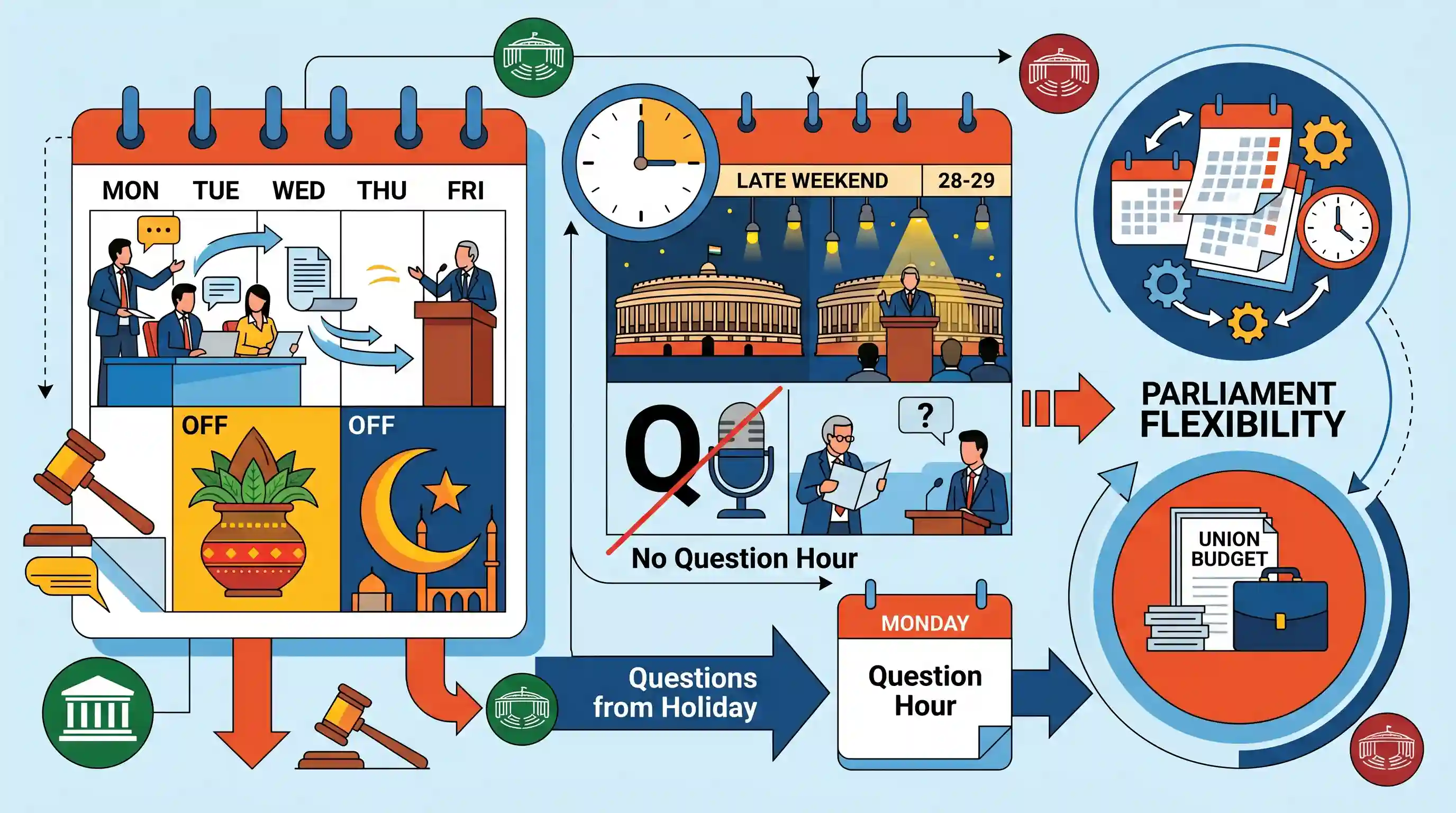
Provides a practical example of how the schedule of parliamentary sittings can be adjusted for holidays and the procedural consequences for Question Hour, reflecting on the constitutional and procedural flexibility of the Indian Parliament.
Summary
Parliament will convene on the weekend of March 28-29 to make up for the holidays on March 19 (Ugadi) and March 20 (Eid). While questions originally slated for the holidays will be tabled on the subsequent Monday, the weekend sittings will not include a Question Hour. Both the Lok Sabha and Rajya Sabha will follow this schedule, demonstrating the flexibility in parliamentary sittings, which have occasionally occurred on weekends for significant events like the Union Budget presentation.
Key Points
- Parliament will function on the weekend of March 28-29 to compensate for the Ugadi and Eid holidays on March 19 and 20.
- Questions scheduled for the suspended days will be tabled in the Lok Sabha on the following Monday.
- No questions will be taken up during the weekend sessions on March 28 and 29.
- The flexibility of parliamentary schedules has been demonstrated previously, such as meeting on a Sunday for the Union Budget presentation.
Important Terms
Question Hour

The first hour of a parliamentary sitting where MPs ask questions to ministers. It is a critical tool for ensuring executive accountability and transparency.
UPSC context
GS Paper II (Polity); tests understanding of parliamentary oversight mechanisms and the principle of executive responsibility.
Lok Sabha
The lower house of India's Parliament (House of the People). Its members are directly elected, and it holds primary power over Money Bills and the Union Budget.
UPSC context
GS Paper II (Legislature); essential for questions on the legislative process, bicameralism, and representative democracy.
Rajya Sabha
The upper house of Parliament (Council of States). It represents states and UTs, is a permanent body not subject to dissolution, and maintains federal equilibrium.
UPSC context
GS Paper II (Polity); relevant for federalism-related topics and the role of the 'House of Review.'
Sittings of Parliament
Individual daily meetings of a House during a session. While the Constitution mandates a maximum six-month gap between sessions, the frequency of sittings is flexible.
UPSC context
GS Paper II (Parliamentary Procedures); tests knowledge of the working calendar, executive-legislative relations, and Article 85.
Tabling of Questions
The formal process of submitting a document, question, or bill for the House's consideration. Tabled questions require a formal response from the concerned minister.
UPSC context
GS Paper II (Governance); relates to procedural rules that enable the legislature to scrutinize government actions.
Article 85
The constitutional provision empowering the President to summon and prorogue both Houses and dissolve the Lok Sabha, ensuring Parliament meets at least twice annually.
UPSC context
GS Paper II (Polity); fundamental for understanding the President's role and the continuity of the legislative organ.
Prelims Trap
The Question Hour is a constitutional mandate that must be held on every day Parliament is in session.
The Question Hour is not mentioned in the Constitution. It is dictated by the Rules of Procedure and is routinely omitted during weekend sittings or special sessions.
Static Concepts Connected
What dictates the summoning and scheduling of Parliament sittings?
- Article 85: The President summons each House to meet, ensuring the gap between two sessions does not exceed six months.
- Flexible scheduling: Parliament usually meets on weekdays but can convene on weekends to clear legislative backlogs or for special events like the Budget.
What are the primary rules governing the Question Hour?
- Source of authority: It is mentioned in the Rules of Procedure of both Houses, not explicitly in the Constitution of India.
- Procedural exemptions: It is generally omitted during weekend sittings, joint sittings, or during the President's special address to both Houses.
- Executive accountability: It enables MPs to hold the Council of Ministers accountable through Starred (oral), Unstarred (written), and Short Notice questions.
Cross-Topic Patterns
Rules of Procedure vs. Constitution
UPSC routinely tests if parliamentary devices like Question Hour, Zero Hour, or No-Confidence Motions are constitutional. They are actually derived from conventions and the Rules of Procedure of the Houses.
Productivity vs. Executive Accountability
Skipping Question Hour during weekend or special sessions triggers debates on executive accountability, linking procedural flexibility to the role of the Opposition in a parliamentary democracy.

A 2026 Prelims question will likely contrast constitutional mandates (like Art 85 summoning) with Rules of Procedure (like Question Hour).
Linked PYQs · 2
Linked PYQs · 2
- 2020PrelimsGS1
Consider the following statements: 1. The President of India can summon a session of the Parliament at such place as he/she thinks fit. 2. The Constitution of India provides for three sessions of the Parliament in a year, but it is not mandatory to conduct all three sessions. 3. There is no minimum number of days that the Parliament is required to meet in a year. Which of the statements given above is/are correct?
- 2017PrelimsGS1
The Parliament of India exercises control over the functions of the Council of Ministers through 1. Adjournment motion 2. Question hour 3. Supplementary questions Select the correct answer using the code given below:
