Parliament Special Session Scheduled for Women Reservation Bills
Source:Indian Express ↗
Why It Matters
The convening of Parliament sessions, the constitutional mechanisms for amending the 106th Amendment Act (Women's Reservation), and the demographic and federal implications of the Delimitation Commission on the representation of Southern versus Northern states are highly critical themes for both Prelims and GS2 Mains.
Summary
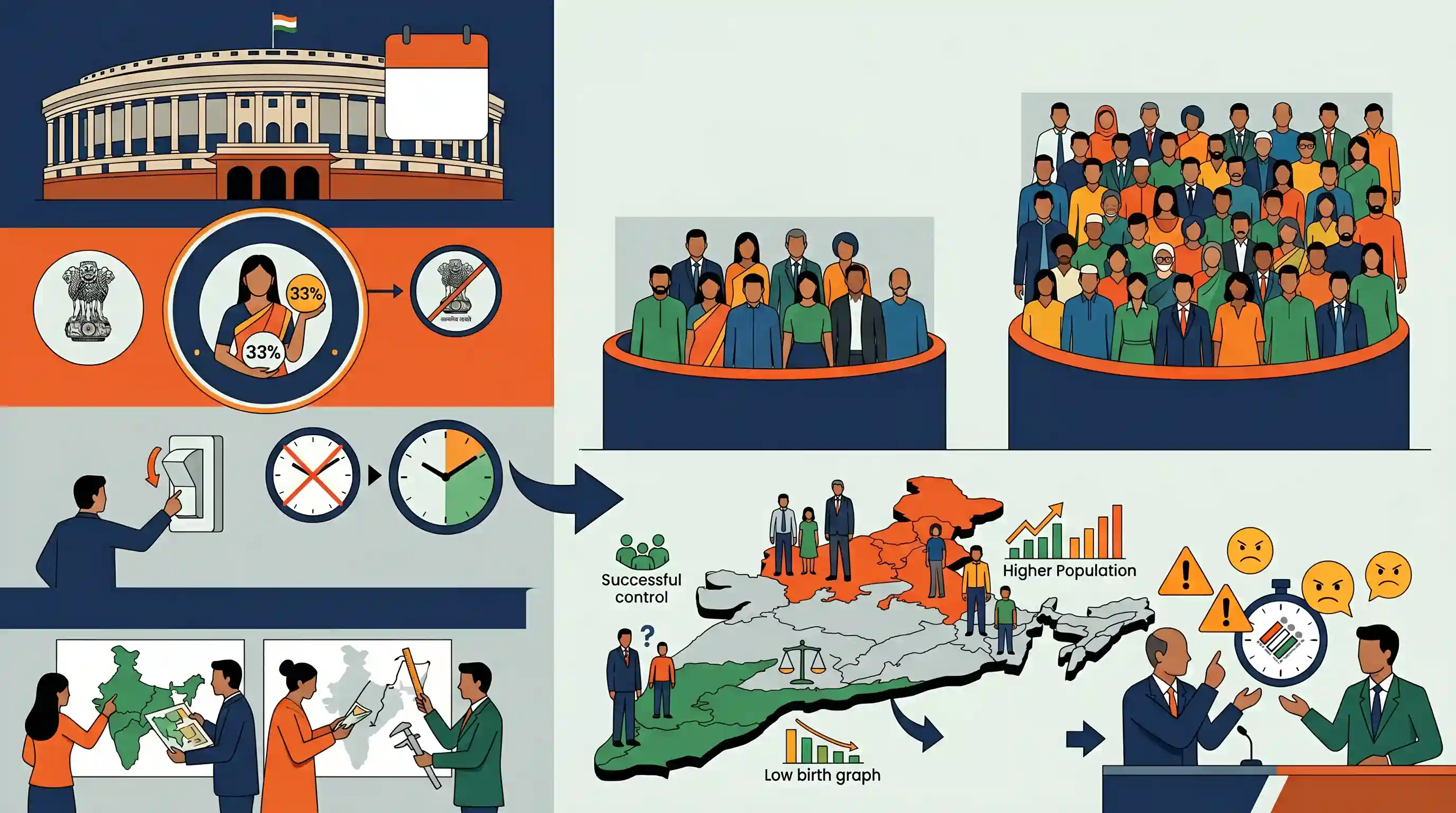
Parliament is scheduled to reconvene for a three-day session starting April 16 to consider crucial legislation, primarily amendments to the recently enacted Nari Shakti Vandan Adhiniyam (Women's Reservation Act). The amendment aims to implement the 33% women's quota using 2011 Census data rather than waiting for the 2027 Census. This shift will necessitate a delimitation exercise, purportedly increasing total Lok Sabha seats from 543 to 816 to accommodate the reservation without shrinking existing unreserved seats. The Opposition has criticized the move, warning that delimitation could diminish the political representation of Southern states that have effectively controlled their populations, while labeling the hurried implementation an election-oriented tactic.
Key Points
- The government plans to reconvene Parliament for three days starting April 16 to take up important legislation.
- A key agenda is amending the Nari Shakti Vandan Adhiniyam (106th Constitutional Amendment Act) to implement the 33% women's reservation using 2011 Census data instead of the 2027 Census.
- The proposed changes involve a delimitation exercise that would increase the total number of Lok Sabha seats from 543 to 816, with around 270 seats reserved for women.
- The Opposition has raised concerns that delimitation based on population could disproportionately reduce the political representation of Southern states, which have successfully curbed population growth.
- Critics also allege the sudden move is politically motivated to secure electoral advantages ahead of upcoming Assembly elections.
Important Terms
Nari Shakti Vandan Adhiniyam

The popular name for the Women’s Reservation Act, 2023, reserving 33% of seats in the Lok Sabha and State Legislative Assemblies for women to enhance political participation.
UPSC context
GS Paper II (Polity & Governance). Tests legislative measures for social justice and women's empowerment.
Constitution (One Hundred and Sixth Amendment) Act
The formal title of the 2023 amendment that inserted Articles 330A and 332A into the Constitution to operationalize legislative quotas for women.
UPSC context
GS Paper II (Constitutional Amendments). Tests knowledge of specific provisions and the amendment process.
Delimitation
The process of redrawing electoral constituency boundaries and reallocating seats to ensure each representative corresponds to a roughly equal population segment.
UPSC context
GS Paper II (Elections & Representation). Tests the principle of 'one person, one vote' and administrative bodies.
Federal Structure
The constitutional division of power between the Centre and States; here, it concerns regional equity and the political weight of Southern vs. Northern states.
UPSC context
GS Paper II (Federalism). Tests awareness of challenges to cooperative federalism and regional representation.
Census of India
The official demographic survey that serves as the mandatory statistical baseline for redrawing electoral boundaries and calculating reservation quotas under Article 82.
UPSC context
GS Paper II (Governance). Tests understanding of how population data influences political representation and planning.
Representation of the People Act (RPA)
The primary laws (1950 and 1951) providing the statutory framework for seat allocation, electoral rolls, and the actual conduct of Indian elections.
UPSC context
GS Paper II (Salient Features of RPA). Tests knowledge of the legal basis for legislative composition.
Prelims Trap
"The 106th Amendment guarantees 33% reservation for women in both houses of Parliament and State Legislatures."
The 106th CAA applies exclusively to the Lok Sabha, State Legislative Assemblies, and the Delhi Assembly. It does not apply to the Rajya Sabha or State Legislative Councils.
Static Concepts Connected
What are the constitutional powers of the Delimitation Commission?
- Appointment: It is appointed by the President of India and works in collaboration with the Election Commission of India.
- Absolute Authority: Its orders have the force of law and are final; they cannot be challenged before any court.
- No Modification: While copies of its orders are laid before the Lok Sabha and State Assemblies, the legislatures cannot effect any modifications to them.
What is the constitutional freeze on the allocation of Lok Sabha seats?
- Original Freeze: The 42nd Amendment (1976) froze state-wise seat allocation based on the 1971 census to ensure states weren't penalized for successful family planning.
- Current Extension: The 84th Amendment (2001) extended this freeze on the total number of seats until the relevant figures for the first census taken after 2026 are published.
- Internal Redrawing: The 87th Amendment (2003) allowed for the internal redrawing of constituencies within a state based on the 2001 census, without altering the total seat count.
Cross-Topic Patterns
Demographic Dividend vs Political Representation
Southern states' success in population control risks reducing their proportional representation in a newly delimited Lok Sabha, creating a major North-South federal faultline that intersects with Finance Commission debates.
Domino effects of delayed Census
The indefinite delay of the decadal Census is forcing ad-hoc legislative bypasses (like using 2011 data) for critical governance issues, cascading into delays for welfare targeting and reserved-seat rotation.

The intersection of the 84th Amendment freeze, Delimitation Commission powers, and the 106th CAA is prime for a 2026 Prelims question.
Linked PYQs · 5
Linked PYQs · 5
- 2020PrelimsGS1
Consider the following statements: 1. The President of India can summon a session of the Parliament at such place as he/she thinks fit. 2. The Constitution of India provides for three sessions of the Parliament in a year, but it is not mandatory to conduct all three sessions. 3. There is no minimum number of days that the Parliament is required to meet in a year. Which of the statements given above is/are correct?
- 2024PrelimsGS1
As per Article 368 of the Constitution of India, the Parliament may amend any provision of the Constitution by way of : 1. Addition 2. Variation 3. Repeal Select the correct answer using the code given below:
- 2025MainsGS2
Indian Constitution has conferred the amending power on the ordinary legislative institutions with a few procedural hurdles. In view of this statement, examine the procedural and substantive limitations on the amending power of the Parliament to change the Constitution.
- 2024PrelimsGS1
How many Delimitation Commissions have been constituted by the Government of India till December 2023?
- 2012PrelimsGS1
With reference to the Delimitation Commission, consider the following statements: 1. The orders of the Delimitation Commission cannot be challenged in a Court of Law. 2. When the orders of the Delimitation Commission are laid before the Lok Sabha or State Legislative Assembly, they cannot effect any modifications in the orders. Which of the statements given above is/are correct?
