Government Details Measures to Boost Sugarcane Cultivation
Source:chinimandi ↗
Why It Matters
For APPSC Group 1 Prelims, the socio-economic and geographic dimensions of agriculture in Andhra Pradesh are highly relevant. Aspirants must understand the specific centrally sponsored schemes (RKVY, PDMC, SMAM) implemented in the state, the mechanism of fixing crop prices (FRP vs MSP), and agricultural advancements such as new crop varieties and micro-irrigation techniques.
Summary
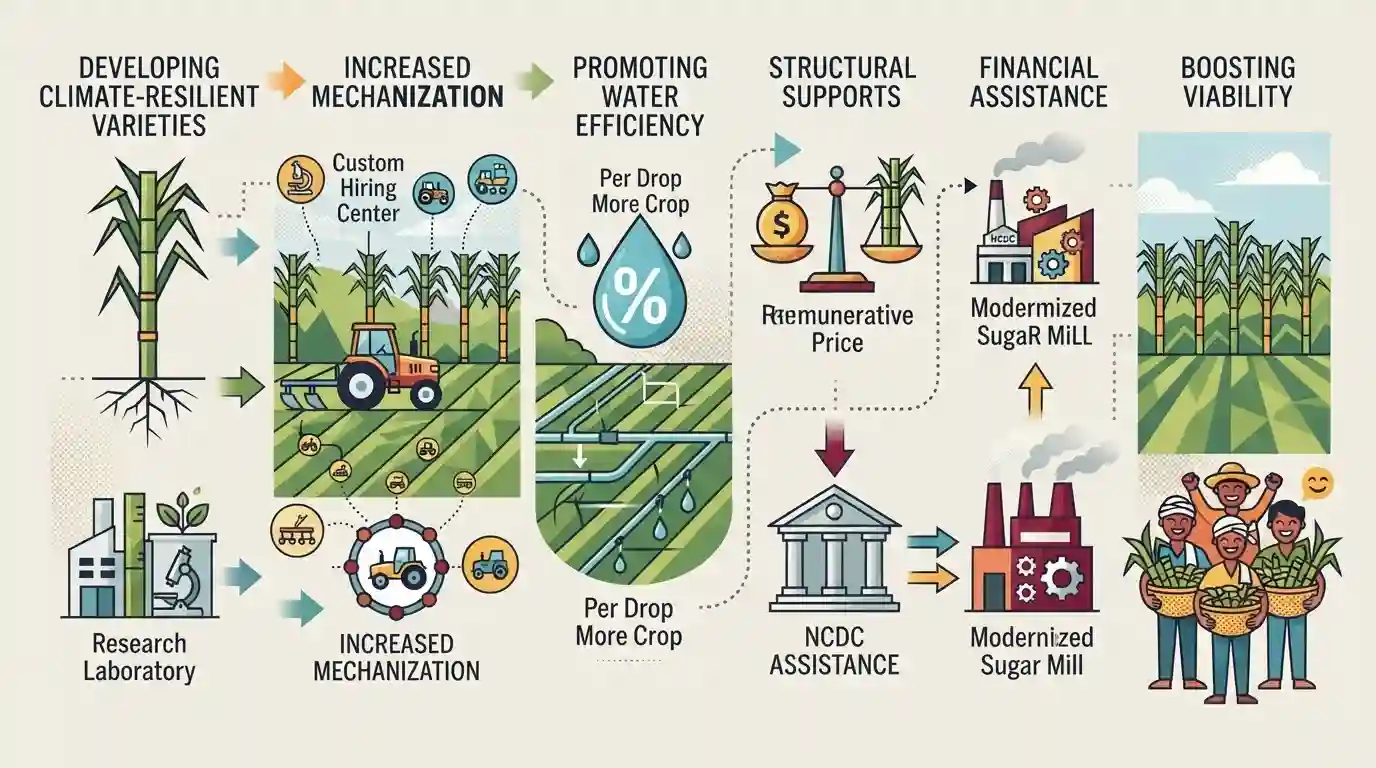
In a written reply to the Lok Sabha, the Union Government detailed the multi-pronged strategies aimed at boosting sugarcane cultivation in Andhra Pradesh. These measures include developing climate-resilient and high-yielding crop varieties via the ICAR-Sugarcane Breeding Institute, increasing farm mechanization through Custom Hiring Centers under RKVY-SMAM, and promoting water-use efficiency through subsidized micro-irrigation under the Per Drop More Crop (PDMC) scheme. The government also emphasized structural supports such as fixing the Fair and Remunerative Price (FRP) on the advice of the CACP and extending financial assistance through the NCDC to revive cooperative sugar mills, thereby enhancing the overall viability of sugarcane farming.
Key Points
- The ICAR-Sugarcane Breeding Institute has introduced 'Co 09004', a new early maturing, high-yielding sugarcane variety resistant to red-rot and smut, specifically suited for Andhra Pradesh.
- Under the Rashtriya Krishi Vikas Yojana (RKVY) and its Sub Mission on Agricultural Mechanization (SMAM), Custom Hiring Centers have been set up to facilitate farmer access to modern agricultural machinery.
- The Per Drop More Crop (PDMC) scheme improves water-use efficiency by subsidizing micro-irrigation systems, providing a 55% subsidy for small/marginal farmers and a 45% subsidy for others.
- To safeguard farmer incomes, the Central Government fixes the Fair and Remunerative Price (FRP) of sugarcane based on CACP recommendations under the Sugarcane (Control) Order, 1966.
Important Terms
Fair and Remunerative Price (FRP)

The minimum price at which sugar mills are legally mandated to purchase sugarcane from farmers, determined by the central government based on CACP recommendations.
UPSC context
GS Paper III (Agriculture/Pricing Policy); crucial for understanding agricultural subsidies, pricing mechanisms, and farmer welfare.
Commission for Agricultural Costs and Prices (CACP)
An attached office of the Ministry of Agriculture & Farmers Welfare that recommends Minimum Support Prices (MSPs) and FRPs for designated crops to ensure price stability.
UPSC context
GS Paper III (Agriculture); tests mechanisms of crop pricing, agricultural economics, and price incentives for farmers.
Sugarcane (Control) Order, 1966
A statutory order issued under the Essential Commodities Act, 1955, regulating sugarcane pricing, distribution, and the payment framework (such as FRP) to protect growers.
UPSC context
GS Paper III (Government Policies/Agriculture); evaluates regulatory frameworks governing commercial crops and supply chain interventions.
Rashtriya Krishi Vikas Yojana (RKVY)
A centrally sponsored scheme launched in 2007 to ensure holistic agricultural development by giving states flexibility to plan and execute customized farm rejuvenation programs.
UPSC context
GS Paper III (Government Schemes/Agriculture); key for studying cooperative federalism in agriculture and public investment strategies.
Per Drop More Crop (PDMC)
A flagship scheme focusing on water-use efficiency at the farm level by promoting micro-irrigation systems like drip and sprinkler irrigation under RKVY.
UPSC context
GS Paper III (Irrigation/Water Management); tests concepts of climate-resilient agriculture, precision farming, and resource conservation.
Sub Mission on Agricultural Mechanization (SMAM)
A government initiative aimed at promoting farm mechanization, especially among small and marginal farmers, by establishing Custom Hiring Centres and distributing modern farm machinery.
UPSC context
GS Paper III (Agriculture/Mechanization); crucial for evaluating technological interventions in farming, land fragmentation challenges, and farm productivity.
Prelims Trap
The Fair and Remunerative Price (FRP) of sugarcane is declared under the same administrative, non-statutory MSP framework as foodgrains.
Aspirants often assume all major crop support prices share the same legal framework. However, standard MSP has no statutory backing, whereas sugarcane's FRP is legally mandated under the Sugarcane (Control) Order, 1966.
Static Concepts Connected
What is the regulatory and pricing framework for sugarcane in India?
- FRP Determination: FRP is recommended by the Commission for Agricultural Costs and Prices (CACP) and approved by the Cabinet Committee on Economic Affairs (CCEA).
- Statutory Backing: Unlike regular MSP, the FRP is legally enforceable under the Sugarcane (Control) Order, 1966, issued under the Essential Commodities Act, 1955.
- FRP vs SAP: State governments often declare a State Advised Price (SAP), which is generally higher than the Central FRP, causing pricing disputes.
Why is sugarcane cultivation shifting from Northern to Peninsular India?
- Higher Sucrose Content: The tropical maritime climate in the south prevents early flowering, resulting in a higher sucrose yield per ton of cane.
- Longer Crushing Season: The tropical climate ensures a longer crushing period compared to the restricted winter-dominated season of Northern India.
- Cooperative Efficiency: Cooperative sugar mills are better managed and financially structured in the southern and western states.
Cross-Topic Patterns
Water-guzzling crops & micro-irrigation mandate
Connects water-guzzling sugarcane cultivation with mandatory micro-irrigation (PDMC) to resolve groundwater depletion in key peninsular river basins like the Krishna and Godavari.
Cooperative sugar federalism and NCDC
Examines the interaction between Central funding (via NCDC) and cooperative sugar mills, highlighting federal dynamics under the Ministry of Cooperation and State-list cooperative laws.

2026 Prelims will likely contrast the statutory backing of sugarcane's FRP under the ECA 1955 with the non-statutory nature of regular MSP.
Linked PYQs · 2
Linked PYQs · 2
- 2023APPSC_PRELIMSGS1
Which of the following factors are responsible for the higher Sugarcane production in tropical regions as compared to sub-tropical regions of India ? I. Cool nights with clear skies II. Latitudinal position III. Long hours of sunshine IV. High temperature disparity Choose the correct answer using the codes given below :
- 2019APPSC_PRELIMSGS1
To enhance food security and to make Indian Agriculture more resilient to climate change, which programme was started in 2011-12?
