Tribunals Reforms Legislation and Separation of Powers Debate
Source:Indian Express ↗
Why It Matters
Tribunals form a vital pillar of alternative dispute resolution and administrative justice. Legislative reforms affecting their composition, tenure, and autonomy directly impact the separation of powers, judicial independence, and efficiency in case management.
Summary
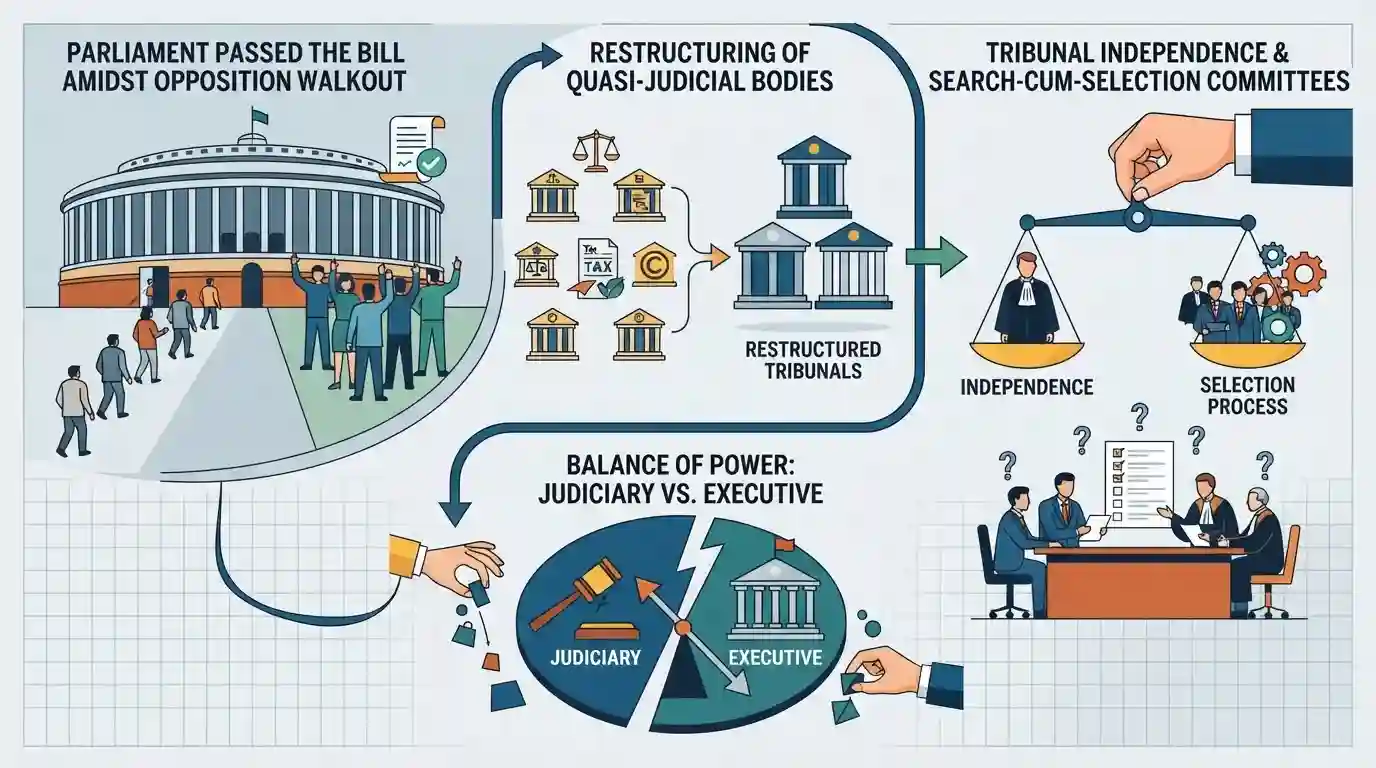
The Parliament passed the Tribunals Reforms Bill amidst an opposition walkout, raising key questions regarding the restructuring of quasi-judicial bodies, tribunal independence, search-cum-selection committees, and the balance of power between the judiciary and the executive.
Key Points
- Parliament passed the Tribunals Reforms Bill amid opposition walkout.
- The legislation aims to restructure and reform various tribunals in the country, impacting their functioning, qualification of members, and term conditions.
- Concerns have been raised regarding judicial independence, the separation of powers, and the dilution of oversight through legislative changes in tribunal structures.
Important Terms
Tribunals Reforms Bill

Legislative measures enacted to restructure quasi-judicial bodies, standardize service conditions, tenures, and appointment processes for tribunals across India, balancing executive oversight with judicial independence.
UPSC context
UPSC Polity & Governance (GS Paper II): Tests structural reforms, separation of powers, and executive-judiciary friction regarding quasi-judicial tribunals.
National Tribunals Commission
A statutory body established to oversee tribunal administration, appointments, and service conditions independently, reducing executive interference in quasi-judicial adjudicatory bodies.
UPSC context
UPSC GS Paper II (Polity & Governance): Essential for questions on tribunal independence, judicial governance, and institutional bodies.
Search-cum-Selection Committees
Specialized panels responsible for screening and recommending candidates for tribunal appointments, whose composition remains a key battleground between judicial independence and executive control.
UPSC context
UPSC GS Paper II (Structure and Functioning of Judiciary): Tests transparency, appointment mechanisms, and separation of powers.
Prelims Trap
Tribunals are constitutional bodies created under the direct superintendence of the Supreme Court with exclusive judicial personnel.
Aspirants often assume tribunals are purely judicial bodies; however, they are statutory quasi-judicial bodies created under Article 323A or 323B, and their members include both judicial and administrative experts.
Static Concepts Connected
What are the constitutional provisions and key features of tribunals in India? (Articles 323A & 323B)
- Article 323A: Article 323A empowers Parliament to provide for the establishment of administrative tribunals for public service matters.
- Article 323B: Article 323B enables Parliament and state legislatures to establish tribunals for other matters like taxation, foreign exchange, industrial and labor disputes, etc.
- Constitutional Basis: Added by the 42nd Constitutional Amendment Act, 1976, to reduce pendency and speed up adjudication in specialized domains.
- Judicial Review: L. Chandra Kumar case (1997) ruled that High Courts retain power of judicial review over tribunal decisions under Articles 226/227.
Cross-Topic Patterns
Tribunals Reform vs. Separation of Powers
Executive dominance in tribunal appointments directly challenges Article 50 (separation of judiciary from executive), echoing past Supreme Court rulings on judicial independence.
Tribunal Rationalization vs. High Court Pendency
The abolition and merger of pre-existing appellate bodies shifts subject-matter adjudication back to High Courts, impacting judicial pendency and writ jurisdictions under Article 226.

Expect a multi-statement prelims question on the Search-cum-Selection Committee composition or Article 323B provisions for tribunals.
Linked PYQs · 3
Linked PYQs · 3
- 2025MainsGS2
Comment on the need of administrative tribunals as compared to the court system. Assess the impact of the recent tribunal reforms through rationalization of tribunals made in 2021.
- 2016MainsGS2
What is a quasi-judicial body? Explain with the help of concrete examples.
- 2020MainsGS2
Recent amendments to the Right to Information Act will have profound impact on the autonomy and independence of the Information Commission". Discuss.
