Tribunals Reforms Legislation and Judicial Independence Debate
Source:Indian Express ↗
কেন এটি গুরুত্বপূর্ণ
The functioning, appointment processes, and term structures of tribunals directly impact judicial independence, case pendency relief, and the separation of powers between the executive and the judiciary.
সারসংক্ষেপ
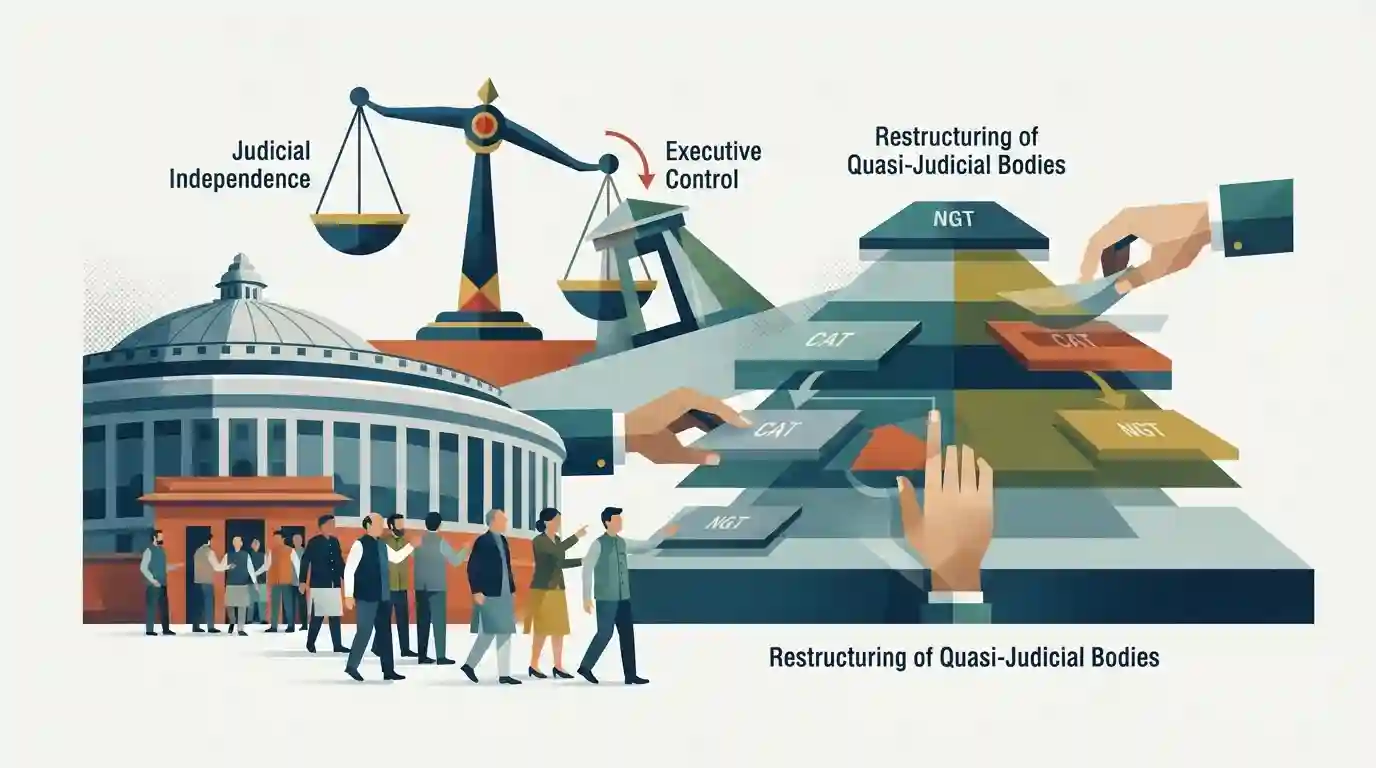
The passage of the Tribunals Reforms Bill in Parliament amidst an opposition walkout has reignited debates concerning judicial independence, the separation of powers, and the restructuring of quasi-judicial bodies in India.
মূল বিষয়
- Parliament passed the Tribunals Reforms Bill amidst opposition walkout.
- The legislation deals with the rationalization and regulation of conditions of service of members of various tribunals.
- Critics and opposition raised concerns regarding judicial independence, separation of powers, and the dilution of institutional checks.
- Tribunals play a critical role in reducing backlog of regular courts and providing specialized adjudication.
গুরুত্বপূর্ণ শব্দ
Tribunals Reforms Bill

A legislative measure aimed at streamlining quasi-judicial bodies, modifying service conditions, tenure, and search-cum-selection committees for tribunal members in India.
UPSC context
UPSC GS Paper II: Polity and Governance – Structure, organization, and functioning of the Judiciary and Executive, and related institutional issues.
Parliament
The supreme legislative body of India consisting of the President, Lok Sabha, and Rajya Sabha, responsible for enacting laws and holding the executive accountable.
UPSC context
UPSC GS Paper II: Indian Constitution—historical underpinnings, evolution, features, amendments, significant provisions, and basic structure.
Supreme Court
The apex judicial court of India under the Constitution, possessing original, appellate, and advisory jurisdiction, and acting as the guardian of the Constitution.
UPSC context
UPSC GS Paper II: Structure, organization, and functioning of the Judiciary; judicial review and judicial activism.
প্রিলিমস ফাঁদ
Tribunals under Articles 323A and 323B were part of the original text of the Constitution framed by the Constituent Assembly.
Articles 323A and 323B were not part of the original Constitution; they were introduced via the 42nd Constitutional Amendment Act, 1976.
সংযুক্ত স্থির ধারণা
What are Articles 323A and 323B of the Constitution regarding Tribunals?
- Article 323A: Article 323A empowers Parliament to provide for administrative tribunals for adjudication of disputes relating to recruitment and conditions of service of public servants.
- Article 323B: Article 323B empowers the Legislature to establish tribunals for other matters such as taxation, foreign exchange, industrial labor, and land reforms.
- Constitutional Basis: Added by the 42nd Constitutional Amendment Act, 1976, creating a separate tier of specialized quasi-judicial dispute resolution bodies outside the strict hierarchy of regular courts.
আন্তঃবিষয় প্যাটার্ন
Tribunals Reforms vs. Administrative Governance
Tribunals reforms intersect directly with the Public Administration syllabus regarding regulatory governance, administrative discretion, and the tension between executive control and independent regulatory bodies.
Judicial Review vs. Parliamentary Supremacy
Successive tribunal legislations struck down by the Supreme Court test the limits of parliamentary sovereignty vis-à-vis the Basic Structure doctrine.

Tribunals reforms + Supreme Court jurisprudence on judicial independence will likely be tested via a statement-based polity question.
সংযুক্ত PYQ · 1
সংযুক্ত PYQ · 1
- 2025MainsGS2
Comment on the need of administrative tribunals as compared to the court system. Assess the impact of the recent tribunal reforms through rationalization of tribunals made in 2021.
