Tribunals Reforms Legislation and Judicial Independence Debate
Source:Indian Express ↗
Why It Matters
Tribunal reforms directly impact the speedy delivery of justice, administrative efficiency, and the constitutional balance of power between the executive and the judiciary.
Summary
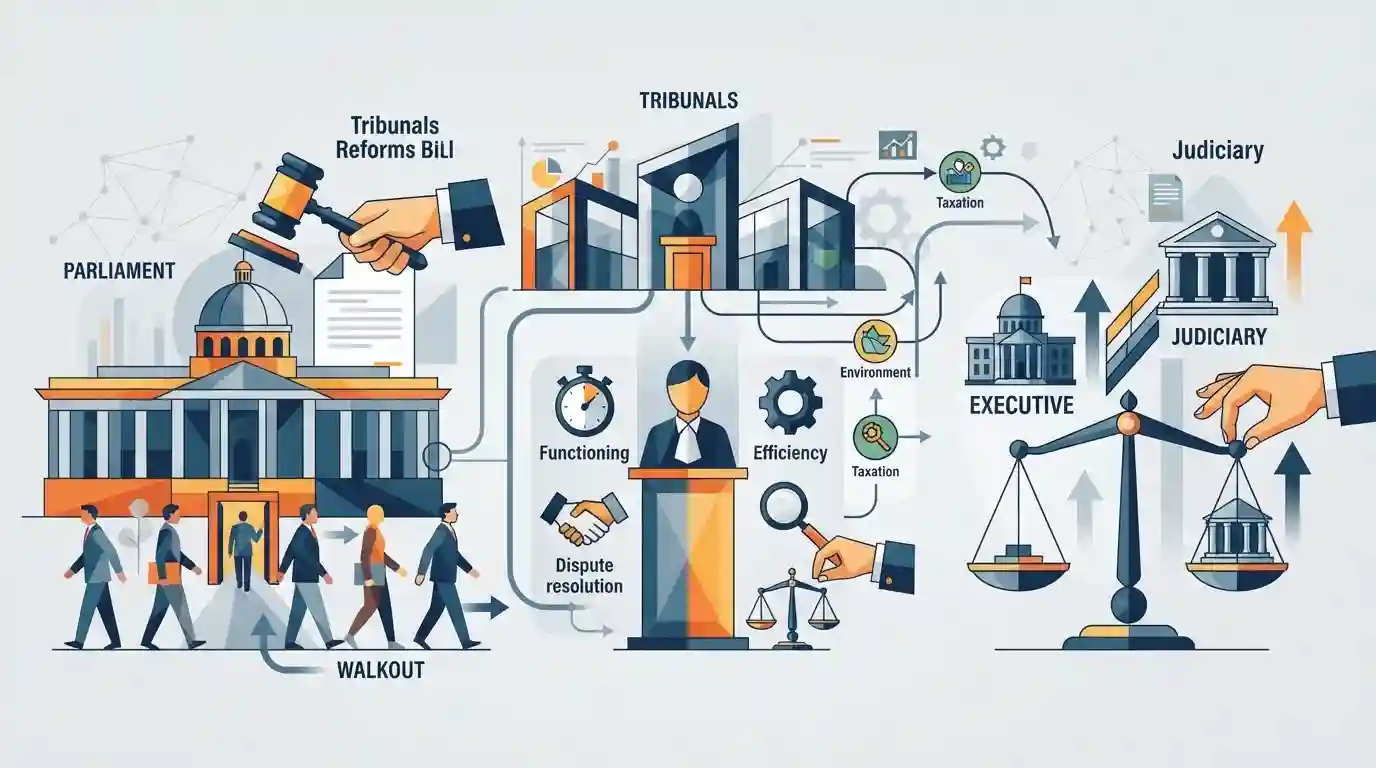
The Parliament has passed the Tribunals Reforms Bill amid opposition walkouts, bringing significant changes to the functioning, appointment processes, and service conditions of various tribunals across the country, which remains a key area of discussion concerning judicial independence and administrative justice.
Key Points
- Parliament passed the Tribunals Reforms Bill amidst an opposition walkout.
- The legislation deals with the restructuring, conditions of service, and term limits of members of various tribunals in India.
- Tribunal reforms often face intense debate regarding judicial independence, the separation of powers, and the executive's role in appointments.
Important Terms
Tribunals Reforms Bill

Legislative measure altering the appointment processes, service conditions, and functioning of various tribunals, often addressing concerns regarding judicial independence and executive oversight.
UPSC context
GS Paper II - Polity and Governance; tests understanding of administrative justice, separation of powers, and tribunal reforms.
Parliament
The supreme legislative body of India comprising the President and the two Houses (Lok Sabha and Rajya Sabha).
UPSC context
GS Paper II - Indian Constitution and Polity; tests legislative process, parliamentary oversight, and constitutional powers.
Supreme Court
The highest judicial forum and final court of appeal under the Constitution of India, possessing powers of judicial review.
UPSC context
GS Paper II - Judiciary and Judicial Review; tests the apex court's role in safeguarding constitutionalism and checking executive overreach.
Prelims Trap
Article 323A empowers both Parliament and State Legislatures to establish tribunals for public service matters.
Aspirants often assume Article 323A and 323B tribunals can be set up by both Parliament and State Legislatures alike, whereas 323A permits only Parliament to create administrative tribunals.
Static Concepts Connected
What are the constitutional provisions and key differences between Articles 323A and 323B of the Indian Constitution?
- Scope difference: Article 323A deals exclusively with Administrative Tribunals for public service matters of the Centre or States, whereas 323B covers tribunals for other subjects like taxation, industrial disputes, and foreign exchange.
- Enacting authority: Article 323A empowers only Parliament to establish tribunals, whereas both Parliament and State Legislatures can establish tribunals under Article 323B depending on their legislative competence.
- Hierarchy rule: Article 323A permits the establishment of only one central tribunal and one for each state or two or more states, whereas Article 323B allows a hierarchy of tribunals.
Cross-Topic Patterns
Tribunal Reforms vs. Separation of Powers
The executive's role in tribunal appointments and service conditions directly challenges Article 50 (Separation of Judiciary from Executive) and the basic structure doctrine.

Executive overreach in tribunal appointments vs. judicial independence will be tested via Articles 323A/323B and past Supreme Court rulings.
Linked PYQs · 2
Linked PYQs · 2
- 2025MainsGS2
Comment on the need of administrative tribunals as compared to the court system. Assess the impact of the recent tribunal reforms through rationalization of tribunals made in 2021.
- 2023MainsGS2
“Constitutionally guaranteed judicial independence is a prerequisite of democracy.” Comment.
