Repealing and Amending Bill Scraps Seventy One Obsolete Laws
Source:The Hindu ↗
Why It Matters
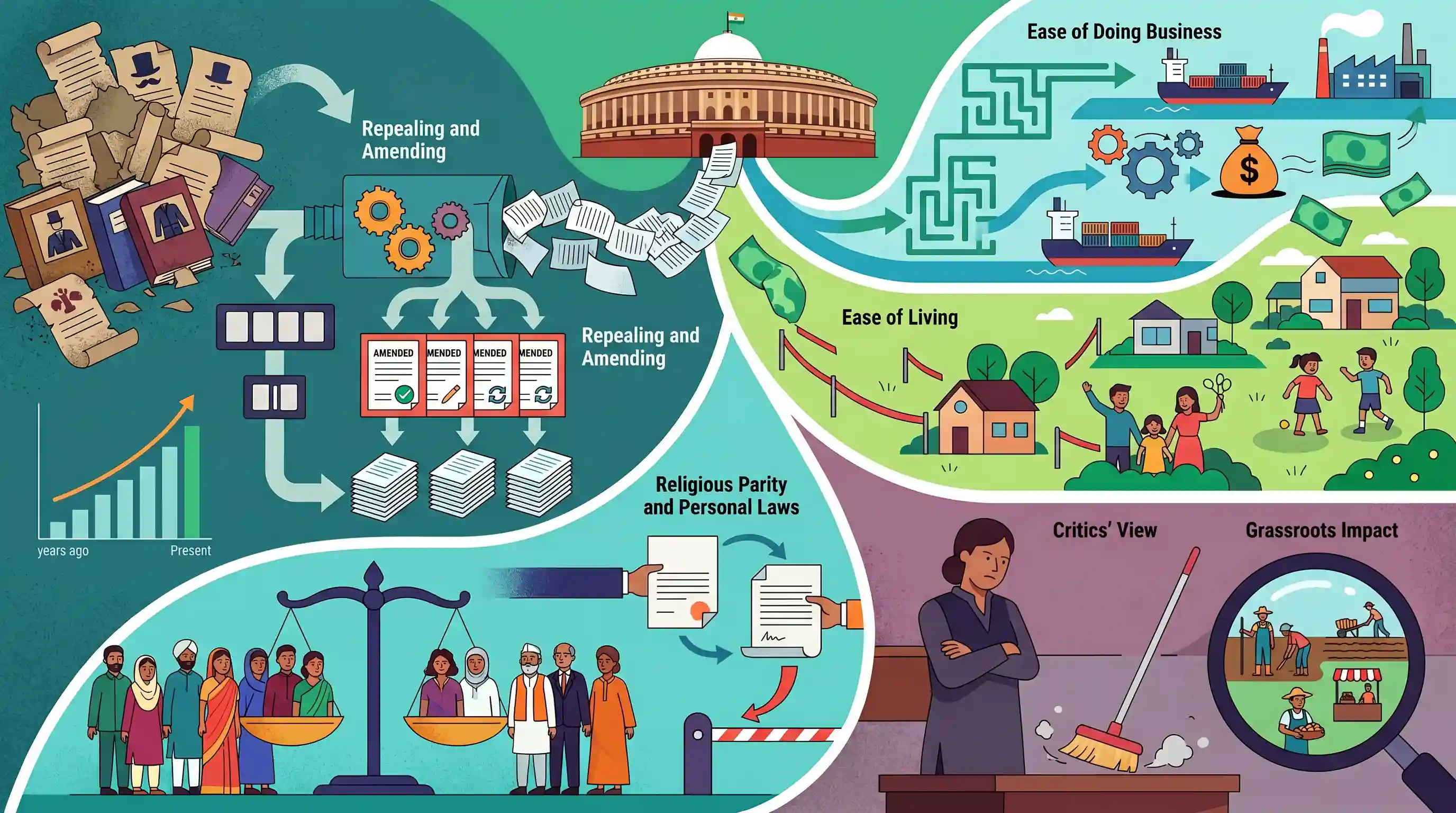
The continuous repeal of colonial-era and obsolete legislation highlights the government's approach towards minimal governance, administrative efficiency, and legal rationalization. The specific amendment to the Indian Succession Act touches upon the core UPSC themes of religious parity, personal laws, and secularism, acting as a stepping stone towards the discourse on a Uniform Civil Code.
Summary
Parliament has passed the Repealing and Amending Bill, 2025, effectively repealing 71 obsolete laws and amending four others to declutter the statute books and discard colonial-era legacies. Driven by the Union Law Ministry, the legislation seeks to improve the 'ease of living' and 'ease of doing business' by removing archaic provisions, bringing the total number of repealed outdated laws to over 1,500 since 2014. A major highlight is the amendment to the Indian Succession Act, 1925, which eliminates a discriminatory mandate requiring non-Muslims to probate wills in former presidency towns, thereby promoting religious parity in civil procedures. While the government frames this as a significant step toward modern governance, critics argue it is merely administrative housekeeping with minimal grassroots impact.
Key Points
- Parliament passed the Repealing and Amending Bill, 2025 to repeal 71 obsolete Acts and amend four existing laws, aiming to reduce statutory clutter.
- Since 2014, the government has successfully repealed or amended over 1,577 archaic and colonial-era laws to promote ease of living and doing business.
- A significant amendment targets the Indian Succession Act, 1925, abolishing the discriminatory requirement for Hindus, Buddhists, Sikhs, Jains, and Parsis to probate wills in the erstwhile Madras, Bombay, and Calcutta presidencies (a mandate from which Muslims were exempt).
- Other amended frameworks include the General Clauses Act, 1897, the Code of Civil Procedure, 1908, and the Disaster Management Act, 2005.
- The Opposition criticized the move as largely administrative 'paperwork', arguing it lacks substantial on-ground impact on the everyday lives of citizens.
Important Terms
Repealing and Amending Bill, 2025

A periodic legislative tool used to discard obsolete laws and correct technical errors in existing statutes to maintain a current legal framework.
UPSC context
Relevant for GS Paper II (Governance/Legislative Process); tests knowledge of legal reforms and administrative streamlining.
Probate
The legal process by which a court validates a will; recently made optional in former presidency towns to reduce litigation and promote religious parity.
UPSC context
GS Paper II (Social Justice/Personal Laws); critical for questions on the Uniform Civil Code or civil procedure reforms.
Indian Succession Act, 1925
A consolidated law governing inheritance and wills; its 2025 amendment removes a colonial-era probate requirement that discriminated based on religion and geography.
UPSC context
GS Paper II (Judiciary/Governance); focuses on legal parity and the removal of colonial-era legacies.
Indian Tramways Act, 1886
An 1886 statute regulating tramways; its repeal signifies the removal of outdated colonial laws that have outlived their utility in modern infrastructure.
UPSC context
GS Paper II (Governance); used as an example of "statutory deadwood" in administrative reform discussions.
Levy Sugar Price Equalisation Fund Act, 1976
A 1976 law originally establishing a fund for uniform sugar pricing; repealed as part of the 2025 "decluttering" of the statute book.
UPSC context
GS Paper III (Economy/Food Processing); shows transition from controlled to market-oriented regulatory frameworks.
General Clauses Act, 1897
A fundamental act providing interpretation rules for Indian laws; amended in 2025 to update terminology (e.g., "speed post") for modern administration.
UPSC context
GS Paper II (Legislative Procedures); illustrates how technical amendments modernize day-to-day governance.
Minimum Government, Maximum Governance
A governance approach prioritizing simplified laws, reduced compliance, and citizen-centric reforms to enhance efficiency and transparency.
UPSC context
GS Paper II (Governance); a core theme for essays and questions on administrative reforms since 2014.
Prelims Trap
The 2025 amendment achieves parity by making probate mandatory for Muslims alongside other religions.
It achieves parity by abolishing the mandatory probate requirement for non-Muslims in erstwhile presidency towns, rather than imposing a new mandate on Muslims.
Static Concepts Connected
How does a Repealing and Amending Act function in India?
- Legislative Nature: It is an ordinary bill passed by a simple majority, designed solely to remove obsolete or redundant laws from the statute books.
- Saving Clause: It typically includes a saving clause ensuring that any prior actions, rights, or liabilities created under the repealed laws remain legally valid.
What is a 'Probate' in the context of succession and personal laws?
- Definition: A copy of a will formally certified by a court of competent jurisdiction, legally confirming the document's authenticity.
- Executor Authority: It legally establishes the authority of the executor named in the will to administer the deceased's estate and distribute the assets.
Cross-Topic Patterns
Personal law parity and the UCC
Removing religious disparity in probate requirements aligns with Article 44's vision for a Uniform Civil Code, serving as a concrete example of incremental civil law standardization for Mains answers.
Decolonisation of statutory frameworks
Repealing colonial-era regulations parallels the transition from the IPC to the Bharatiya Nyaya Sanhita, reflecting a broader governance theme of easing compliance and discarding imperial legacies.

The Indian Succession Act amendment and 'probate' parity could feature as a multi-statement Prelims question on civil law reforms or the UCC.
Linked PYQs · 4
Linked PYQs · 4
- 2015MainsGS2
Discuss the possible factors that inhibit India from enacting for its citizens a uniform civil code as provided for in the Directive Principles of State Policy.
- 2018MainsGS1
How the Indian concept of secularism is different from the western model of secularism? Discuss.
- 2024MainsGS2
Discuss India as a secular state and compare with the secular principles of the US constitution.
- 2024MainsGS3
What is disaster resilience? How is it determined? Describe various elements of a resilience framework. Also mention the global targets of Sendai Framework for Disaster Risk Reduction (2015–2030).
