Repealing And Amending Act 2025 Streamlines Laws To Aid Ease Of Living
Source:The Hindu ↗
Why It Matters
The systematic repeal of obsolete laws is a critical ongoing governance reform in India. For UPSC aspirants, citing this drive (over 1,500 laws repealed since 2014) is highly relevant for GS2 Mains answers on 'minimum government, maximum governance', decolonization of the Indian legal system, and institutional quality. The specific correction in the Indian Succession Act also serves as a strong example of addressing legislative discrimination to uphold fundamental equality.
Summary
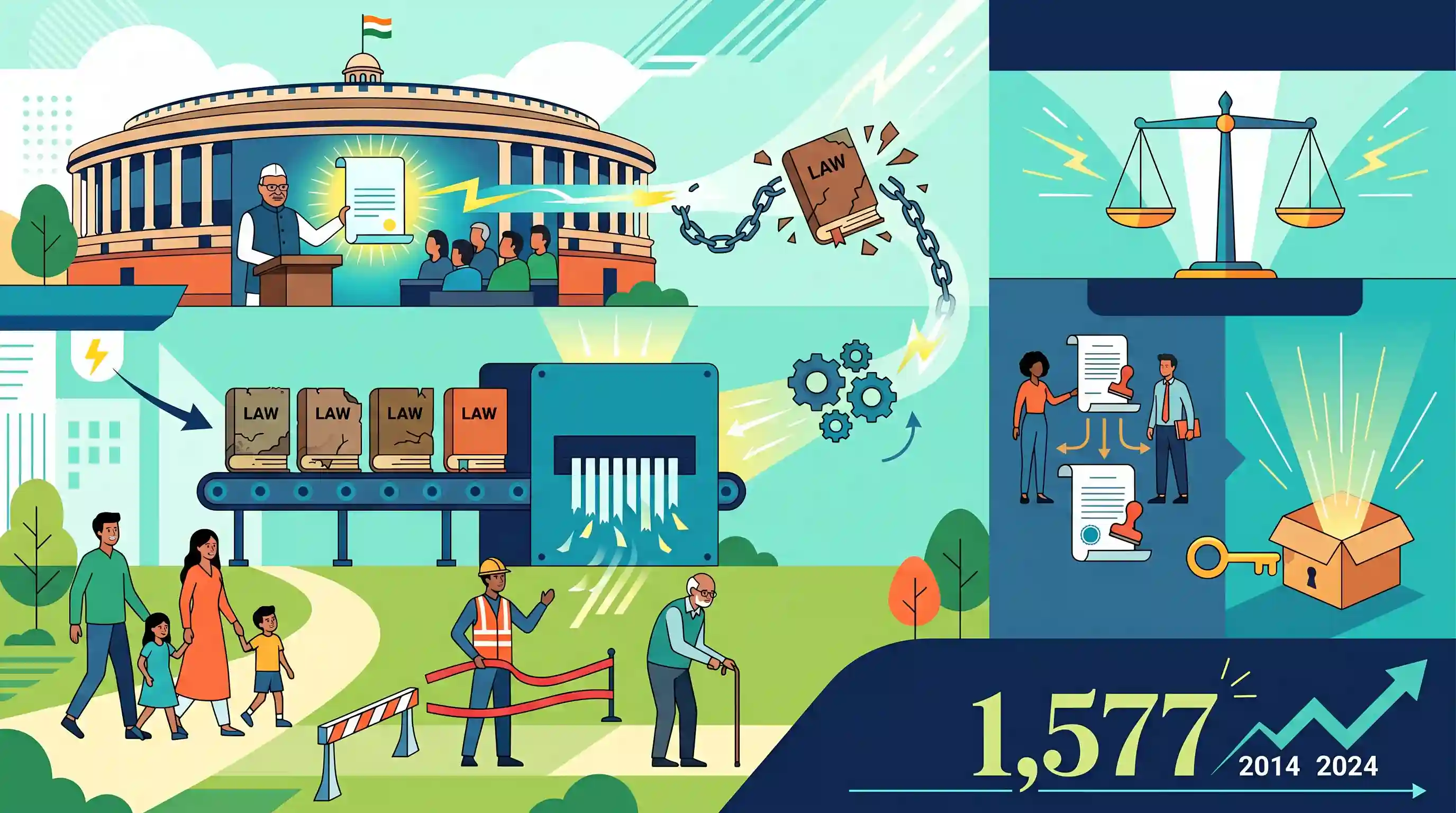
The Indian Parliament has successfully passed the Repealing and Amending Bill, 2025, to scrap 71 obsolete laws and amend four others. Piloted by Law Minister Arjun Ram Meghwal, the legislation aims to declutter the statute books, remove discriminatory provisions, and promote the 'ease of living' by discarding laws rooted in a colonial mindset. Notably, it amends the Indian Succession Act of 1925 to eliminate the mandatory probate of wills for certain communities, addressing constitutional concerns of equality. Since 2014, the government has repealed 1,577 archaic statutes.
Key Points
- Parliament passed the Repealing and Amending Bill, 2025, which strikes down 71 obsolete laws and amends four existing acts.
- The move is part of an ongoing drive since 2014 that has repealed or amended 1,577 archaic laws to shed the 'colonial mindset'.
- The core objectives are to simplify the legal framework, rectify drafting errors, and enhance the 'ease of living' for citizens.
- A key amendment applies to the Indian Succession Act, 1925, removing the discriminatory requirement for mandatory validation (probate) of wills for Hindus, Buddhists, Jains, and Sikhs in certain jurisdictions.
Important Terms
Repealing and Amending Act, 2025

Legislation passed to scrap 71 obsolete laws and amend four others, aiming to declutter the statute book and remove redundant colonial-era regulations.
UPSC context
Relevant for GS Paper II (Governance and Legislative Process); tests understanding of statutory reforms and 'Minimum Government, Maximum Governance'.
Indian Succession Act, 1925
A century-old law governing testamentary succession; its 2025 amendment removes the mandatory 'probate' requirement for specific communities in erstwhile presidency towns to ensure equality.
UPSC context
GS Paper II (Social Justice/Constitution); pertains to removing discriminatory provisions and achieving uniform civil standards.
Probate
A court-certified copy of a will that establishes its authenticity and the executor's authority; its mandatory requirement was scrapped for certain communities to reduce litigation.
UPSC context
GS Paper II (Governance); tests knowledge of procedural reforms that simplify legal compliance for citizens.
Ease of Living
A governance philosophy focused on simplifying regulations, reducing compliance burdens, and digitizing services to improve the daily life of citizens.
UPSC context
GS Paper II (Governance/Government Policies); a core theme for questions on administrative reforms and citizen-centric governance.
General Clauses Act, 1897
An 1897 statute that provides standard definitions and rules for interpreting Indian laws; recently amended to modernize terminology, such as replacing 'registered post' with 'speed post'.
UPSC context
GS Paper II (Legislative Process); demonstrates how technical laws are updated to reflect modern administrative practices.
Archaic Statutes
Laws that have lost relevance due to social, economic, or technological changes but remain on statute books; 1,577 such laws have been repealed since 2014.
UPSC context
GS Paper II (Judiciary/Governance); tests the rationale behind 'statutory clean-up' and its impact on judicial efficiency.
Prelims Trap
Obsolete laws that are not enforced for a long period automatically lapse under the doctrine of desuetude.
India does not follow the doctrine of 'desuetude' (automatic lapse through disuse). Outdated statutes remain fully in force until Parliament explicitly repeals them.
Static Concepts Connected
How does the Indian Constitution govern the repeal of laws?
- Source of power: The power to repeal is derived from Article 245, the exact same constitutional provision that grants Parliament and State Legislatures the power to enact laws.
- Symmetrical authority: The power to repeal a statute is inherent in the power to make it. No separate or special constitutional article is required to strike down a law.
- Doctrine of Desuetude: Indian laws do not automatically lapse through disuse. They require explicit repeal by Parliament via a Repealing Act or an Ordinance.
What is a 'probate' under Indian succession law?
- Legal definition: A legally certified copy of a will granted by a competent court, officially establishing the document's validity and the executor's authority.
- Historical context: Previously, certain communities (Hindus, Parsis, etc.) were mandatorily required to obtain a probate only in colonial presidency towns (Kolkata, Madras, Mumbai).
- Equal protection: The 2025 amendment scraps this mandatory, geography-based probate requirement for specified communities, addressing Article 14 (Right to Equality) concerns.
Cross-Topic Patterns
Decolonizing Indian laws: Criminal to Civil
The drive to repeal obsolete civil statutes parallels the recent overhaul of criminal codes (BNS, BNSS, BSA), reflecting a broader governance shift to decolonize the legal system and improve ease of living.
Sendai Framework and DM Act terminology
Amending the DM Act's wording from 'prevention' to 'preparation' aligns with the Sendai Framework's emphasis on readiness and resilience, acknowledging that natural hazards cannot always be entirely prevented.

Expect a Prelims statement testing the 'doctrine of desuetude' alongside Article 245, contrasting explicit legislative repeal with automatic lapses.
Linked PYQs · 3
Linked PYQs · 3
- 2023MainsGS2
e-governance, as a critical tool of governance, has ushered in effectiveness, transparency and accountability in governments. What inadequacies hamper the enhancement of these features ?
- 2020MainsGS2
Institutional quality is a crucial driver of economic performance". In this context suggest reforms in Civil Service for strengthening democracy.
- 2021PrelimsGS1
Under the Indian Constitution, concentration of wealth violates
