Parliament Passes Legislation to Rename Kerala as Keralam
Source:The Hindu ↗
Why It Matters
The renaming of a state is a direct application of Article 3 of the Constitution, providing a contemporary example of how boundaries and names of states are altered. It highlights the federal procedural mechanisms, specifically the requirement for the President to refer the Bill to the State legislature for its views before Parliamentary approval, which is crucial for Polity and Governance topics.
Summary
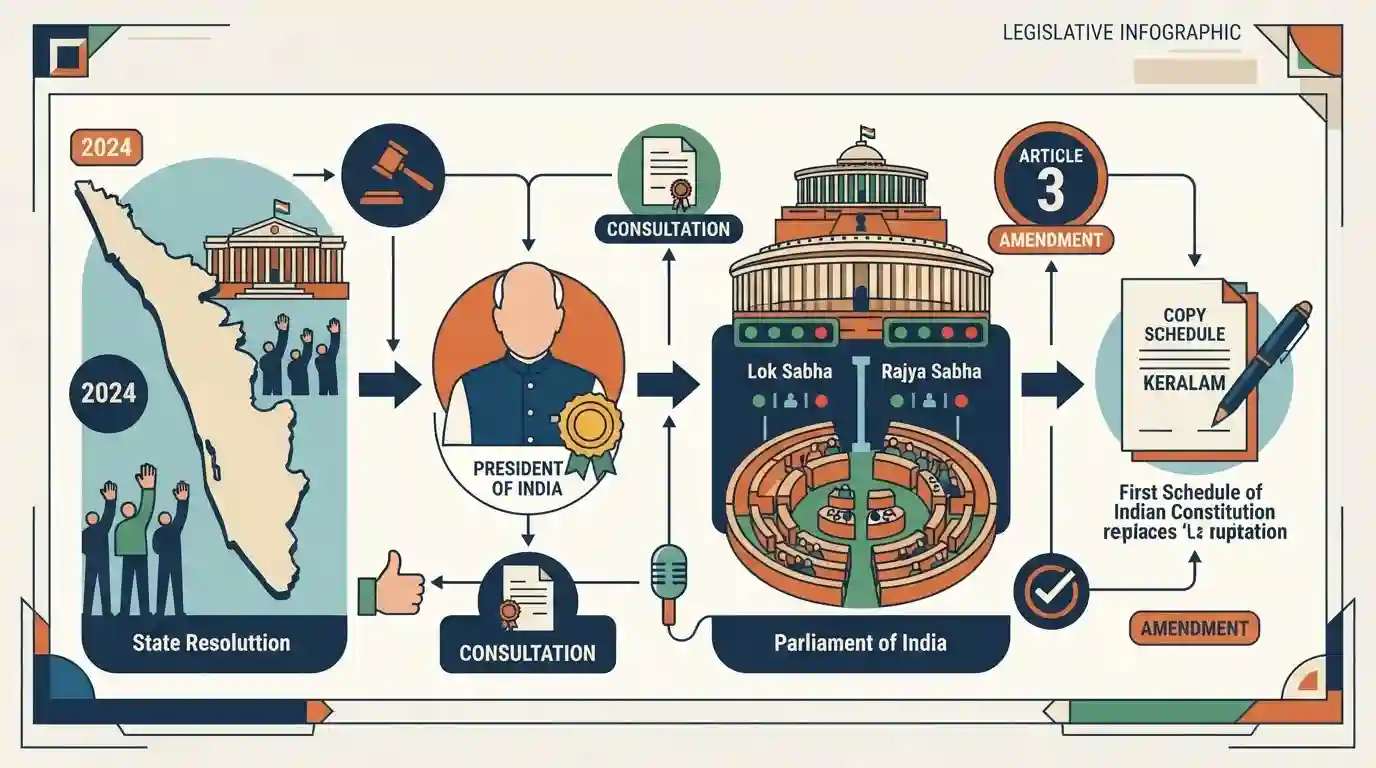
Parliament has successfully passed the Kerala (Alteration of Name) Bill, 2026, officially changing the name of the state from Kerala to Keralam. The legislative process followed the provisions of Article 3 of the Constitution, beginning with a unanimous resolution by the Kerala Assembly in 2024. The President of India then referred the Bill back to the state legislature for its views before it was cleared by both the Lok Sabha and Rajya Sabha. The Bill effectively amends the First Schedule of the Constitution to reflect the new name.
Key Points
- Parliament has passed the Kerala (Alteration of Name) Bill, 2026, officially renaming the State from Kerala to Keralam.
- The process was initiated by a unanimous resolution passed by the Kerala State Assembly in June 2024 urging the Central Government to bring forth the change.
- In accordance with Article 3 of the Constitution, the President of India referred the Bill to the State legislature for its views prior to its passage in Parliament.
- The legislation amends the First Schedule of the Constitution to formally record the State's new name.
Important Terms
Article 3

A constitutional provision that empowers the Parliament of India to form new states, alter areas, boundaries, or rename existing states, highlighting the centralizing feature of Indian federalism.
UPSC context
GS Paper II (Indian Polity). Tests concepts of state reorganisation, federalism, and the distribution of power between the Centre and states.
First Schedule
A schedule of the Constitution of India that lists all the states and union territories, specifying their names and corresponding territorial jurisdictions.
UPSC context
GS Paper II (Indian Constitution). Tests knowledge of constitutional schedules, federal territorial boundaries, and amendments regarding state lists.
Kerala (Alteration of Name) Bill, 2026
A legislative bill passed by Parliament in 2026 to change the official name of the State of Kerala to 'Keralam,' amending the First Schedule of the Constitution.
UPSC context
GS Paper II (State Reorganisation). Tests the application of state reorganisation laws, legislative procedures, and linguistic identity politics.
Kerala Legislative Assembly
The unicameral state legislature of Kerala which passed unanimous resolutions in 2024 and endorsed a Presidential reference, paving the way for the state's renaming.
UPSC context
GS Paper II (State Legislature). Tests the procedural role of state assemblies in expressing views during reorganisation under Article 3.
Parliament of India
The supreme legislative authority of the country, consisting of the President, Lok Sabha, and Rajya Sabha, holding the exclusive power to alter state names under Article 3.
UPSC context
GS Paper II (Parliamentary Procedures). Tests knowledge of legislative supremacy, passage of bills, and federal legislative mechanisms.
Prelims Trap
A Bill altering the name of a State requires a special majority under Article 368 as it amends the First Schedule.
Article 4 explicitly states that laws renaming states (amending the First Schedule under Article 3) are passed by simple majority and are not considered constitutional amendments under Article 368.
Static Concepts Connected
What is the constitutional procedure for altering state names and boundaries under Article 3?
- Presidential recommendation: The bill can only be introduced in Parliament with the prior recommendation of the President.
- State consultation: The President must refer the bill to the concerned state legislature for its views within a specified timeframe.
- Non-binding views: Parliament is not bound by the views of the state legislature and can proceed regardless of its feedback.
- Simple majority: Under Article 4, such laws are passed by simple majority and are not deemed Article 368 constitutional amendments.
Cross-Topic Patterns
Federalism and unitary bias
Article 3 showcases India's character as an 'indestructible Union of destructible states', allowing Parliament to modify regional boundaries without binding consent from state assemblies.
Linguistic identity and renaming
Renaming states to match vernacular pronunciation connects Article 3 procedures with Article 29 cultural rights and Eighth Schedule linguistic representation.

Prelims 2026 will likely test the non-binding nature of state views under Article 3 and the Article 4 simple-majority bypass.
Linked PYQs · 3
Linked PYQs · 3
- 2024PrelimsGS1
As per Article 368 of the Constitution of India, the Parliament may amend any provision of the Constitution by way of : 1. Addition 2. Variation 3. Repeal Select the correct answer using the code given below:
- 2024MainsGS2
What changes has the Union Government recently introduced in the domain of Centre-State relations ? Suggest measures to be adopted to build the trust between the Centre and the States and for strengthening federalism.
- 2025PrelimsGS1
Consider the following subjects under the Constitution of India : I. List I-Union List, in the Seventh Schedule II. Extent of the executive power of a State III. Conditions of the Governor's office For a constitutional amendment with respect to which of the above, ratification by the Legislatures of not less than one-half of the States is required before presenting the bill to the President of India for assent?
