Maritime infrastructure legislative reforms and cooperative federalism
Source:The Hindu ↗
Why It Matters
The article highlights a major legislative reform in India's port infrastructure governance while also illustrating the practical dynamics of Parliamentary functioning, disruptions, and the use of procedural tools like adjournment motions. These are highly relevant for both GS2 (Polity and Governance) and GS3 (Infrastructure/Economy).
Summary
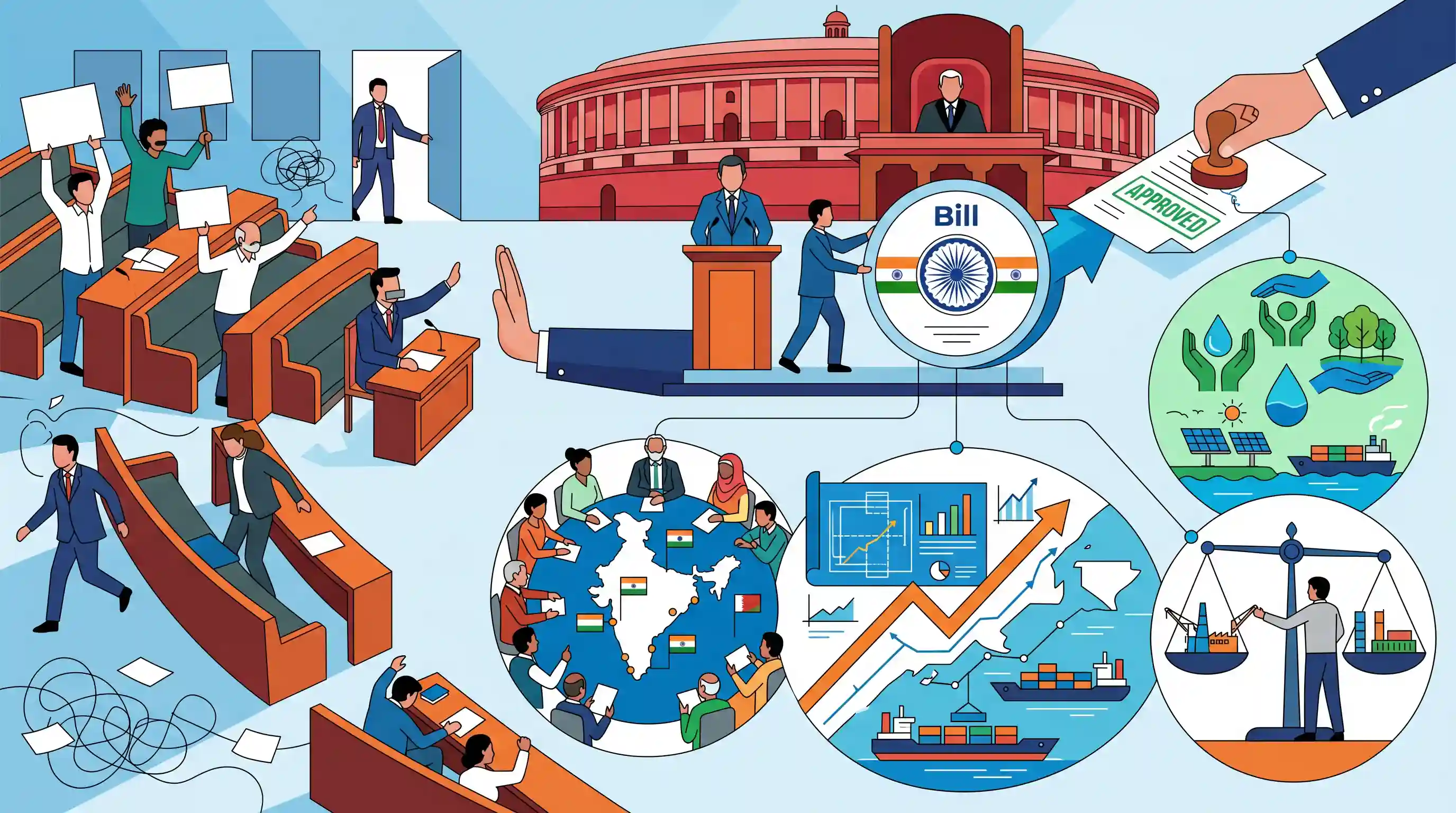
The Rajya Sabha passed the Indian Ports Bill, 2025, to overhaul India's maritime infrastructure by replacing the 1908 colonial-era legislation. The Bill introduces the Maritime State Development Council and mandates long-term national planning, environmental safeguards, and dispute resolution for ports. However, the legislative proceedings were marred by protests, walkouts, and rejected adjournment notices by the Opposition, primarily concerning the Special Intensive Revision of voters' lists in Bihar and alleged silencing of the Leader of the Opposition.
Key Points
- The Rajya Sabha passed the Indian Ports Bill, 2025, which replaces the archaic Indian Ports Act of 1908 to reposition the maritime sector for a modern ecosystem.
- The Bill establishes the Maritime State Development Council to recommend growth strategies, promote efficiency, and foster cooperative federalism in port operations.
- Key provisions include empowering the Union government to notify new ports, alter port limits, and devise a national perspective plan for maritime trade.
- The Opposition boycotted the debate and staged a walkout demanding a discussion on the Special Intensive Revision (SIR) of Bihar's voter list.
- Rajya Sabha proceedings witnessed disruptions as 19 adjournment notices were rejected by the Deputy Chairman, and the Leader of the Opposition's microphone was muted for raising sub judice matters.
Important Terms
Indian Ports Bill, 2025

Legislation modernizing maritime governance by replacing the 1908 Act. It empowers statutory bodies, mandates environmental compliance (MARPOL), and establishes a framework for "cooperative federalism" in managing major and non-major ports.
UPSC context
GS Paper 3 (Infrastructure) and GS Paper 2 (Federalism). Tests knowledge of maritime reforms and Centre-State distribution of powers.
Maritime State Development Council (MSDC)
A statutory consultative body chaired by the Union Ports Minister. It coordinates national maritime development between the Centre and States, advising on infrastructure strategies, connectivity, and national port planning.
UPSC context
GS Paper 2 (Statutory Bodies/Federalism). Focuses on inter-governmental coordination and institutional frameworks for economic infrastructure.
Special Intensive Revision (SIR)
A comprehensive door-to-door verification and house-to-house enumeration process by the Election Commission (under RPA 1950) to clean electoral rolls by removing deceased, shifted, or duplicate voters.
UPSC context
GS Paper 2 (Electoral Reforms/Constitutional Bodies). Tests understanding of the ECI's powers and integrity of the democratic process.
Indian Ports Act of 1908
The colonial-era law that governed Indian ports for over 117 years. It lacked modern provisions for integrated planning, private participation, and strict environmental safeguards found in the 2025 replacement.
UPSC context
GS Paper 1 (Modern Indian History) and GS Paper 3. Useful for analyzing legislative evolution from colonial to modern governance.
Rajya Sabha
The Upper House of India's Parliament representing States/UTs. It acts as a permanent chamber and revising body, scrutinizing legislation and providing a platform for federal debate and executive oversight.
UPSC context
GS Paper 2 (Parliament). Focuses on legislative procedures, the role of the Opposition, and the federal structure of Parliament.
State Maritime Boards (SMBs)
Statutory state-level bodies formally recognized by the 2025 Bill to administer and regulate "non-major" ports. They oversee planning, infrastructure development, licensing, and safety/environmental compliance within coastal states.
UPSC context
GS Paper 2 (Federalism/Devolution). Tests knowledge of State autonomy in managing Concurrent List subjects like non-major ports.
Prelims Trap
Non-major ports fall exclusively under the State List.
While 'Major Ports' are under the Union List (Entry 27), 'Non-Major Ports' are actually in the Concurrent List (Entry 31), even though they are administered by State Maritime Boards.
Static Concepts Connected
How is legislative jurisdiction over ports divided in the 7th Schedule?
- Union List: Entry 27 covers 'Major Ports', including their declaration and the constitution of port authorities, giving the Centre exclusive domain.
- Concurrent List: Entry 31 covers 'Ports other than major ports'. Thus, minor/intermediate ports fall under concurrent jurisdiction, though practically administered by states.
How do disruption notices in Rajya Sabha differ from the Lok Sabha?
- Adjournment Motion: Available strictly in the Lok Sabha. It involves an element of censure against the government for a recent matter of urgent public importance.
- Rule 267: Specific to the Rajya Sabha. It allows a member to move for the suspension of listed business to discuss a pressing issue, but without implying censure.
Cross-Topic Patterns
Ports + Cooperative Federalism
Elevating the Maritime State Development Council to a statutory body highlights a trend of using institutional frameworks to manage Centre-State friction in infrastructure, similar to the GST Council in taxation.
Infrastructure + Marine Pollution
The Bill explicitly incorporates MARPOL and the Ballast Water Management Convention, linking domestic port modernization directly to GS-3 marine environment and international treaties.

7th Schedule jurisdiction of non-major ports (Concurrent List) paired with the new statutory status of the MSDC is a prime 2026 target.
Linked PYQs · 2
Linked PYQs · 2
- 2025MainsGS3
Why is maritime security vital to protect India's sea trade? Discuss maritime and coastal security challenges and the way forward.
- 2023MainsGS2
Discuss the role of Presiding Officers of state legislatures in maintaining order and impartiality in conducting legislative work and in facilitating best democratic practices.
