Parliament passes Transgender Persons Amendment Bill amid protests
Source:The Hindu ↗
Why It Matters
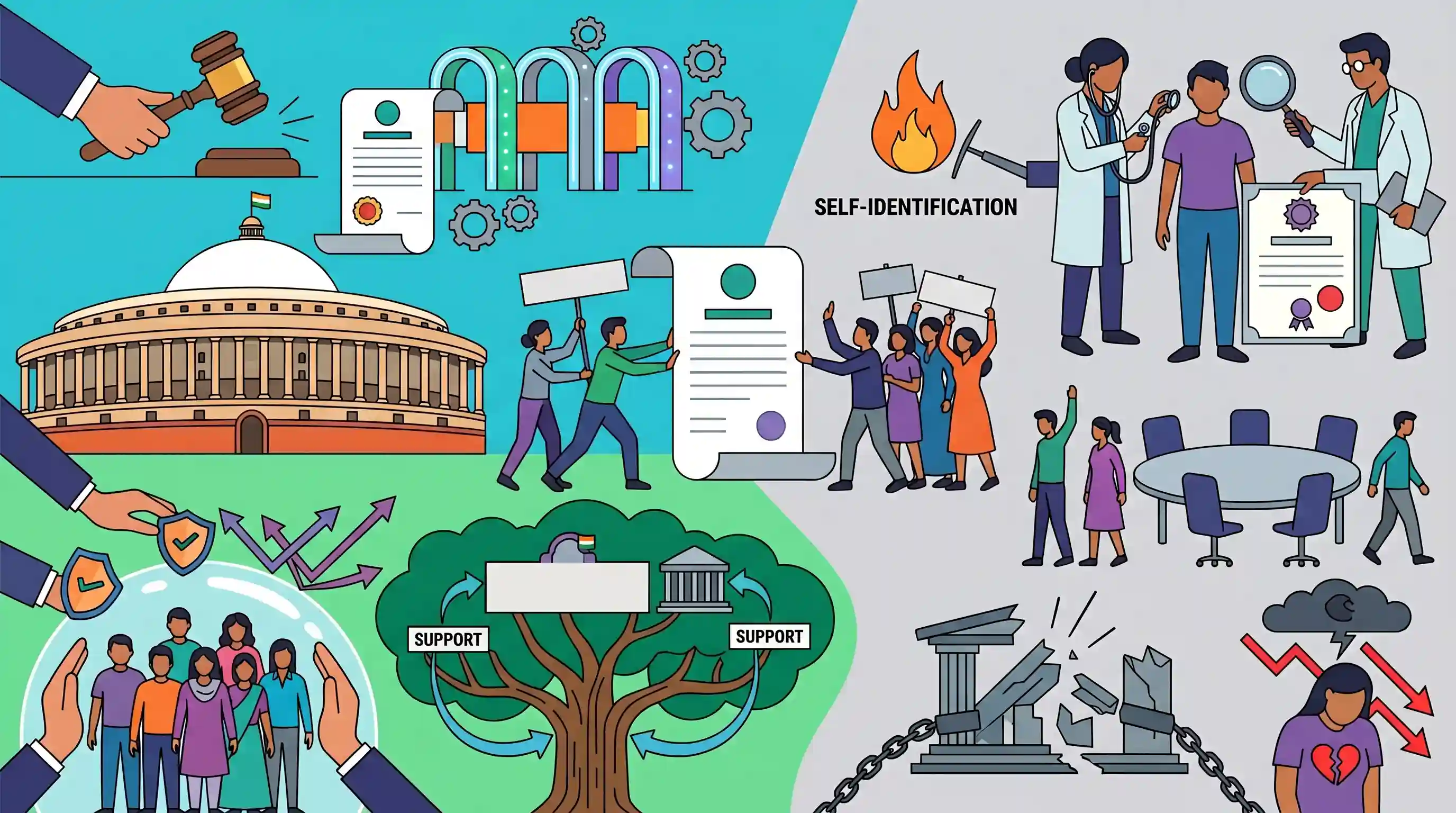
The passage of the Transgender Persons Amendment Bill 2026 highlights ongoing tensions between state-prescribed medical boards for gender identification versus the principle of self-identification. It underscores the challenges in formulating inclusive policies for marginalized communities and reflects the dynamics of legislative scrutiny in Parliament.
Summary
Parliament has passed the Transgender Persons (Protection of Rights) Amendment Bill, 2026, amidst strong opposition demands to refer it to a Select Committee. The government argued the Bill is necessary to protect transgender persons from discrimination and highlighted the establishment of transgender welfare boards across states. However, critics assert the legislation takes away the right to self-identification by forcing individuals to undergo medical evaluation for gender certification. The controversy led to the resignation of two members from the National Council for Transgender Persons, with opposition MPs highlighting poor implementation of existing laws and high suicide rates within the community.
Key Points
- Parliament passed the Transgender Persons (Protection of Rights) Amendment Bill, 2026, despite Opposition protests.
- The Opposition demanded the Bill be sent to a Select Committee, arguing it compromises the dignity and right to self-identification of transgender individuals by requiring medical board certification.
- Union Minister Virendra Kumar defended the Bill as a protective measure against discrimination and noted that transgender welfare boards have been set up in over 30 states.
- Two members of the National Council for Transgender Persons resigned in protest against the "regressive" nature of the Bill.
- Critics highlighted severe socio-economic challenges faced by the community, including high suicide rates and extremely low rates of obtaining gender certificates under current frameworks.
Important Terms
Transgender Persons (Protection of Rights) Amendment Bill 2026

A 2026 legislative proposal mandating medical board evaluation for gender certification and narrowing the 'transgender' definition, reversing the previous emphasis on self-identification.
UPSC context
GS Paper II: Social Justice; tests understanding of legislative changes affecting vulnerable sections and constitutional rights.
Transgender Persons (Protection of Rights) Act, 2019
The 2019 framework providing legal recognition and prohibiting discrimination against transgender persons in education, employment, and healthcare, though criticized for requiring DM-issued certificates.
UPSC context
GS Paper II: Governance and Welfare Schemes; core legislation for protecting rights of marginalized communities.
National Council for Transgender Persons
A statutory body established in 2020 to advise the Central Government on transgender policies, monitor implementation, and redress grievances of the community.
UPSC context
GS Paper II: Statutory Bodies; tests knowledge of institutional mechanisms for social justice.
NALSA Judgment (2014)
A 2014 landmark Supreme Court ruling that recognized transgender persons as the 'third gender' and upheld their fundamental right to self-perceived gender identity.
UPSC context
GS Paper II: Judiciary and Fundamental Rights; essential case law for civil rights and equality.
Select Committee
A temporary parliamentary committee formed to conduct a detailed, clause-by-clause examination of a specific Bill before it is passed by the House.
UPSC context
GS Paper II: Parliament; tests understanding of the legislative process and parliamentary oversight.
Right to Self-Identification
The constitutional principle (affirmed in NALSA) that an individual’s gender identity is an innate perception of self, independent of biological or medical verification.
UPSC context
GS Paper II: Fundamental Rights (Articles 14, 19, 21); explores the tension between state regulation and individual autonomy.
Prelims Trap
The NALSA judgment mandates certification from a District Medical Board for the legal recognition of transgender identity.
The NALSA (2014) judgment explicitly upheld self-determination of gender under Article 21 WITHOUT requiring medical intervention. It is the subsequent legislative Acts that introduced controversial certification hurdles.
Static Concepts Connected
What did the Supreme Court establish in the landmark NALSA (2014) judgment?
- Third Gender: Legally recognized transgender persons as a 'third gender' eligible for fundamental rights and affirmative action.
- Self-Determination: Ruled that gender identity is integral to personal liberty under Article 21, entirely independent of medical or surgical intervention.
- Non-Discrimination: Extended Article 14 and 15 protections to the transgender community, strictly prohibiting discrimination based on gender identity.
How does a Select Committee differ from a Joint Parliamentary Committee (JPC)?
- Single House Origin: Select Committees consist of members drawn from only one House, whereas JPCs include members from both the Lok Sabha and Rajya Sabha (usually in a 2:1 ratio).
- Ad-hoc Nature: Both are temporary (ad hoc) committees formed under Article 118 to examine specific Bills or investigate issues, dissolving once their report is submitted.
Cross-Topic Patterns
Self-determination vs State Verification
The clash between NALSA's self-identification and the Bill's medical board requirement mirrors the broader rights-vs-verification tension seen in disability certification and Aadhaar-linked welfare schemes.
Statutory Councils under MoSJE
The NCTP's structure (chaired by the Union Minister) is a classic UPSC mapping target, parallel to the Central Advisory Board on Disability and the National Council for Senior Citizens.

Expect a 2026 Prelims question contrasting the NALSA judgment's self-identification principle with the statutory medical board requirements.
Linked PYQs · 2
Linked PYQs · 2
- 2023MainsGS2
Explain the constitutional perspectives of Gender Justice with the help of relevant Constitutional Provisions and case laws.
- 2021MainsGS2
Do Department-related Parliamentary Standing Committees keep the administration on its toes and inspire reverence for parliamentary control? Evaluate the working of such committees with suitable examples.
