Road Safety Governance And Constitutional Failures Under Article 21
Source:Indian Express ↗
Why It Matters
The article provides a unique and powerful constitutional perspective on road safety. Framing road crash prevention under Article 21 (Right to Life) and proposing a GST Council-like federal mechanism to bridge Seventh Schedule gaps are excellent, high-scoring arguments for GS2 (Polity/Federalism) and GS3 (Infrastructure/Safety) questions.
Summary
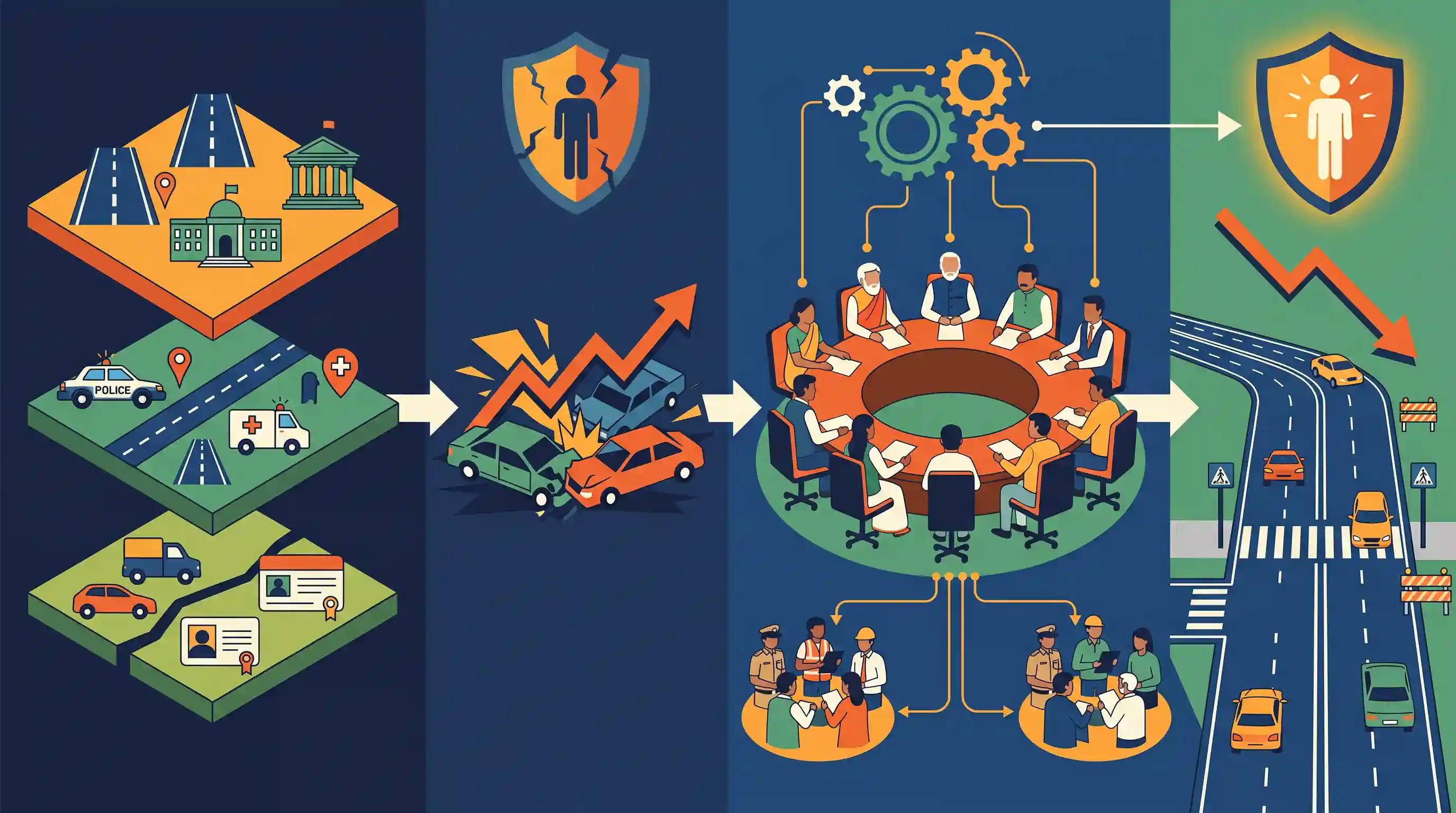
The article argues that India's staggering road fatality rate is a constitutional and governance failure rather than individual misfortune. Because road accidents are human failures and preventable, the author asserts they violate Article 21 (Right to Life) as ruled in S. Rajaseekaran v. Union of India (2014). To overcome the jurisdictional fragmentation of the Seventh Schedule (where highways, policing, public health, and vehicles are divided between Central, State, and Concurrent lists), the author proposes creating a federal 'Road Safety Coordination Council' based on the GST Council model, along with structural legislative reforms to empower local District Road Safety Committees.
Key Points
- Inconsistencies in road safety data for 2024 are prominent, with three official figures: MoRTH (1.77 lakh deaths), NCRB's ADSI (1.75 lakh), and NCRB's 'Crime in India' (1.81 lakh), showing an unexplained variance of nearly 6,000 lives.
- Despite a relatively low share of global vehicles, India suffers more road crash fatalities than any other nation in the world.
- In S. Rajaseekaran v. Union of India (2014), the Supreme Court emphasized the 'Four Es' of road safety (Engineering, Enforcement, Education, and Emergency Care), holding that preventable road deaths constitute a direct violation of the Right to Life under Article 21 of the Constitution.
- The root cause of policy paralysis is constitutional fragmentation within the Seventh Schedule: national highways belong to the Centre; state roads, police, and public health belong to states; and motor vehicles are in the Concurrent List. This jurisdictional overlap prevents unified accountability.
- Proposed constitutional solutions include creating a 'Road Safety Coordination Council' modeled on the GST Council (101st Constitutional Amendment Act) to collaboratively decide standards, amending the Seventh Schedule to centralize legislative authority over traffic, and statutorily mandating District Road Safety Committees.
Important Terms
Constitution of India (Seventh Schedule, Article 21)

Article 21 guarantees the fundamental Right to Life, which includes safe travel. The Seventh Schedule divides legislative powers (Union, State, and Concurrent Lists), dividing road governance among multiple jurisdictions.
UPSC context
GS Paper II (Polity & Constitution); tests federal structure, division of powers, and judicial expansion of fundamental rights.
S. Rajaseekaran v. Union of India (2014)
A landmark Supreme Court case where road safety was recognized under Article 21, leading to the creation of a Committee on Road Safety and directives for systemic reforms.
UPSC context
GS Paper II (Judiciary & Governance); tests judicial activism and the enforceability of citizens' right to safe roads.
101st Constitutional Amendment Act
The 2016 amendment that introduced the Goods and Services Tax (GST) and established the GST Council, serving as a successful model for cooperative federalism.
UPSC context
GS Paper II (Federalism) & III (Economy); tests fiscal federalism and collaborative decision-making bodies.
Crashfree India
A multi-stakeholder national initiative aimed at achieving zero road traffic fatalities through evidence-based research, systemic reforms, behavioral change, and infrastructure audits.
UPSC context
GS Paper III (Infrastructure & Security); tests solutions to public safety challenges and private-public partnerships in governance.
National Crime Records Bureau (NCRB)
A central agency under the Ministry of Home Affairs responsible for collecting and analyzing crime data, including road traffic accidents, to aid policy formulation.
UPSC context
GS Paper II & III (Internal Security & Governance); tests data-driven policing and administrative mechanisms in India.
Ministry of Road Transport and Highways (MoRTH)
The apex Central ministry responsible for formulating and administering laws and policies related to road transport, national highways, and overall road safety in India.
UPSC context
GS Paper III (Infrastructure & Governance); tests policymaking in the transport sector and infrastructure development strategies.
Prelims Trap
The power to levy taxes on motor vehicles is a concurrent power under Entry 35 of List III of the Seventh Schedule.
Entry 35 of the Concurrent List only allows the Centre to lay down the underlying principles of taxation for motor vehicles. The exclusive power to levy and collect actual taxes on vehicles belongs to the States under Entry 57 of the State List.
Static Concepts Connected
How is transport governance divided under the Seventh Schedule?
- Union List (Entry 23): National Highways fall under exclusive Union jurisdiction.
- State List: Police, public health, sanitation, and state roads are state subjects.
- Concurrent List (Entry 35): Mechanically propelled vehicles and their taxation principles are concurrent subjects.
What are the key statutory road safety mechanisms under the Motor Vehicles Act?
- National Road Safety Board: Created to advise Central and State governments on road design and vehicle standards.
- District Road Safety Committees: Statutory district-level bodies designed to audit accident blackspots and coordinate local emergency responses.
- Golden Hour Care: Mandates cashless treatment for all road accident victims during the critical golden hour.
Cross-Topic Patterns
GST Council model for social sectors
Proposing a GST-style joint federal council for road safety shows how fiscal federal structures can be adapted to solve jurisdictional coordination deadlocks in public services.
Article 21 and governance obligations
Judicial expansion of Article 21 to cover road safety reflects a growing jurisprudence of positive state obligations, linking basic infrastructure directly to human rights.

The operationalization of Article 21 via statutory road safety bodies and Seventh Schedule overlaps is a high-probability GS-2 2026 theme.
Linked PYQs · 2
Linked PYQs · 2
- 2023MainsGS2
“The Constitution of India is a living instrument with capabilities of enormous dynamism. It is a constitution made for a progressive society.” Illustrate with special reference to the expanding horizons of the right to life and personal liberty.
- 2015MainsGS2
The concept of cooperative federalism has been increasingly emphasized in recent years. Highlight the drawbacks in the existing structure and the extent to which cooperative federalism would answer the shortcomings.
