Registration of Births and Deaths Amendment Bill and Voter Rolls
Source:The Hindu ↗
Why It Matters
The shift of authority from executive to judicial magistrates for delayed registrations reflects a significant administrative reform. Furthermore, the goal of cleaning up electoral rolls to eliminate 'ghost voters' links this seemingly routine administrative act directly to election integrity, a key topic under Representation of People's Act and constitutional democracy.
Summary
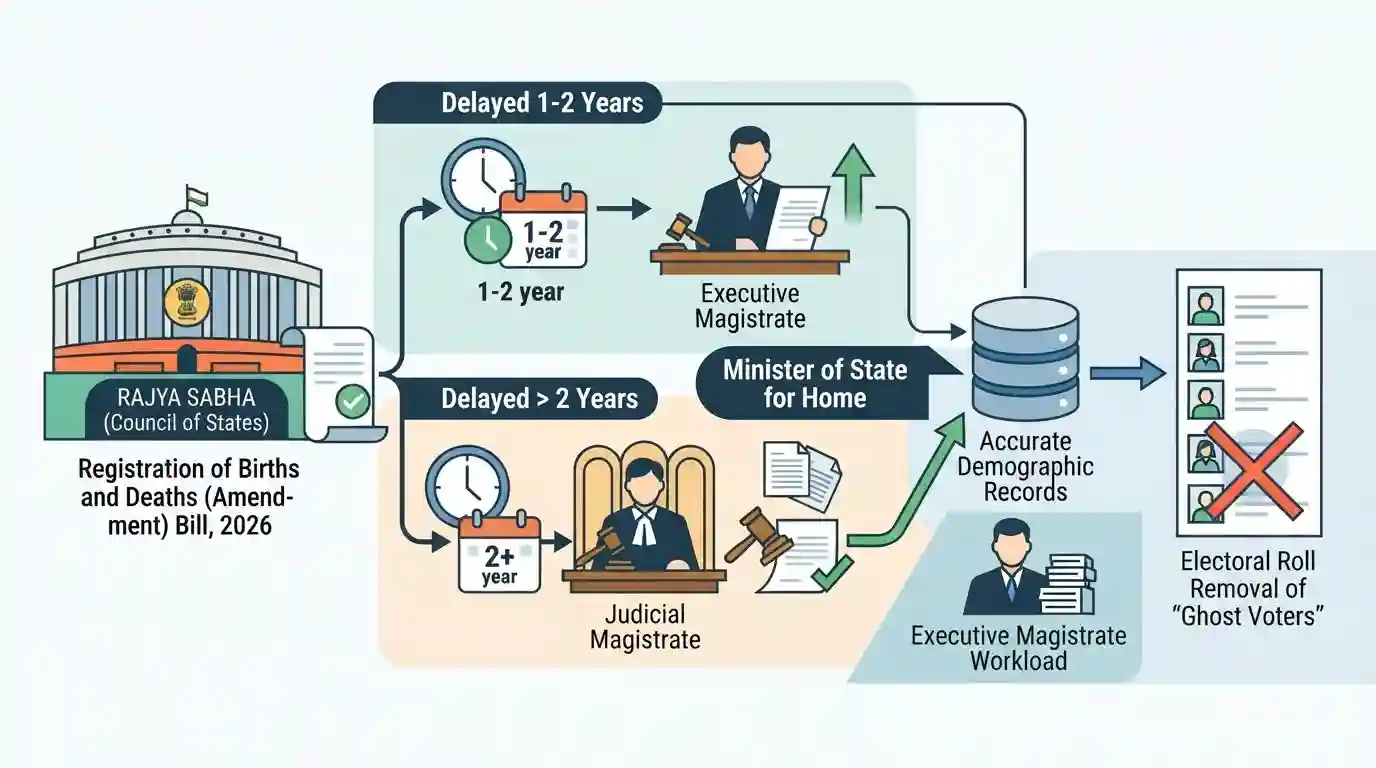
The Rajya Sabha passed the Registration of Births and Deaths (Amendment) Bill, 2026, which introduces changes to the procedures for registering delayed births and deaths. Specifically, for registrations delayed by more than two years, the Bill mandates authorization from a judicial magistrate (first class). The existing provision allowing executive magistrates to authorize registrations delayed by one to two years remains unchanged. Union Minister of State for Home Nityanand Rai noted that the amendment will alleviate the workload on executive magistrates and help maintain accurate demographic records, importantly aiding in the removal of 'ghost voters' from electoral rolls by ensuring all deaths are recorded.
Key Points
- Rajya Sabha passed the Registration of Births and Deaths (Amendment) Bill, 2026 during the Monsoon Session.
- The Bill shifts the authority to authorize delayed registrations (beyond two years) of births and deaths to judicial magistrates (first class).
- For delays between one and two years, executive magistrates, district magistrates, or sub-divisional magistrates will continue to issue the required orders.
- The amendment aims to reduce the administrative burden on executive magistrates and improve demographic data accuracy.
- A key objective highlighted by the government is ensuring deceased individuals are removed from electoral rolls, eliminating 'ghost voters'.
Important Terms
Registration of Births and Deaths (Amendment) Bill, 2026

A legislative bill passed by Parliament that introduces a stringent, two-tier system for delayed registrations, requiring a Judicial Magistrate First Class's authorization for reporting delays exceeding two years.
UPSC context
GS Paper II: Government Policies & Interventions. Tests understanding of identity architecture, legislative reforms, and administrative checks.
Registration of Births and Deaths Act, 1969
The foundational central law establishing a uniform, compulsory civil framework across India for recording births and deaths to compile crucial vital statistics and generate master legal identity documents.
UPSC context
GS Paper II: Statutory Bodies and Laws. Evaluates knowledge of crucial legislative acts shaping India's demographic planning and identity databases.
Judicial Magistrate First Class (JMFC)
A lower judicial officer functioning under the state High Court's supervision, tasked with trying standard criminal cases and, under the 2026 amendment, verifying and approving late birth/death registrations delayed over two years.
UPSC context
GS Paper II: Executive & Judiciary Dynamics. Assesses awareness of the separation of powers and judicial roles in civil administration and verification.
Executive Magistrate
An administrative official from the state’s executive branch (e.g., District Magistrate) responsible for law enforcement, preventive security, and validating civil registrations delayed between one and two years under the new Bill.
UPSC context
GS Paper II: Separation of Powers. Tests understanding of the administrative functions of civil servants versus the judiciary.
Civil Registration System (CRS)
India's unified, statutory mechanism for the continuous and compulsory recording of vital life events, including births, deaths, and stillbirths, ensuring legal status and reliable demographic database management.
UPSC context
GS Paper II: Governance and Social Sector. Assesses comprehension of public policy mechanisms that trace demographic trends and enable welfare delivery.
Prelims Trap
"All delayed birth/death registrations beyond one year now require authorization from a Judicial Magistrate."
The 2026 Bill retains Executive Magistrate authority for 1-2 year delays. Judicial Magistrate approval is only mandated for delays exceeding two years.
Static Concepts Connected
Under which Constitutional lists do vital statistics and census fall?
- Concurrent List: Entry 30 of List III covers vital statistics (births/deaths), granting both Parliament and State Legislatures concurrent legislative powers.
- Census Exception: Unlike vital statistics, 'Census' is listed under Entry 69 of the Union List (List I), giving exclusive domain to the Parliament.
How do Executive and Judicial Magistrates differ in their core functions?
- Executive Magistrates: Appointed by the State Government, they handle administrative tasks, licensing, and law and order maintenance (e.g., DM, SDM).
- Judicial Magistrates: Appointed by the State in consultation with the High Court, they exercise judicial functions and conduct trials, fulfilling the Article 50 mandate.
Cross-Topic Patterns
Electoral Rolls + Civil Registration
Linking the Civil Registration System's death database to the Election Commission automates the removal of deceased 'ghost voters', aligning with broader digital electoral reform efforts.
Single Document Mandate (2023 Act)
This 2026 amendment builds on the 2023 change, which elevated the birth certificate to the singular legal proof for Aadhaar, passports, driving licenses, and school admissions.

Expect a 2026 Prelims statement mixing Entry 30 (Concurrent) for birth registration vs Entry 69 (Union) for Census, testing list-swapping.
Linked PYQs · 5
Linked PYQs · 5
- 2017PrelimsGS1
Right to vote and to be elected in India is a
- 2017PrelimsGS1
For election to the Lok Sabha, a nomination paper can be filed by
- 2022MainsGS2
Discuss the procedures to decide the disputes arising out of the election of a Member of the Parliament or State Legislature under The Representation of the People Act, 1951. What are the grounds on which the election of any returned candidate may be declared void ? What remedy is available to the aggrieved party against the decision ? Refer to the case laws.
- 2020MainsGS2
There is a need for simplification of procedure for disqualification of persons found guilty of corrupt practices under the Representation of Peoples Act". Comment.
- 2017PrelimsGS1
In India, Judicial Review implies
