Parliament Monsoon Session Focuses on Growth and Technology
Source:The Hindu ↗
Why It Matters
This article serves as a snapshot of India's current priorities across governance and economic development. For UPSC aspirants, it links the theoretical functioning of Parliament (GS2) with concrete GS3 topics such as space privatization (IN-SPACe, Skyroot), indigenous clean energy transport (Green Hydrogen), and strategic tech manufacturing (Semiconductors).
Summary
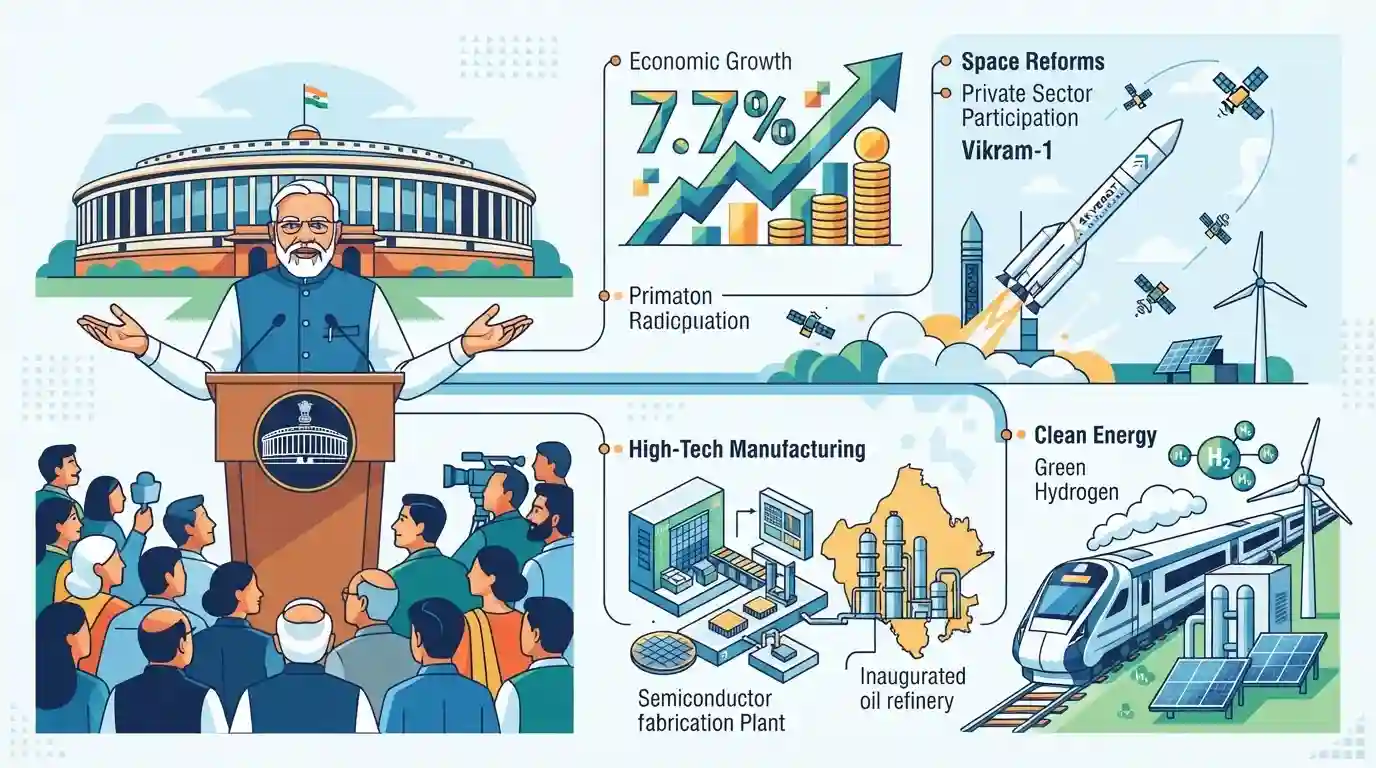
Prime Minister Narendra Modi addressed the media ahead of the Parliament Monsoon Session on July 20, 2026, urging lawmakers to prioritize constructive debate over disruption. He celebrated India's robust 7.7% economic growth amid global geopolitical challenges and highlighted a series of recent technological and infrastructural milestones. Notably, he praised the successful launch of the Vikram-1 rocket by private firm Skyroot Aerospace, alongside the inauguration of a Rajasthan oil refinery, a new semiconductor plant, and a green hydrogen-powered train. These achievements underscore the government's focus on private sector participation, clean energy, and high-tech manufacturing.
Key Points
- PM Modi urged political parties to engage in constructive debate and maintain decorum during the Parliament Monsoon Session.
- He highlighted India's resilience with a 7.7% GDP growth rate, maintaining its status as the fastest-growing major economy despite global energy supply disruptions in West Asia.
- Modi celebrated the successful launch of the Vikram-1 rocket by Skyroot Aerospace from Sriharikota, marking a significant milestone for India's private space sector.
- Other key achievements noted included the dedication of a new oil refinery in Rajasthan, the commissioning of India's third semiconductor plant, and the launch of a green hydrogen-powered train.
- The Prime Minister emphasized that government reforms are fostering a conducive environment for startups and young entrepreneurs across tech and energy sectors.
Prelims Trap
Vikram-1 was India's first-ever private sub-orbital rocket launch under the space sector reforms.
Vikram-S (launched in 2022) was the sub-orbital rocket. Vikram-1 is an orbital launch vehicle designed to place payloads into Low Earth Orbit.
Static Concepts Connected
What are the constitutional rules governing the summoning and frequency of Parliamentary sessions?
- Article 85: The President summons each House of Parliament, ensuring six months do not elapse between consecutive sessions.
- No Fixed Calendar: The Constitution does not mandate a specific calendar; three annual sessions are held purely by established convention.
- Executive discretion: The executive (Cabinet Committee on Parliamentary Affairs) decides the dates before advising the President to summon the houses.
How is Green Hydrogen defined and distinguished from other hydrogen types?
- Production method: Generated via water electrolysis powered entirely by renewable energy sources like solar or wind.
- Zero emissions: Unlike Grey or Blue hydrogen, Green hydrogen production emits no greenhouse gases into the atmosphere.
- Strategic utility: Serves as a vital clean feedstock to decarbonize hard-to-abate sectors like steel, chemical refineries, and heavy transport.
Cross-Topic Patterns
Space reforms + Strategic autonomy
Private launch capability (like Vikram-1) reduces ISRO's commercial payload burden, allowing the state space agency to focus on deep-space exploration and strategic security missions.
Semiconductors + Supply-chain resilience
Developing domestic semiconductor fabrication units acts as a geopolitical buffer, protecting India's automotive and defense manufacturing sectors from East Asian supply-chain shocks.

Mains 2026 may link industrial policy (Semiconductors, Green Hydrogen) with India's strategic autonomy and climate commitments.
Linked PYQs · 5
Linked PYQs · 5
- 2019MainsGS2
Individual Parliamentarian's role as the national law maker is on a decline, which in turn, has adversely impacted the quality of debates and their outcome. Discuss.
- 2025MainsGS3
India aims to become a semiconductor manufacturing hub. What are the challenges faced by the semiconductor industry in India? Mention the salient features of the India Semiconductor Mission.
- 2025MainsGS3
How can India achieve energy independence through clean technology by 2047? How can biotechnology can play a crucial role in this endeavour?
- 2016MainsGS3
Discuss India's achievements in the field of Space Science and Technology. How the application of this technology has helped India in its socio-economic development?
- 2018PrelimsGS1
With reference to India's satellite launch vehicles, consider the following statements: 1. PSLVs launch the satellites useful for Earth resources monitoring whereas GSLVs are designed mainly to launch communication satellites. 2. Satellites launched by PSLV appear to remain permanently fixed in the same position in the sky, as viewed from a particular location on Earth. 3. GSLV Mk III is a four-staged launch vehicle with the first and third stages using solid rocket motors; and the second and fourth stages using liquid rocket engines. Which of the statements given above is/are correct?
