Parliament Monsoon Session Legislative Agenda and Reforms
Source:Indian Express ↗
આ શા માટે મહત્વનું છે
The article highlights key upcoming legislative reforms that intersect with India's federal balance (delimitation) and institutional autonomy (centralizing higher education). It provides a real-time perspective on the functioning of Parliamentary democracy, illustrating how coalition dynamics, federal concerns, and civil society protests shape landmark legislations like the Women's Reservation Act and electoral reforms.
સારાંશ
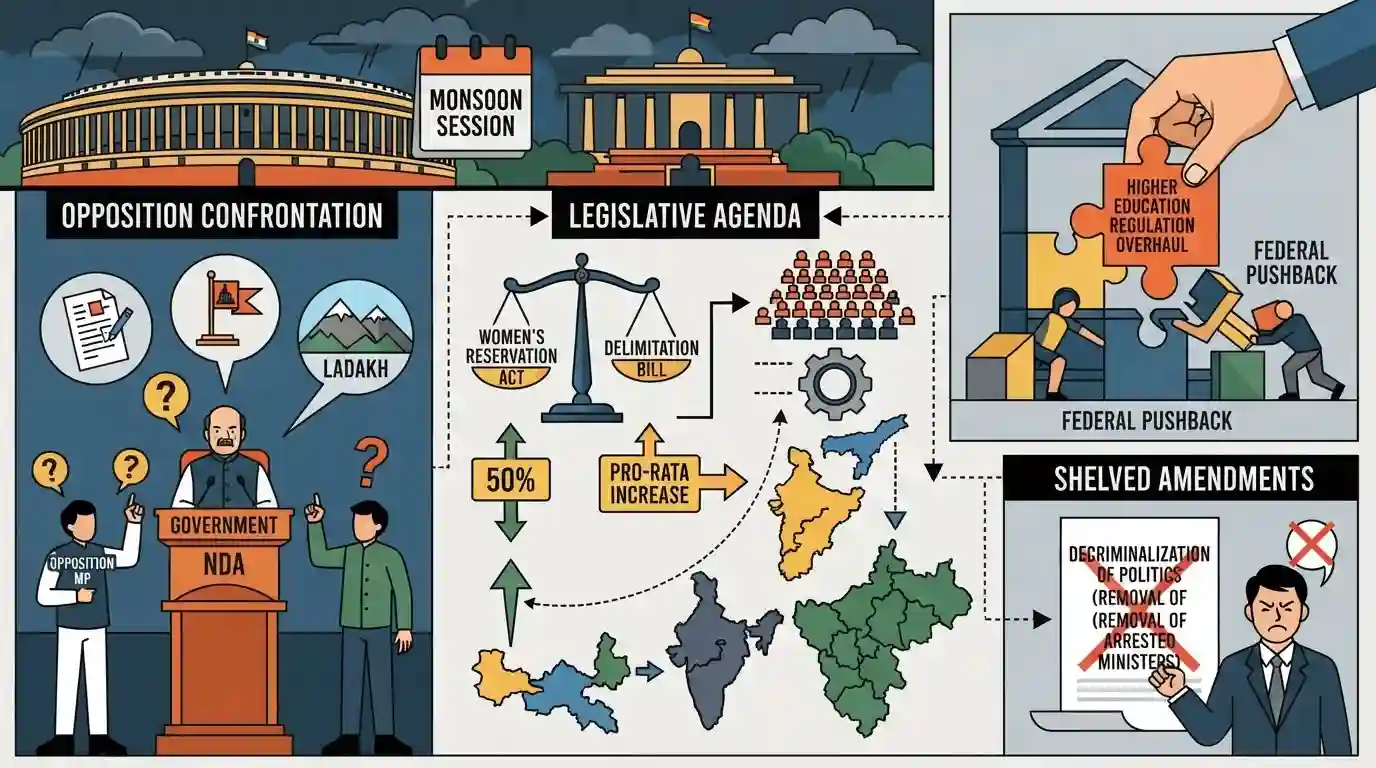
The upcoming Monsoon Session of Parliament is poised for intense political confrontation. The Opposition intends to corner the NDA government on issues such as exam paper leaks, the management of the Ram Temple Trust, and unfulfilled demands for Ladakh. On the legislative front, the government is preparing to reintroduce measures to advance the Women's Reservation Act, heavily linked to an impending Delimitation Bill that proposes a 50% pro-rata increase in parliamentary seats across all states to satisfy federal concerns. Concurrently, a constitutional amendment aimed at the decriminalization of politics by removing arrested ministers has been shelved, and a major overhaul of higher education regulation (Viksit Bharat Shiksha Adhishthan Bill) faces significant pushback over perceived over-centralization.
મુખ્ય મુદ્દા
- The NDA government’s numerical strength in Parliament has been bolstered following the shift of 37 MPs from four Opposition parties.
- The anticipated Delimitation Bill may incorporate a '50% pro-rata model' (a uniform 50% increase in legislative seats across all states) to alleviate southern states' concerns over losing political representation, a crucial step for operationalizing the Women's Reservation Act.
- The Constitution (130th Amendment) Bill, which proposed to dismiss/disqualify ministers arrested for 30 consecutive days for serious offences, has been shelved.
- The Viksit Bharat Shiksha Adhishthan Bill 2025, which aims to create a single centralized regulatory body for higher education (replacing bodies like UGC), is facing resistance from the Opposition and NDA allies alike over fears of excessive centralization.
- The Opposition plans to corner the government over exam paper leaks, alleged financial irregularities in the Ram Temple Trust, and protests by activists like Sonam Wangchuk regarding Ladakh's demands.
મહત્વપૂર્ણ શબ્દો
Women's Reservation Act

Officially the Constitution (106th Amendment) Act, 2023, it mandates a 33% reservation of seats for women in the Lok Sabha, State Legislative Assemblies, and the Delhi Assembly, implemented after the next census and delimitation.
UPSC context
GS Paper II (Polity & Governance) — Tests knowledge on political representation, gender justice, and legislative electoral reforms.
Constitution (130th Amendment) Bill
A pending bill introduced in August 2025 proposing the automatic removal of the Prime Minister, Chief Ministers, and other Ministers if they are arrested and detained for 30 consecutive days for serious criminal offences.
UPSC context
GS Paper II (Polity) — Evaluates decriminalization of politics, executive accountability, and the separation of powers.
Viksit Bharat Shiksha Adhishthan Bill 2025
Proposed legislation seeking to unify and restructure India's higher education regulatory framework under a single apex body (VBSA) to reduce administrative fragmentation and encourage institutional autonomy.
UPSC context
GS Paper II (Education & Governance) — Focuses on National Education Policy implementation, federal dynamics, and centralization issues.
Delimitation Bill
A legislative proposal to redraw the boundaries of Lok Sabha and State Assembly constituencies based on recent census data to ensure equal voter representation across geographical regions.
UPSC context
GS Paper II (Federalism & Representation) — Examines demographic imbalances, democratic parity, and statutory delimitation commission frameworks.
Joint Parliamentary Committee (JPC)
An ad hoc, temporary committee comprising members from both Houses of Parliament, constituted through a legislative motion to examine complex bills, major scandals, or policies of significant public interest.
UPSC context
GS Paper II (Parliamentary Functioning) — Assesses legislative oversight, executive accountability, and parliamentary committee procedures.
Shri Ram Janmbhoomi Teerth Kshetra Trust
A 15-member autonomous public trust established by the Central Government in 2020 to oversee the construction, management, and daily administration of the Ram Temple in Ayodhya.
UPSC context
GS Paper II (Governance) — Evaluates state role in religious trusts, public accountability, and autonomy of institutional management.
પ્રિલિમ્સ ટ્રેપ
The 106th Amendment Act instantly reserved 33% of seats in the Lok Sabha for women starting from the 2024 elections.
The 106th Amendment (Nari Shakti Vandan Adhiniyam) did not immediately implement reservation. Under Article 334A, it is legally frozen until a delimitation exercise is completed using the first census conducted after the Act's commencement.
સંલગ્ન સ્થિર ખ્યાલો
What are the constitutional provisions and mechanisms governing Delimitation in India?
- Article 82 mandate: Under Article 82, Parliament enacts a Delimitation Act after every Census, creating an independent Delimitation Commission.
- Article 170 role: Governs the composition, strength, and territorial delimitation of State Legislative Assemblies based on census data.
- Commission structure: Comprises a retired Supreme Court judge (chairperson), the Chief Election Commissioner, and respective State Election Commissioners.
- Judicial immunity: Its orders have the force of law and cannot be challenged or called into question before any court of law.
What are the current constitutional and statutory rules for the disqualification of legislators?
- Constitutional grounds: Articles 102(1) and 191(1) govern disqualification for MPs and MLAs based on office of profit, unsound mind, or citizenship loss.
- RPA Section 8: Mandates disqualification only upon actual conviction and sentencing to at least two years of imprisonment for specified offences.
- Custody status: Under current laws, mere arrest, custody, or framing of charges does not strip a legislator of their seat or ministerial post.
આંતર-વિષય પેટર્ન
Delimitation & Fiscal Federalism
Linking demographic divergence to both political representation (delimitation) and financial resources (Finance Commission allocations), where southern states risk penalty for successful population control.
Education Governance & Concurrent List
The centralisation of higher education regulators tests Entry 66 (Union List) against Entry 25 (Concurrent List), triggering friction over state-level educational autonomy.

Delimitation criteria, Article 334A linkage, and constitutional limits of executive disqualification during custody are prime 2026 targets.
સંલગ્ન PYQ · 4
સંલગ્ન PYQ · 4
- 2024MainsGS2
What changes has the Union Government recently introduced in the domain of Centre-State relations ? Suggest measures to be adopted to build the trust between the Centre and the States and for strengthening federalism.
- 2019MainsGS2
“The reservation of seats for women in the institutions of local self-government has had a limited impact on the patriarchal character of the Indian Political Process.” Comment.
- 2014MainsGS2
Should the premier institutes like IITs/IIMs. be allowed to retain premier status, allowed more academic independence in designing courses and also decide mode/criteria of selection of students. Discuss in light of the growing challenges.
- 2020MainsGS2
There is a need for simplification of procedure for disqualification of persons found guilty of corrupt practices under the Representation of Peoples Act". Comment.
