Operation Sindoor in Lok Sabha and India Defense Policy Shift
Source:The Hindu ↗
Why It Matters
Operation Sindoor reinforces India's shift toward a proactive and assertive defense policy (similar to the 2016 Surgical Strikes and 2019 Balakot airstrikes) in countering cross-border terrorism. The parliamentary debate surrounding it highlights the intersection of national security, democratic accountability, and the role of the Opposition, while the dismissal of U.S. mediation reinforces India's firm stance on bilateralism.
Summary
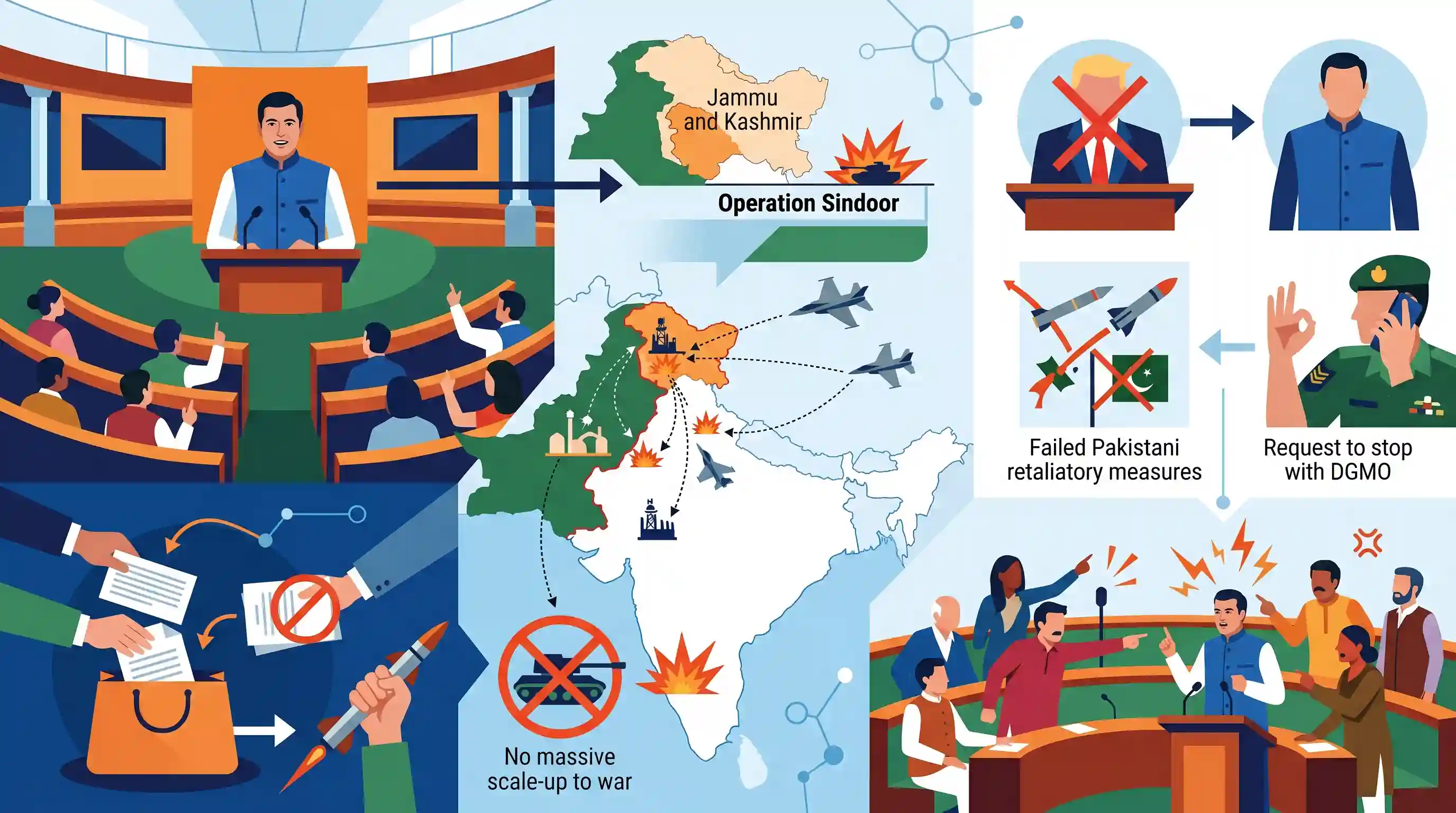
Defence Minister Rajnath Singh informed the Lok Sabha that Operation Sindoor, launched in retaliation to the Pahalgam terror attack, successfully met its politico-military objectives of destroying terror launchpads in Pakistan without escalating into a full-scale war. He emphasized that India's approach to cross-border terrorism has shifted from sharing dossiers to taking decisive military action. Furthermore, Singh dismissed claims of U.S. mediation by President Donald Trump, clarifying that the strikes were halted at the request of Pakistan's DGMO after their retaliatory measures failed. The parliamentary session also witnessed heated exchanges regarding the Opposition's role and their questioning of the operation's outcomes.
Key Points
- Defence Minister Rajnath Singh stated in the Lok Sabha that 'Operation Sindoor' was paused after successfully destroying terror nurseries in response to the Pahalgam terror attack.
- The Defence Minister denied claims that U.S. President Donald Trump brokered a truce, asserting the operation was halted because Pakistan's DGMO requested an end to the strikes after their retaliatory attempts failed.
- The government highlighted a paradigm shift in India's anti-terror strategy, stating that "decisive action has replaced dossiers."
- The debate highlighted friction between the government and the Opposition over accountability and the questioning of military operations in Parliament.
Important Terms
Operation Sindoor

A 2025 Indian military operation involving precision strikes against terrorist infrastructure in Pakistan and PoJK. It marked a shift toward kinetic retaliation following the Pahalgam massacre, utilizing drones and loitering munitions.
UPSC context
GS Paper III: Internal Security. Tests knowledge of India's counter-terrorism doctrine and 'non-contact' warfare strategy.
Pahalgam Terror Attack
A deadly April 2025 assault on tourists in Jammu and Kashmir's Anantnag district that killed 26 civilians. The incident served as the casus belli for Operation Sindoor.
UPSC context
GS Paper III: Security. Contextualizes the shift from diplomatic dossiers to military action in India-Pakistan relations.
Director General of Military Operations (DGMO)
The senior military officer responsible for planning and executing combat operations. During Operation Sindoor, the Pakistani DGMO reportedly contacted his Indian counterpart to request a ceasefire.
UPSC context
GS Paper III: Security. Tests understanding of military communication channels and de-escalation mechanisms between nuclear-armed neighbors.
Lok Sabha
The lower house of India's Parliament where the government defends national security decisions. It serves as the primary forum for legislative oversight of executive and military conduct.
UPSC context
GS Paper II: Parliament and State Legislatures. Evaluates the role of parliamentary oversight in sensitive defense matters.
Indian Air Force (IAF)
The aerial service branch of the Indian Armed Forces. In Operation Sindoor, the IAF executed "non-contact" strikes using loitering munitions and precision missiles to neutralize terror launchpads.
UPSC context
GS Paper III: Security Forces and their Mandate. Tests awareness of modern military technology and air power in counter-terrorism.
Janata Dal (United)
A major regional political party in Bihar and a key member of the National Democratic Alliance (NDA). It supports the government's decisive national security posture in Parliament.
UPSC context
GS Paper II: Polity. Relevant for understanding coalition dynamics and political consensus on internal and external security issues.
Prelims Trap
India accepted US-brokered third-party mediation to de-escalate Operation Sindoor.
India consistently rejects third-party mediation in Pakistan conflicts, strictly adhering to the bilateral framework of the 1972 Simla Agreement. De-escalation occurred bilaterally via the DGMO hotline.
Static Concepts Connected
What are the key military Confidence Building Measures (CBMs) between India and Pakistan?
- DGMO Hotline: Established in 1990 for routine communication between the Directors General of Military Operations to resolve operational issues and prevent border skirmishes from escalating.
- Nuclear Facilities: The 1988 Non-Attack Agreement strictly prohibits both nations from attacking each other's nuclear installations, requiring an annual exchange of lists of such facilities.
- Airspace Agreement: The 1991 agreement mandates advance notice for military exercises near the border and establishes clear protocols to prevent airspace violations by military aircraft.
How does Parliament ensure accountability in national security operations?
- Parliamentary Debates: Through Question Hour and discussions, the Opposition can demand transparency and operational outcomes, balancing democratic accountability with executive operational secrecy.
- Committee Scrutiny: The Parliamentary Standing Committee on Defence reviews the Ministry's budget, policies, and strategic preparedness, though operational tactics and real-time military intelligence remain classified.
Cross-Topic Patterns
Proactive Defense & Nuclear Threshold
Operation Sindoor exemplifies India's shift from post-26/11 'strategic restraint' to 'proactive defense,' aiming to punish cross-border terrorism while remaining strictly below the conventional warfare and nuclear thresholds.
Simla Agreement's Enduring Relevance
The explicit rejection of US mediation claims reiterates the 1972 Simla Agreement's mandate: all Indo-Pak disputes must be resolved bilaterally, contrasting with India's growing multilateralism in other geopolitical arenas.

Expect a 2026 Mains question evaluating India's doctrinal shift from 'strategic restraint' to 'proactive defense' below nuclear thresholds.
Linked PYQs · 4
Linked PYQs · 4
- 2016MainsGS3
The terms 'Hot Pursuit' and 'Surgical Strikes' are often used in connection with armed action against terrorist attacks. Discuss the strategic impact of such actions.
- 2015MainsGS2
Terrorist activities and mutual distrust have clouded India-Pakistan relations. To what extent the use of soft power like sports and cultural exchanges could help generate goodwill between the two countries? Discuss with suitable examples.
- 2016MainsGS2
Increasing cross-border terrorist attacks in India and growing interference in the internal affairs of several member-states by Pakistan are not conducive for the future of SAARC (South Asian Association for Regional Cooperation)." Explain with suitable examples.
- 2019MainsGS2
Individual Parliamentarian's role as the national law maker is on a decline, which in turn, has adversely impacted the quality of debates and their outcome. Discuss.
