Parliamentary Disruptions and Legislative Procedure Debates
Source:The Hindu ↗
Why It Matters
Frequent disruptions in Parliament highlight structural issues in India's legislative functioning. For UPSC aspirants, understanding the procedural mechanisms (like Rule 267), the role of Presiding Officers, and the constitutional significance of issues like electoral roll revisions and ST representation is critical for GS Paper 2.
Summary
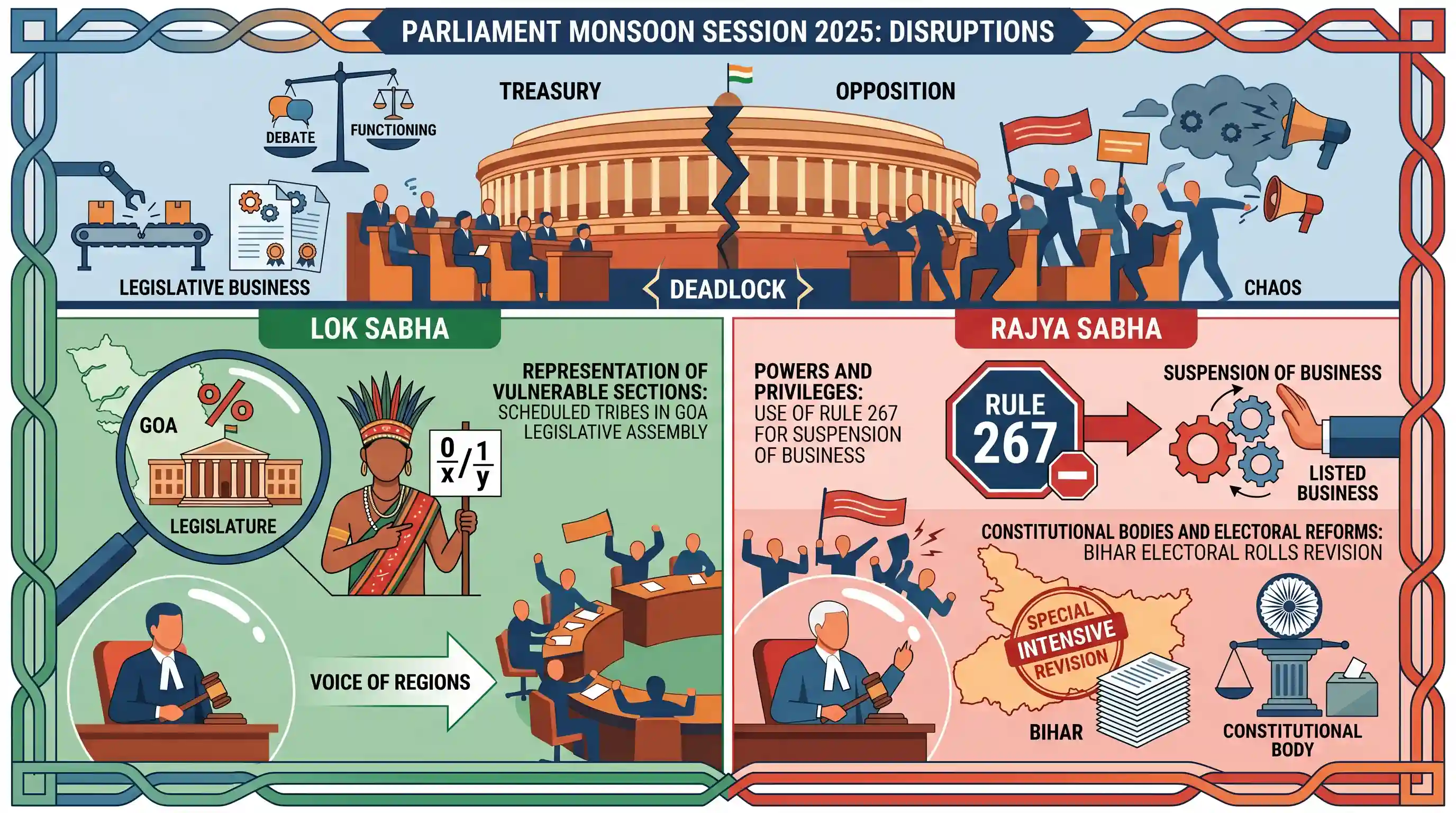
The July 24, 2025, proceedings of the Parliament Monsoon Session were characterized by significant disruptions in both the Lok Sabha and Rajya Sabha. Opposition protests centered around regional and constitutional issues, notably the Special Intensive Revision of electoral rolls in Bihar and the representation of Scheduled Tribes in the Goa Legislative Assembly. The use of Rule 267 in the Upper House to demand the suspension of business underscored the persistent deadlock between the Treasury and Opposition benches. These events highlight ongoing challenges in parliamentary functioning, the impact of disruptions on legislative business, and the crucial role of Presiding Officers in ensuring orderly debates.
Key Points
- The Monsoon Session of Parliament saw significant disruptions in both the Lok Sabha and Rajya Sabha on July 24, 2025.
- Opposition members utilized procedural tools, including Rule 267 notices in the Rajya Sabha, demanding the suspension of regular business to discuss urgent matters.
- Key issues raised by the Opposition included demands for a discussion on the Special Intensive Revision (SIR) of electoral rolls in Bihar and the political representation of Scheduled Tribes (STs) in Goa.
- The continuous disruptions impeded normal legislative proceedings and the passage of bills, bringing focus to the role of the Presiding Officers in maintaining order.
Important Terms
Rule 267

A Rajya Sabha procedural rule allowing members to move a motion to suspend the day's listed business to discuss a matter of urgent public importance.
UPSC context
GS II: Parliament—Functioning and Conduct of Business; frequently tested regarding parliamentary oversight and the powers of the Presiding Officer.
Election Commission of India (ECI)
A constitutional body established under Article 324 tasked with the superintendence, direction, and control of electoral rolls and elections to Parliament and State Legislatures.
UPSC context
GS II: Constitutional Bodies; crucial for topics on electoral management, independence of institutions, and Article 324.
Special Intensive Revision (SIR)
A comprehensive, house-to-house verification drive conducted by the ECI under the Representation of the People Act, 1950, to update electoral rolls and ensure voter list accuracy.
UPSC context
GS II: Electoral Reforms; relevant to the Representation of the People Act and the administrative challenges of ensuring 'one person, one vote'.
Carriage of Goods by Sea Bill, 2025
Legislation passed in 2025 to modernize India’s maritime trade by repealing the 1925 Act and aligning cargo liability standards with the international Hague-Visby Rules.
UPSC context
GS III: Infrastructure (Ports) and Economy; tests knowledge of maritime legal reforms, Ease of Doing Business, and international trade conventions.
Article 332
A constitutional mandate providing for the reservation of seats for Scheduled Castes and Scheduled Tribes in State Legislative Assemblies based on their population proportion.
UPSC context
GS II: Governance and Vulnerable Sections; essential for understanding political reservation and the role of the Delimitation Commission.
Prelims Trap
"Rule 267 allows members of both Lok Sabha and Rajya Sabha to suspend legislative business for urgent matters."
Rule 267 is exclusive to the Rajya Sabha. The Lok Sabha uses the Adjournment Motion to raise and discuss matters of urgent public importance.
Static Concepts Connected
How does Rajya Sabha's Rule 267 differ from Lok Sabha's Adjournment Motion?
- RS Rule 267: Suspends the pre-decided legislative agenda of the Upper House to discuss an urgent national matter; strictly requires the Chairman's prior consent.
- LS Adjournment Motion: Exclusive to Lok Sabha; requires the support of 50 members to be admitted and involves an element of censure against the ruling government.
How are electoral rolls legally managed and ST seats constitutionally reserved?
- RPA 1950: Section 21(3) governs the preparation and Special Intensive Revision of electoral rolls (conducted by ECI) to ensure accurate, updated voter lists.
- Article 332: Mandates the reservation of seats for Scheduled Castes and Scheduled Tribes in State Legislative Assemblies strictly in proportion to their state population.
Cross-Topic Patterns
Parliament disruptions & executive accountability
Persistent disruptions and the bypass of standard legislative scrutiny, such as skipping Parliamentary Standing Committees, severely erode constitutional mechanisms of parliamentary control over executive actions.
ST representation & Delimitation debates
The demand for proper ST representation in the Goa Assembly ties into broader national debates on the upcoming delimitation exercise, delayed Census data, and political empowerment of vulnerable sections.

Expect a comparative Prelims question on Rule 267 vs Adjournment Motion, or a Mains question on how disruptions erode legislative scrutiny.
Linked PYQs · 5
Linked PYQs · 5
- 2020PrelimsGS1
Consider the following statements: 1. According to the Constitution of India, a person who is eligible to vote can be made a minister in a State for six months even if he/she is not a member of the Legislature of that State. 2. According to the Representation of People Act, 1951, a person convicted of a criminal offence and sentenced to imprisonment for five years is permanently disqualified from contesting an election even after his release from prison. Which of the statements given above is/are correct?
- 2024PrelimsGS1
With reference to the Indian Parliament, consider the following statements: 1. A bill pending in the Lok Sabha lapses on its dissolution. 2. A bill passed by the Lok Sabha and pending in the Rajya Sabha lapses on the dissolution of the Lok Sabha. 3. A bill in regard to which the President of India notified his/her intention to summon the Houses to a joint sitting lapses on the dissolution of the Lok Sabha. Which of the statements given above is/are correct?
- 2025PrelimsGS1
Consider the following statements : I. On the dissolution of the House of the People, the Speaker shall not vacate his/her office until immediately before the first meeting of the House of the People after the dissolution. II. According to the provisions of the Constitution of India, a Member of the House of the People on being elected as Speaker shall resign from his/her political party immediately. III. The Speaker of the House of the People may be removed from his/her office by a resolution of the House of the People passed by a majority of all the then Members of the House, provided that no resolution shall be moved unless at least fourteen days' notice has been given of the intention to move the resolution. Which of the statements given above are correct?
- 2023MainsGS2
Discuss the role of Presiding Officers of state legislatures in maintaining order and impartiality in conducting legislative work and in facilitating best democratic practices.
- 2020MainsGS2
Once a Speaker, Always a Speaker' ! Do you think this practice should be adopted to impart objectivity to the office of the Speaker of Lok Sabha ? What could be its implications for the robust functioning of parliamentary business in India?
