Taxation and UPI Charges Bill Clears Lok Sabha in Monsoon Session
Source:The Hindu ↗
কেন এটি গুরুত্বপূর্ণ
This legislation is pivotal for GS Paper 3 (Indian Economy) as the potential reintroduction of MDR on UPI transactions could significantly alter the ecosystem of digital public infrastructure and financial inclusion. Furthermore, its targeted tax exemptions for contract manufacturing and FPIs are central to India's strategy for boosting foreign direct investment, expanding domestic manufacturing capabilities, and integrating into global value chains. For GS Paper 2 (Polity), the passage of a bill with such wide-ranging economic impacts without parliamentary debate underscores persistent issues regarding legislative scrutiny and the decline of deliberative democracy.
সারসংক্ষেপ
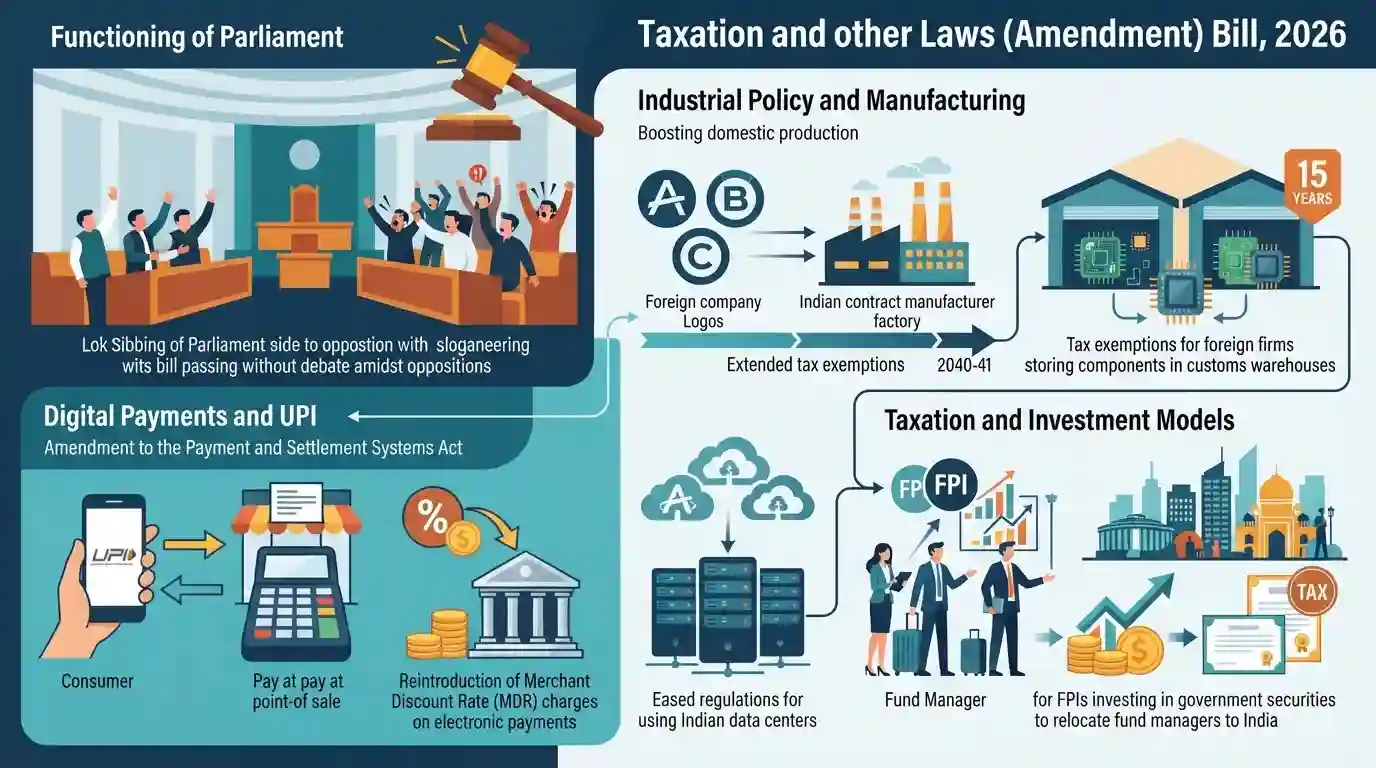
The Lok Sabha passed the Taxation and other Laws (Amendment) Bill, 2026, without debate amid opposition sloganeering. A key provision amends the Payment and Settlement Systems Act, 2007, authorizing the government to permit banks to levy charges, such as the Merchant Discount Rate (MDR), on UPI and other electronic payments. To boost domestic electronic manufacturing, the bill extends income tax exemptions for foreign companies using Indian contract manufacturers until 2040-41, and offers a 15-year exemption for foreign firms storing components in customs warehouses. Additionally, it eases regulations for foreign cloud companies using Indian data centres and provides tax exemptions for Foreign Portfolio Investors (FPIs) investing in government securities to encourage fund managers to relocate to India.
মূল বিষয়
- The bill amends the Payment and Settlement Systems Act, 2007, enabling the government to allow banks and service providers to levy charges (like MDR) on UPI and other electronic payment modes.
- To boost 'Make in India', the bill extends income tax exemptions until 2040-41 for foreign companies engaging Indian contract manufacturers for electronic goods like mobile phones and laptops.
- Foreign entities storing components in customs-bonded warehouses for supply to contract manufacturers will receive a 15-year income tax exemption.
- Regulatory burdens are eased for foreign cloud computing companies utilizing Indian data centres by removing prior approval and notification requirements.
- The bill grants IT exemptions to Foreign Portfolio Investors (FPIs) on income from interest and capital gains in Government Securities (G-Secs), facilitating the relocation of offshore fund managers to India.
- The legislation was passed without parliamentary debate amid continuous opposition sloganeering, highlighting concerns over legislative scrutiny.
গুরুত্বপূর্ণ শব্দ
The Taxation and other Laws (Amendment) Bill, 2026

A bill passed to replace the Income-tax (Amendment) Ordinance, 2026, aimed at encouraging foreign investment, promoting domestic electronic manufacturing, providing tax certainty, and permitting charges on certain electronic payments.
UPSC context
GS Paper III: Mobilisation of resources. Tests legislative changes affecting taxation, FDI, and the digital payment ecosystem.
Payment and Settlement Systems Act, 2007
A legislative framework designating the RBI as the regulatory authority to supervise, safe-keep, and govern all electronic and retail payment and settlement systems in India.
UPSC context
GS Paper III: Indian Economy. Tests knowledge of regulatory institutions, financial markets, and laws governing digital payments.
Unified Payments Interface (UPI)
A real-time, mobile-first instant inter-bank payment system developed in India, merging multiple banking features and enabling seamless peer-to-peer and peer-to-merchant payments.
UPSC context
GS Paper III: Infrastructure and Science and Technology. Tests digital public infrastructure, cashless transactions, and fintech innovation.
Foreign Portfolio Investors (FPIs)
Foreign individuals or entities investing in India's financial assets like stocks, bonds, and government securities, without acquiring direct control over the underlying companies.
UPSC context
GS Paper III: Mobilisation of resources. Tests concepts of external capital inflows, financial market regulations, and investment instruments.
National Payments Corporation of India (NPCI)
An umbrella organization founded by the Reserve Bank of India and Indian Banks' Association to manage and operate retail payment and settlement systems nationwide.
UPSC context
GS Paper III: Economic Development. Tests key financial institutions driving cashless transactions and digital public goods.
প্রিলিমস ফাঁদ
MDR is a statutory tax levied by the RBI to regulate digital payments.
MDR is neither a tax nor levied by the RBI. It is a commercial fee paid by merchants to acquiring banks and payment networks for processing digital transactions.
সংযুক্ত স্থির ধারণা
What is the Merchant Discount Rate (MDR) and how is it structured?
- Definition: The fee that a merchant pays to a bank or payment service provider for accepting digital payments (cards, UPI) from customers.
- Revenue split: The fee is typically split between the acquiring bank, the card/payment network (e.g., NPCI, Visa), and the issuer bank.
- UPI Context: In 2020, the government mandated zero MDR for UPI and RuPay debit cards to promote digital transactions, a rule now being amended for select categories.
What distinguishes Foreign Portfolio Investment (FPI) from Foreign Direct Investment (FDI)?
- Investment Limit: FPI involves foreign entities investing in less than 10% of the post-issue paid-up equity capital of a listed Indian company. FDI is 10% or more.
- Nature of investment: FPIs represent short-term, highly liquid financial investments (hot money) aimed at capital gains, whereas FDI targets long-term ownership and management control.
- G-Sec Eligibility: FPIs are permitted to invest in Indian Government Securities (G-Secs), subject to macro-prudential limits set by the RBI to manage capital flows.
আন্তঃবিষয় প্যাটার্ন
Legislation without debate
Passing major financial and digital infrastructure amendments without debate reflects the ongoing tension between legislative efficiency and effective parliamentary scrutiny (GS2).
PLI Schemes + Contract Manufacturing
Long-term tax exemptions for customs-bonded warehouses complement hardware PLI schemes, signaling a strategic shift to mimic Vietnam's success in contract electronics manufacturing.

Changes to UPI MDR and FPI safe harbour rules make digital payments and offshore fund taxation prime targets for 2026 Economy prelims.
সংযুক্ত PYQ · 4
সংযুক্ত PYQ · 4
- 2018PrelimsGS1
Which one of the following best describes the term "Merchant Discount Rate" sometimes seen in news?
- 2026PrelimsGS1
Which one of the following statements about Unified Payments Interface (UPI) and Central Bank Digital Currency (Digital Rupee) is not correct ?
- 2023MainsGS3
What is the status of digitalization in the Indian economy? Examine the problems faced in this regard and suggest improvements.
- 2019MainsGS2
Individual Parliamentarian's role as the national law maker is on a decline, which in turn, has adversely impacted the quality of debates and their outcome. Discuss.
