Parliamentary deadlock persists over electoral roll revision protests
Source:The Hindu ↗
Why It Matters
Parliamentary disruptions are a recurrent theme reflecting the tension between the opposition's demand for accountability and the government's legislative agenda. The rejection of Rule 267 notices highlights the procedural tools and the role of Presiding Officers in conducting legislative business. The controversy over electoral roll revision in Bihar touches upon the functions and perceived impartiality of the Election Commission. Additionally, the arrest of Indian fishermen remains a persistent irritant in India-Sri Lanka bilateral relations.
Summary
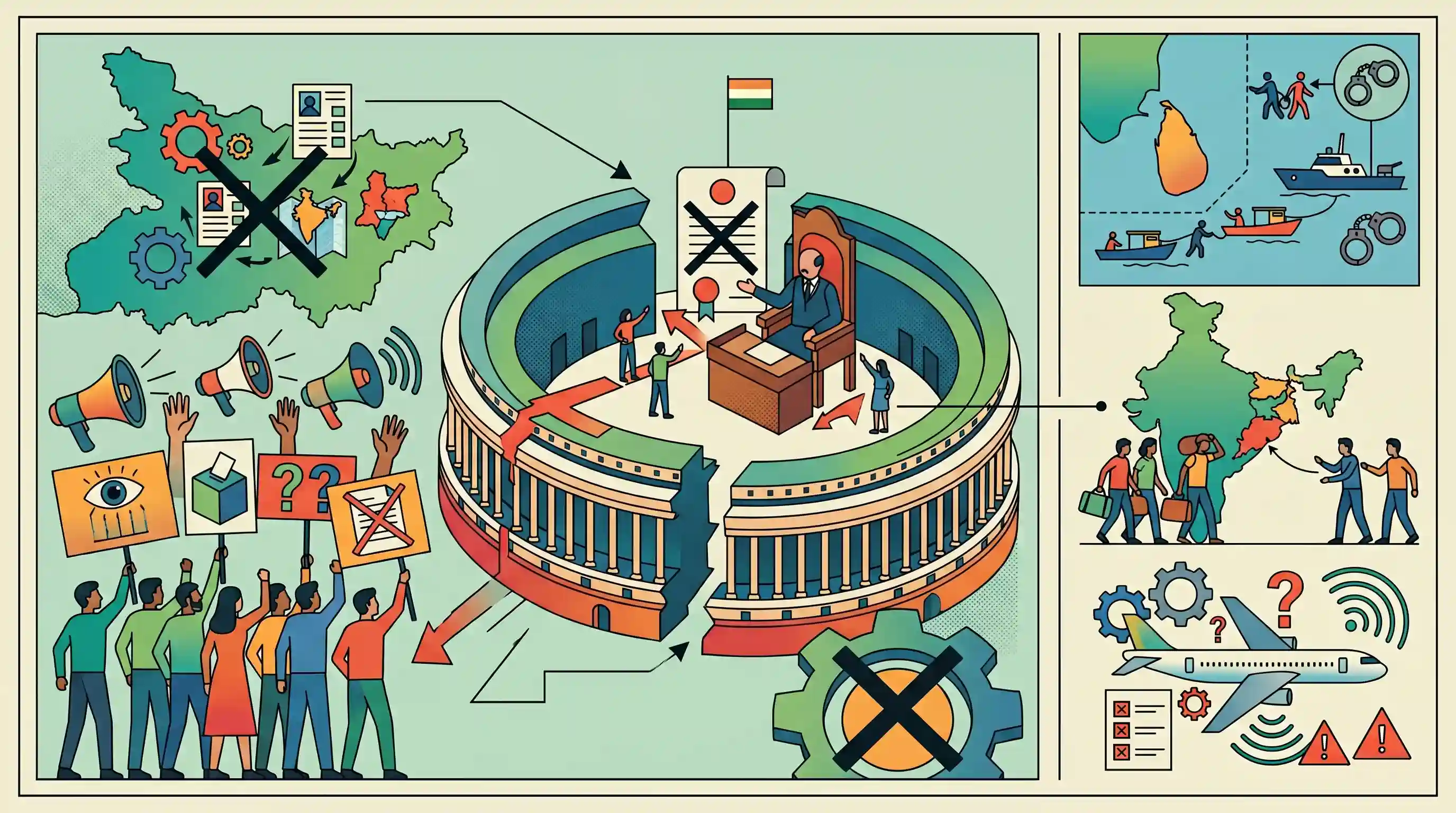
Both Houses of Parliament remained deadlocked for the third straight day during the Monsoon Session as opposition parties protested the Election Commission of India's Special Intensive Revision (SIR) of electoral rolls in Bihar. Rajya Sabha Deputy Chairman Harivansh rejected several Rule 267 notices demanding a discussion on the issue, leading to further disruptions and adjournments. Members also attempted to raise other pressing issues, including the arrest of Indian fishermen by Sri Lanka, the targeting of Bengali migrant workers in Odisha, and aviation safety concerns.
Key Points
- The Monsoon Session of Parliament saw disruptions and adjournments for the third consecutive day due to protests by opposition parties.
- The primary cause of the deadlock was the opposition's demand to discuss the Election Commission of India's 'Special Intensive Revision' (SIR) of electoral rolls in Bihar, which they termed arbitrary.
- Rajya Sabha Deputy Chairman Harivansh rejected multiple notices under Rule 267, which sought to suspend the scheduled business to debate the Bihar electoral roll issue.
- Other concerns raised by members included the arrest of Indian fishermen by the Sri Lankan Navy, alleged discrimination against Bengali migrant workers in Odisha, and recent aviation safety incidents.
Important Terms
Rule 267 of the Rajya Sabha

A Rajya Sabha rule allowing members to move for the suspension of listed business to discuss a matter of urgent public importance, requiring the Chairman's consent.
UPSC context
GS Paper II: Parliament functioning; tests understanding of legislative tools and executive-legislative friction.
Special Intensive Revision (SIR)
A comprehensive door-to-door verification and update of electoral rolls conducted by the Election Commission to ensure accuracy by removing duplicate or ineligible entries.
UPSC context
GS Paper II: Electoral reforms and Representation of the People Act (RPA); tests knowledge of election administration.
Election Commission of India (ECI)
A permanent constitutional body established under Article 324 to ensure free and fair elections to Parliament, State Legislatures, and the offices of President and Vice-President.
UPSC context
GS Paper II: Constitutional Bodies; tests powers, functions, and independence of the commission.
Representation of the People Act, 1950
The primary legislation providing for the allocation of seats, delimitation of constituencies, and the preparation/revision of electoral rolls for elections to Parliament and State Legislatures.
UPSC context
GS Paper II: Salient features of the RP Act; essential for understanding the legal basis of electoral management.
Rule 176 of the Rajya Sabha
A procedure in the Rajya Sabha for a 'Short Duration Discussion' on urgent matters, not exceeding two-and-a-half hours, without a formal motion or voting.
UPSC context
GS Paper II: Parliamentary procedures; often contrasted with Rule 267 regarding the scale of discussion and Chairman's discretion.
Section 21(3) of the RPA 1950
The specific provision in the 1950 Act that empowers the Election Commission to direct a special revision of electoral rolls for any constituency or part thereof.
UPSC context
GS Paper II: Statutory provisions; tests specific legal authority behind administrative actions like SIR.
Prelims Trap
"The Special Intensive Revision of electoral rolls is conducted under the Representation of the People Act, 1951."
Preparation and revision of electoral rolls fall strictly under the Representation of the People Act, 1950. The 1951 Act governs the conduct of elections.
Static Concepts Connected
What is the difference between Rule 267 and Rule 176 in the Rajya Sabha?
- Rule 267: A written notice to the Chairman to suspend all listed business of the day to discuss a matter of urgent public importance. Requires voting if opposed.
- Rule 176: Allows for a short duration discussion (max 2.5 hours) on urgent matters without suspending the regular listed business. There is no voting.
What governs the preparation and revision of electoral rolls in India?
- Article 324: Vests the overarching power of superintendence, direction, and control of electoral roll preparation with the Election Commission of India.
- RPA 1950: Provides the statutory framework for the allocation of seats, delimitation of constituencies, and the preparation/revision of electoral rolls.
- Special Intensive Revision: A comprehensive, time-bound house-to-house verification exercise ordered by the ECI when significant discrepancies are suspected in regular rolls.
Cross-Topic Patterns
Bottom trawling + Bilateral Maritime Treaties
The India-Sri Lanka fishermen dispute merges UNCLOS maritime boundaries with ecological destruction (bottom trawling), consistently linking Geography/Environment with International Relations.
Migrant Worker Rights + New Labour Codes
Regional targeting of migrant workers tests the enforcement capabilities of the OSH Code 2020, which subsumed the older Inter-State Migrant Workmen Act, 1979.

Expect a 2026 prelims question contrasting Rule 267 in Rajya Sabha with the Adjournment Motion in Lok Sabha for suspending daily business.
Linked PYQs · 4
Linked PYQs · 4
- 2023MainsGS2
Discuss the role of Presiding Officers of state legislatures in maintaining order and impartiality in conducting legislative work and in facilitating best democratic practices.
- 2022MainsGS2
Discuss the role of the Election Commission of India in the light of the evolution of the Model Code of Conduct.
- 2017MainsGS2
To enhance the quality of democracy in India the Election Commission of India has proposed electoral reforms in 2016. What are the suggested reforms and how far are they significant to make democracy successful?
- 2022MainsGS2
India is an age-old friend of Sri Lanka.’ Discuss India's role in the recent crisis in Sri Lanka in the light of the preceding statement.
