Parliamentary Disruptions and Security Personnel Deployment Debates
Source:The Hindu ↗
Why It Matters
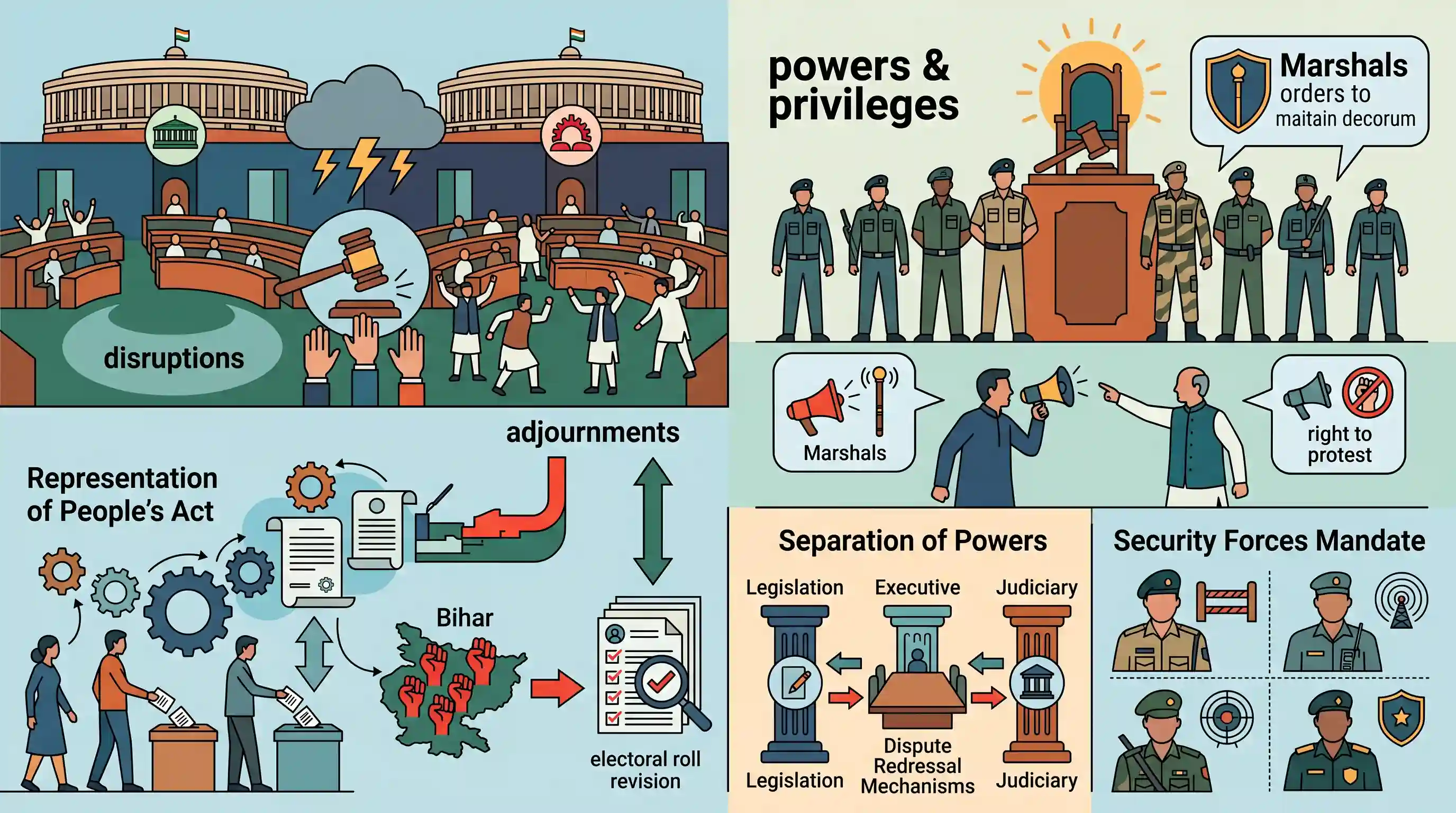
The controversy over deploying security forces (such as CISF) as parliamentary marshals brings to light crucial questions about parliamentary autonomy, the separation of powers between the executive and the legislature, and the Presiding Officer's role in ensuring order without stifling the Opposition's democratic right to protest. Furthermore, the disruption over electoral roll revisions highlights ongoing political concerns surrounding the integrity of the electoral process.
Summary
The ongoing Monsoon Session of Parliament saw significant disruptions, leading to adjournments in both Houses. In the Rajya Sabha, Deputy Chairman Harivansh dismissed the Opposition's allegations that Central Industrial Security Force (CISF) personnel were deployed inside the House to block MPs from entering the Well. The Leader of the House, J.P. Nadda, clarified that security personnel acting under the Chair's orders to maintain decorum function as "marshals," irrespective of their parent organization. The Opposition, led by Mallikarjun Kharge, criticized the move, questioning the limits of a democratic right to protest. Both Houses were adjourned amid protests over the special intensive revision (SIR) of electoral rolls in Bihar.
Key Points
- Rajya Sabha Deputy Chairman Harivansh dismissed the Opposition's claims of CISF personnel being deployed inside the House to block MPs from protesting in the Well.
- Leader of the House J.P. Nadda clarified that security personnel acting under the Presiding Officer's instructions to maintain decorum are considered "marshals," regardless of their parent paramilitary organization.
- Leader of Opposition Mallikarjun Kharge accused the government of stifling democratic protest and treating MPs improperly.
- Both Houses of Parliament were adjourned amid disruptions over the special intensive revision (SIR) of electoral rolls in Bihar.
Important Terms
Special Intensive Revision (SIR) of electoral rolls

A comprehensive house-to-house voter verification exercise by the ECI under Section 21(3) of the RPA, 1950, to ensure roll accuracy before major elections.
UPSC context
GS Paper II: Electoral reforms, Representation of the People Act, and the powers of the Election Commission of India.
Central Industrial Security Force (CISF)
A Central Armed Police Force (CAPF) under the Ministry of Home Affairs that recently took over the comprehensive security of the Parliament House complex.
UPSC context
GS Paper III: Mandate and role of various security forces and agencies in protecting critical infrastructure.
Parliamentary Marshals
Officials appointed by the presiding officers of Parliament to maintain order and decorum within the chambers, now drawn from CISF personnel.
UPSC context
GS Paper II: Parliamentary procedures, conduct of business, and the authority of the Speaker/Chairperson.
Representation of the People Act, 1950
The primary legal framework governing the preparation of electoral rolls, registration of voters, and the allocation of seats in Indian legislatures.
UPSC context
GS Paper II: Salient features of the RPA and its implementation in ensuring free and fair elections.
Operation Sindoor
A 2025 Indian military action targeting terror infrastructure across the Line of Control, launched in response to a major terrorist attack in Pahalgam.
UPSC context
GS Paper III: Security challenges and their management in border areas; India's counter-terrorism strategy.
Rajya Sabha
The Upper House of Parliament (Council of States), representing states and UTs, with permanent status and headed by the Vice President of India.
UPSC context
GS Paper II: Structure and functioning of Parliament; role of the Upper House in a federal democracy.
Article 324
Constitutional provision granting the Election Commission of India the power of superintendence, direction, and control over all elections to Parliament and State Legislatures.
UPSC context
GS Paper II: Constitutional bodies and their mandate in maintaining democratic processes.
Prelims Trap
"CISF personnel deployed inside Parliament remain under the direct command of the Ministry of Home Affairs."
Inside the chambers, all security personnel function as "marshals" strictly under the authority of the Presiding Officer, regardless of their parent executive ministry. This preserves parliamentary autonomy.
Static Concepts Connected
Who controls security and marshals inside the Parliament complex?
- Ultimate Authority: The Presiding Officer (Speaker of Lok Sabha or Chairman of Rajya Sabha) holds absolute, exclusive authority over security arrangements within their respective Houses.
- Role of Marshals: Any security personnel deployed inside the chambers act as marshals under the Chair's direct instruction, independent of executive ministries.
- Recent Transition: Traditionally handled by the Parliament Security Service, comprehensive access control has now transitioned to the CISF, acting under the Parliament's administrative control.
What is the difference between Summary and Intensive Revision of electoral rolls?
- Statutory Backing: Governed by Section 21 of the Representation of the People Act, 1950, which gives the ECI power to revise rolls as it deems fit.
- Summary Revision: A routine, annual updating of existing electoral rolls conducted by inviting public claims and objections without full-scale ground enumeration.
- Intensive Revision: A complete, fresh preparation of electoral rolls from scratch, conducted through comprehensive house-to-house enumeration by Booth Level Officers.
Cross-Topic Patterns
Executive forces under Legislative command
The deployment of MHA-controlled CAPFs (CISF) as parliamentary marshals highlights a unique overlap where executive forces temporarily submit to the absolute authority of the Legislature to preserve the separation of powers.
ECI's extraordinary powers under RPA 1950
The Special Intensive Revision (SIR) highlights the ECI's broad discretionary powers under Section 21(3) of the RPA 1950 to order fresh electoral rolls from scratch during political or demographic exigencies.

Expect a tricky prelims statement contrasting Summary vs. Intensive roll revision under RPA 1950, or testing the Chair's security powers.
Linked PYQs · 4
Linked PYQs · 4
- 2023MainsGS2
Discuss the role of Presiding Officers of state legislatures in maintaining order and impartiality in conducting legislative work and in facilitating best democratic practices.
- 2021MainsGS2
To what extent, in your view, the Parliament is able to ensure accountability of the executive in India?
- 2024MainsGS2
Examine the need for electoral reforms as suggested by various committees with particular reference to "one nation one election" principle.
- 2023MainsGS3
What are the internal security challenges being faced by India? Give out the role of Central Intelligence and Investigative Agencies tasked to counter such threats.
