Parliamentary Debate on India China Relations and Economic Strategy
Source:Indian Express ↗
Why It Matters
The article highlights the 'economy vs. security' paradox in India's China policy. The tension between the Economic Survey's pragmatic call for Chinese FDI to fuel manufacturing and the political/strategic reality of the LAC standoff is a highly probable analytical area for UPSC GS-2 (IR) and GS-3 (Economy/Security). It also serves as a practical example of the Opposition exercising parliamentary oversight.
Summary
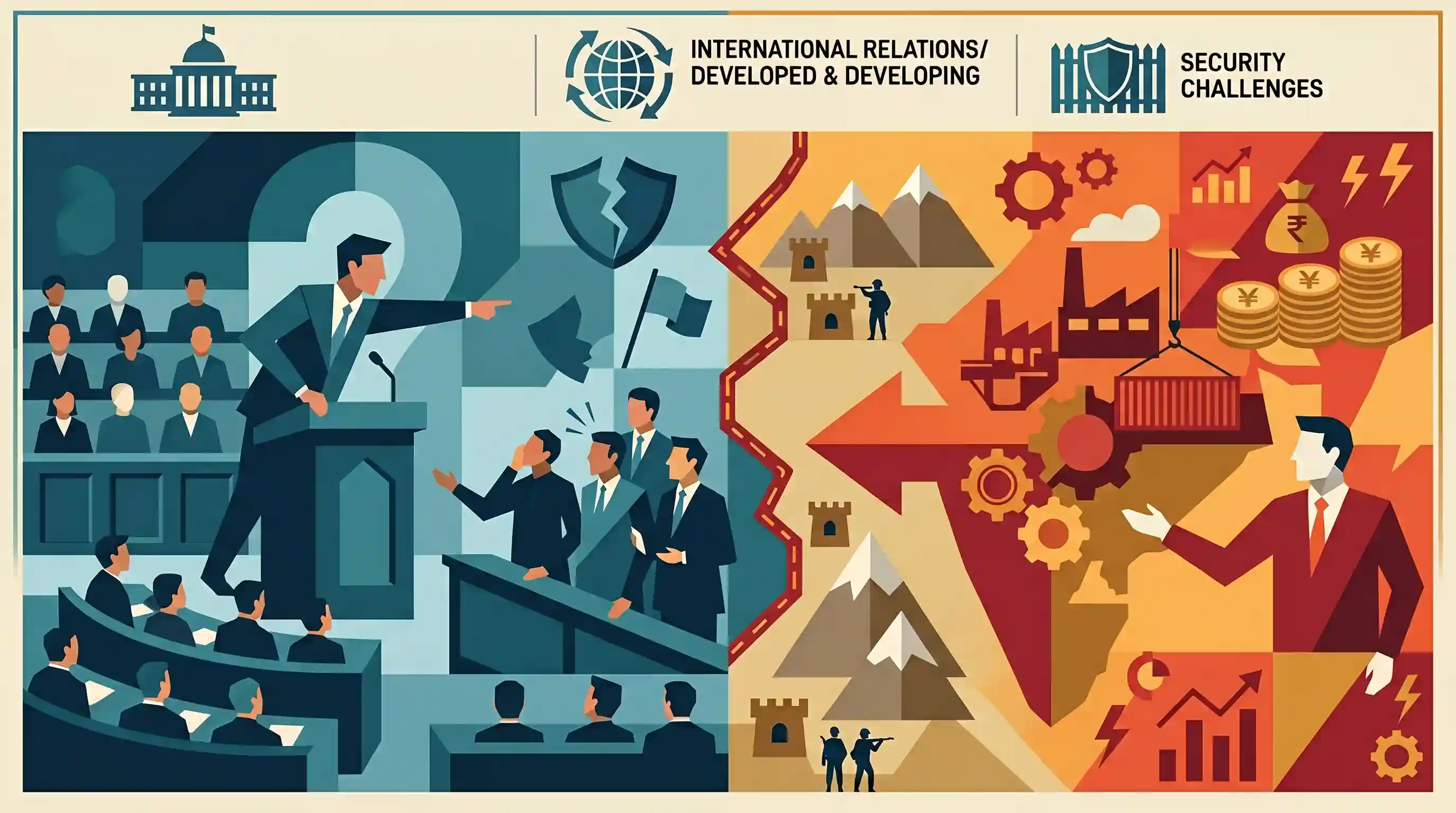
During the Parliament's Monsoon Session, Congress MP Gaurav Gogoi led the Opposition in questioning the government's stance on China, famously asking, 'Before whom did India surrender?' The charge was a direct response to the Economic Survey 2023-24, which advocated for increased Chinese Foreign Direct Investment (FDI) to integrate India into global value chains and boost domestic manufacturing. The Opposition accused the government of compromising national security and disrespecting the sacrifices of soldiers at the Galwan Valley. The debate highlighted the complex challenge of balancing India's strategic imperatives along the Line of Actual Control (LAC) with its economic reliance on Chinese supply chains, while also showcasing the crucial role of the Opposition in ensuring executive accountability.
Key Points
- Congress MP Gaurav Gogoi spearheaded the Opposition's attack on the government's China policy during the Parliament Monsoon Session.
- The criticism was triggered by the Economic Survey 2023-24, which controversially suggested encouraging Chinese Foreign Direct Investment (FDI) to boost India's manufacturing and export capabilities.
- The Opposition termed this economic pivot a 'surrender', highlighting the contradiction between seeking Chinese capital and the unresolved military standoff at the Line of Actual Control (LAC) following the 2020 Galwan clash.
- The debate underscored the strategic dilemma India faces in balancing national security imperatives with the economic reality of deep supply chain dependencies on China.
- The proceedings demonstrated the role of parliamentary debates in holding the executive accountable on sensitive national security and macroeconomic shifts.
Important Terms
Economic Survey 2023-24

An annual document by the Ministry of Finance reviewing the economy's performance and proposing policy directions. The 2023-24 edition suggested leveraging Chinese FDI to boost domestic manufacturing.
UPSC context
GS Paper III: Indian Economy; tests ability to analyze official policy outlooks and resource mobilization strategies.
Global Value Chains (GVCs)
A production network where different stages of manufacturing a product (e.g., design, parts, assembly) are spread across multiple countries to maximize efficiency and reduce costs.
UPSC context
GS Paper III: Economy/Manufacturing; tests understanding of India's integration into global trade and industrial competitiveness.
China Plus One Strategy
A global business trend where companies diversify their supply chains away from China to other countries, like India, to reduce geopolitical and supply-disruption risks.
UPSC context
GS Paper III: Economy; essential for questions on manufacturing, trade diversion, and India's 'Atmanirbhar Bharat' mission.
Executive Accountability
The constitutional principle that the executive is answerable to the legislature. It is exercised through parliamentary tools like Question Hour, Zero Hour, and debates.
UPSC context
GS Paper II: Polity; tests the role of the Opposition in maintaining checks and balances in a democracy.
Foreign Direct Investment (FDI)
Investment made by a foreign individual or firm into a country's business interests. For China, India requires prior government approval due to security concerns along shared borders.
UPSC context
GS Paper III: Economy; focuses on investment models and the impact of liberalization on national security.
Line of Actual Control (LAC)
The de facto, non-demarcated boundary separating Indian-controlled territory from Chinese-controlled territory. It is a major source of strategic friction and military posturing.
UPSC context
GS Paper III: Internal Security; critical for studying border management and India-China bilateral relations.
Prelims Trap
"Under India's FDI policy, foreign direct investment from countries sharing a land border with India is strictly prohibited."
Press Note 3 (2020) does not enact a blanket ban. It merely mandates that such investments must take the 'Government Route' (prior approval).
Static Concepts Connected
How does India regulate FDI from bordering nations?
- Press Note 3: Amended in 2020, it mandates prior government approval for investments originating from countries sharing a land border with India.
- Beneficial ownership: The restriction applies even if the ultimate beneficial owner of the investment is situated in or is a citizen of a bordering country.
- Objective: The primary aim was to curb opportunistic takeovers or acquisitions of Indian companies due to economic vulnerabilities during the COVID-19 pandemic.
What are key Parliamentary devices for day-to-day executive accountability?
- Question Hour: Usually the first hour of a sitting where MPs ask starred, unstarred, or short notice questions to elicit facts and scrutinize ministries.
- Adjournment Motion: Introduced only in Lok Sabha (needs 50 members' support) to draw the House's attention to a definite matter of urgent public importance.
- Calling Attention Motion: Used by a member to call the attention of a Minister to a matter of urgent public importance and seek an authoritative statement.
Cross-Topic Patterns
Manufacturing push vs. Strategic decoupling
The PLI scheme aims to leverage the 'China Plus One' strategy, but integrating into Global Value Chains currently demands Chinese intermediate goods, tech transfers, and capital.
Green transition dependencies vs. Border security
India's record trade deficit highlights a structural dependency on Chinese imports for critical emerging sectors like green energy (solar, EVs) and electronics, complicating border diplomacy.

Mains 2026: Expect a GS3 question evaluating the 'China Plus One' paradox—can India boost global manufacturing while restricting Chinese FDI?
Linked PYQs · 4
Linked PYQs · 4
- 2024MainsGS2
‘The West is fostering India as an alternative to reduce dependence on China's supply chain and as a strategic ally to counter China's political and economic dominance.’ Explain this statement with examples.
- 2021MainsGS2
To what extent, in your view, the Parliament is able to ensure accountability of the executive in India?
- 2016MainsGS3
Justify the need for FDI for the development of the Indian economy. Why there is gap between MOUs signed and actual FDIs? Suggest remedial steps to be taken for increasing actual FDIs in India.
- 2014MainsGS2
With respect to the South China sea, maritime territorial disputes and rising tension affirm the need for safeguarding maritime security to ensure freedom of navigation and over flight throughout the region. In this context, discuss the bilateral issues between India and China.
