Anti Paper Leak Bill Discussion In Lok Sabha
Source:The Hindu ↗
Why It Matters
Integrity in public examinations is vital for protecting meritocracy and public trust in educational institutions. This legislative amendment reflects a significant policy shift toward viewing exam malpractice as organized crime, introducing stringent penal deterrence and strict timelines for judicial redressal, making it highly relevant for governance, education, and judicial reform debates.
Summary
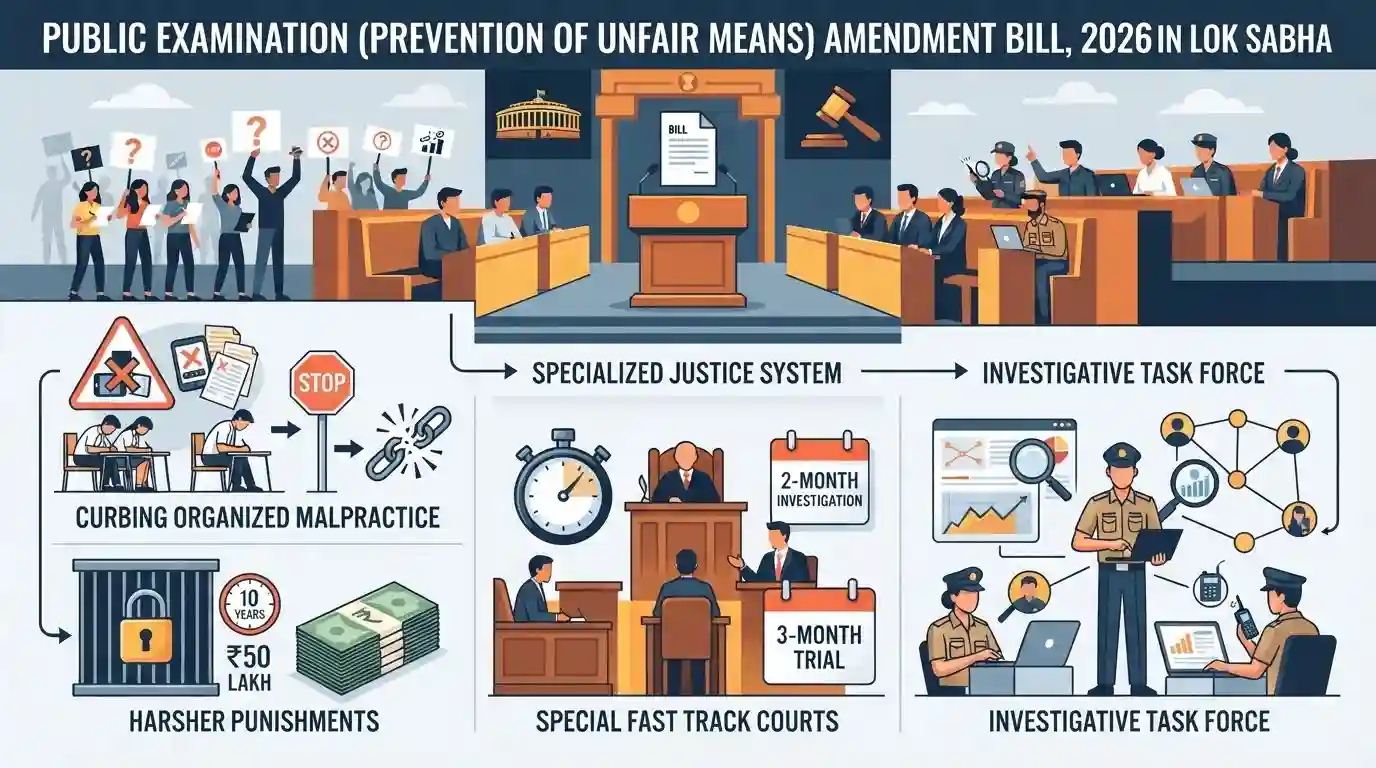
The Central Government initiated a discussion on the Public Examination (Prevention of Unfair Means) Amendment Bill, 2026 in the Lok Sabha. Aimed at curbing organized examination-related malpractice, the Bill introduces harsher punishments (up to 10 years jail and a ₹50 lakh fine), mandates Special Fast Track Courts for speedy trials (2-month investigation, 3-month trial limits), and establishes a Special Task Force to investigate organized exam crimes. The legislation comes in the wake of massive student protests over NEET exam leaks.
Key Points
- The Union Government has taken up the Public Examination (Prevention of Unfair Means) Amendment Bill, 2026 for discussion in the Lok Sabha, calling it a milestone legislation aimed at safeguarding the welfare of students.
- The Bill proposes stricter punishments, introducing up to 10 years of imprisonment and a fine of up to ₹50 lakh for offences related to paper leaks and examination malpractice.
- To ensure speedy justice, the Bill mandates the establishment of Special Fast Track Courts, stipulating that investigations must be completed within two months and trials concluded within three months from the date of filing the chargesheet.
- It empowers the Central Government to refer investigations of organised examination-related crimes to a dedicated, newly constituted Special Task Force (STF) for swift and coordinated action.
- The legislative push follows nationwide student protests over the NEET paper leak controversy, which previously led to the resignation of Dharmendra Pradhan as the Union Education Minister.
- The Opposition, which had stalled the House demanding discussion on police action against protesting students, moved 91 amendments to the Bill, with some members proposing stakeholder consultations.
Important Terms
Public Examinations (Prevention of Unfair Means) Amendment Bill, 2026

A legislative proposal to overhaul India's anti-paper leak law by introducing harsher punishments, time-bound investigations, and specialized investigative mechanisms to curb organized examination malpractices.
UPSC context
GS Paper II: Government policies, intervention, and education sector reforms. Tests policy analysis and governance.
Public Examinations (Prevention of Unfair Means) Act, 2024
India's foundational central law enacted to penalize and deter cheating, paper leaks, and organized malpractices in competitive or recruitment examinations conducted by scheduled central bodies.
UPSC context
GS Paper II: Important legislative acts and statutory frameworks for maintaining administrative transparency.
National Testing Agency (NTA)
An autonomous testing organization under the Ministry of Education, established to conduct standardized, transparent, and internationally benchmarked entrance examinations like NEET, JEE, and CUET in India.
UPSC context
GS Paper II: Development and management of education, and statutory/autonomous educational authorities.
Special Fast Track Courts
Designated sessions courts proposed to conduct daily hearings and resolve public examination fraud and leakage cases within a strict three-month timeline.
UPSC context
GS Paper II: Judicial reforms and mechanisms for speedy trial and delivery of justice.
Special Task Force
A proposed specialized central investigative unit empowered to carry out professional, time-bound investigations (completed within two months) into organized networks executing public exam frauds.
UPSC context
GS Paper III: Security challenges and police/investigative reforms. Tests institutional capacity to counter organized crime.
Prelims Trap
The Public Examinations Act automatically extends criminal penalties to all state-level public service commission and university examinations.
The central legislation only automatically governs specified central bodies (UPSC, SSC, NTA, etc.). State-level exams (like state PSCs or school boards) require separate state-enacted laws or official adoption.
Static Concepts Connected
What are the legal implications of cognizable, non-bailable, and non-compoundable offences?
- Cognizable Offence: The police can arrest the accused without a judicial warrant and commence an investigation without formal magisterial permission.
- Non-Bailable: Bail is not an absolute right of the accused; its grant remains at the statutory discretion of the court based on merit.
- Non-Compoundable: The charge cannot be privately compromised or settled out of court by the victim and the accused; it must go to trial.
What is the constitutional distribution of legislative power regarding education in India?
- Concurrent List: Education, including universities and vocational training, is placed in List III (Concurrent List) via the 42nd Amendment Act of 1976.
- Union Standards: Co-ordination and determination of standards in institutions for higher education or research fall under Entry 66 of List I (Union List).
- State Commissions: State Public Service Commissions (SPSCs) are constitutionally governed under Article 315-323, falling under state legislative competence.
Cross-Topic Patterns
Digital infrastructure + Exam security
The Nandan Nilekani task force's focus on secure digital systems links education sector governance (GS2) with critical information infrastructure protection and cybersecurity protocols (GS3).
Judicial reform + Special courts
Imposing strict statutory timelines for trials under this Bill intersects with the broader debate on judicial pendency, structural vacancies, and the efficacy of Fast-Track Special Courts.

Expect a multi-statement question on the 2024/2026 Exam Act's jurisdiction (central vs state) and its criminal classifications.
Linked PYQs · 1
Linked PYQs · 1
- 2024MainsGS2
What are the aims and objects of recently passed and enforced, The Public Examination (Prevention of Unfair Means) Act, 2024? Whether University/State Education Board examinations, too, are covered under the Act ?
