Institutional Decay versus Parliamentary Deadlocks in Democracy
Source:Indian Express ↗
Why It Matters
It provides a critical analytical perspective for GS-2 on the distinction between visible legislative inefficiency (deadlocks) and invisible systemic decay (loss of institutional autonomy), essential for answering questions on democratic accountability, executive overreach, and the health of constitutional bodies.
Summary
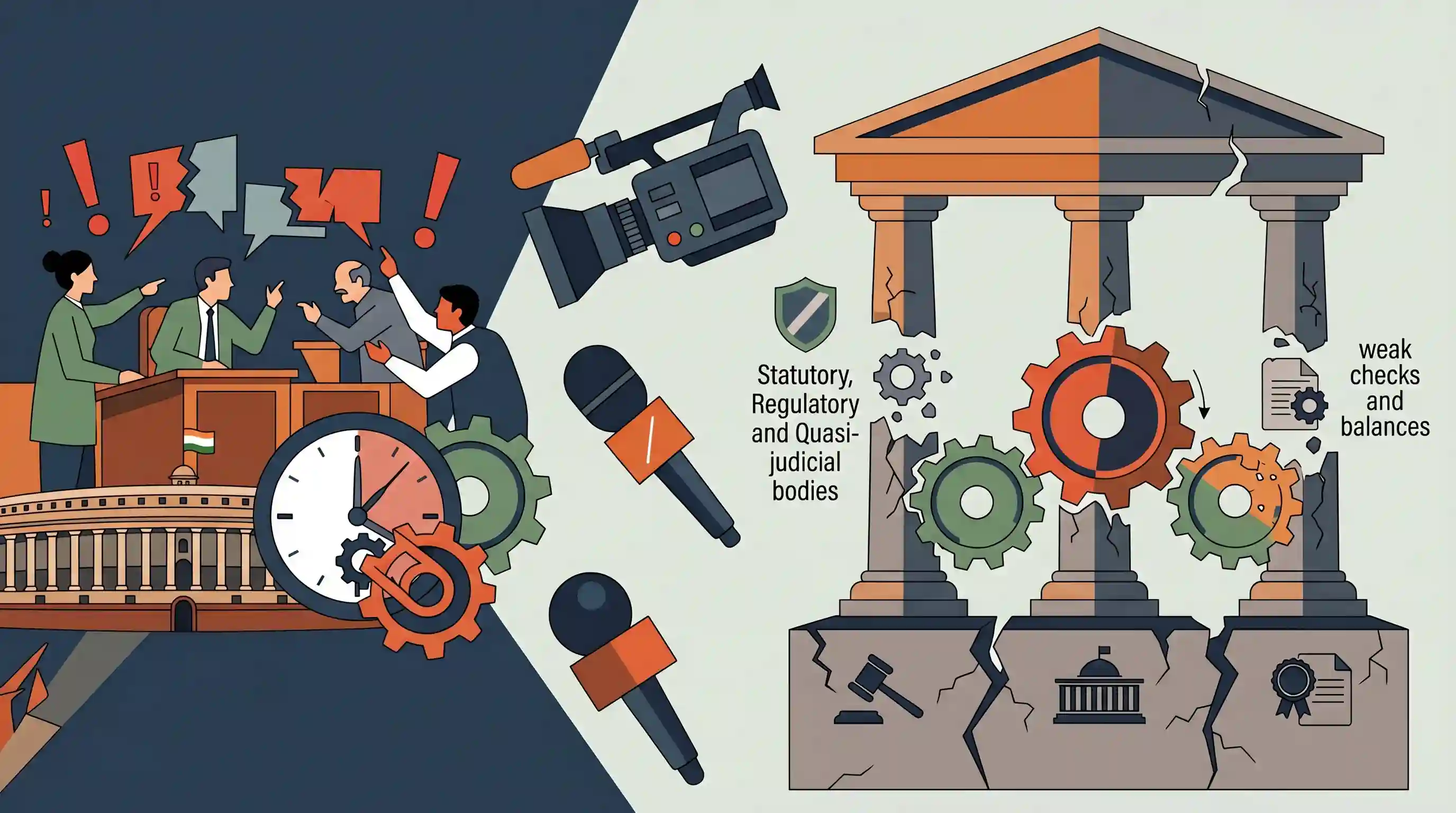
The article argues that while parliamentary disruptions and deadlocks attract significant public and media attention, the true danger to Indian democracy lies in the systemic 'hollowing out' of its institutions. It highlights that an erosion of institutional autonomy and the weakening of checks and balances are far more detrimental than temporary legislative stalls. The commentary shifts the focus from merely ensuring smooth parliamentary sessions to the urgent need of preserving the structural integrity, independence, and effectiveness of democratic and regulatory institutions that hold the executive accountable.
Key Points
- Parliamentary deadlocks and disruptions, while visible and problematic, are temporary political phenomena compared to the deeper systemic threat of institutional decay.
- The 'hollowing out' of democratic institutions—referring to the loss of their autonomy, independence, and functional integrity—poses a severe long-term danger to democratic checks and balances.
- Erosion of institutional oversight leads to diminished accountability of the executive branch, undermining the constitutional separation of powers.
- Safeguarding the structural integrity and independence of key institutions (such as regulatory bodies and investigative agencies) is more critical for a healthy democracy than merely ensuring a functional legislative session.
Important Terms
Institutional Hollowing Out

The process where democratic or regulatory institutions maintain their formal structure but lose their independence, effectiveness, and credibility due to political interference, systemic neglect, or the erosion of norms.
UPSC context
GS Paper 2: Tests understanding of institutional integrity versus procedural democracy and its impact on the 'Basic Structure' doctrine.
Executive Accountability
The constitutional requirement (Articles 75 and 164) that the Council of Ministers must be answerable to the Legislature for their actions, policies, and expenditures to ensure democratic control.
UPSC context
GS Paper 2: Core principle of the Parliamentary system; tested via mechanisms like Question Hour and No-Confidence Motions.
Checks and Balances
A constitutional doctrine where the Executive, Legislature, and Judiciary exercise mutual oversight to prevent any single branch from gaining absolute power or violating the Constitution.
UPSC context
GS Paper 2: Fundamental concept of Indian Polity; tests knowledge of inter-organ relations and the separation of powers.
Institutional Autonomy
The degree of independence a body (like ECI or RBI) has from executive or partisan control, enabling it to fulfill its mandate impartially and without fear or favor.
UPSC context
GS Paper 2: Critical for the 'Independence of Judiciary' and the fair functioning of regulatory and constitutional bodies.
Parliamentary Deadlock
A state of legislative paralysis occurring when persistent disruptions, protests, or a lack of consensus between the ruling party and the opposition stall parliamentary proceedings and law-making.
UPSC context
GS Paper 2: Relates to declining legislative productivity and the need for parliamentary reforms to restore deliberative democracy.
Constitutional Bodies
Independent entities established directly by the Constitution of India (e.g., CAG, ECI, UPSC) to perform essential governance functions that require protection from political influence.
UPSC context
GS Paper 2: Explicit syllabus topic; tests knowledge of their appointment, powers, and role in upholding democratic values.
Prelims Trap
"Withdrawal of general consent by a State totally bars the CBI from probing any case within that State's territory."
False. The Supreme Court and High Courts can direct the CBI to investigate cases in a state without its consent. Previously registered cases also remain unaffected.
Static Concepts Connected
How does 'general consent' for the CBI operate under the DSPE Act?
- Legal Basis: The CBI derives its investigative powers from the Delhi Special Police Establishment (DSPE) Act, 1946. It is not a statutory body in the traditional sense, nor a constitutional one.
- Section 6 mandate: Section 6 of the DSPE Act mandates that the CBI must obtain the state government's consent to exercise jurisdiction within that specific state's territory.
- Judicial Exception: The Supreme Court and High Courts can order CBI investigations anywhere in the country, completely bypassing the requirement for the respective state's consent.
What are the core parliamentary mechanisms for ensuring continuous executive accountability?
- Question Hour: The first hour of a sitting allows MPs to elicit factual information from ministers regarding government administration, guaranteeing day-to-day accountability.
- Motions & Resolutions: Adjournment motions, censure motions, and no-confidence motions force the executive to defend its actions on the floor, testing its policy merit and legislative majority.
- Parliamentary Committees: Department-Related Standing Committees (DRSCs) perform detailed, non-partisan scrutiny of legislation, budgets, and policies away from the politically charged environment of the main House.
Cross-Topic Patterns
Federalism vs. Central investigative agencies
The politicization of central agencies like the CBI and ED directly fuels Centre-State friction, frequently tested in GS-2 alongside the partisan role of Governors and fiscal centralization.
Bypassing legislative scrutiny
The 'hollowing out' narrative connects with the executive's increasing use of Ordinances, classification of laws as Money Bills, and shortened sessions to bypass rigorous parliamentary checks.

Expect a GS-2 Mains question linking parliamentary deadlocks to 'cabinet dictatorship' and the erosion of autonomy in regulatory bodies.
Linked PYQs · 4
Linked PYQs · 4
- 2019MainsGS2
Individual Parliamentarian's role as the national law maker is on a decline, which in turn, has adversely impacted the quality of debates and their outcome. Discuss.
- 2024MainsGS2
“The growth of cabinet system has practically resulted in the marginalisation of the parliamentary supremacy.” Elucidate.
- 2015MainsGS2
For achieving the desired objectives, it is necessary to ensure that the regulatory institutions remain independent and autonomous. Discuss in the light of the experiences in recent past.
- 2021MainsGS2
To what extent, in your view, the Parliament is able to ensure accountability of the executive in India?
