Special Intensive Revision of Electoral Rolls and Citizenship Proof
Source:Indian Express ↗
Why It Matters
The article addresses critical overlaps between electoral integrity, citizenship verification, and fundamental democratic rights. It is highly relevant for GS2 Polity questions concerning the Election Commission's mandate, electoral reforms, and the balance between state administrative processes and citizens' constitutional rights.
Summary
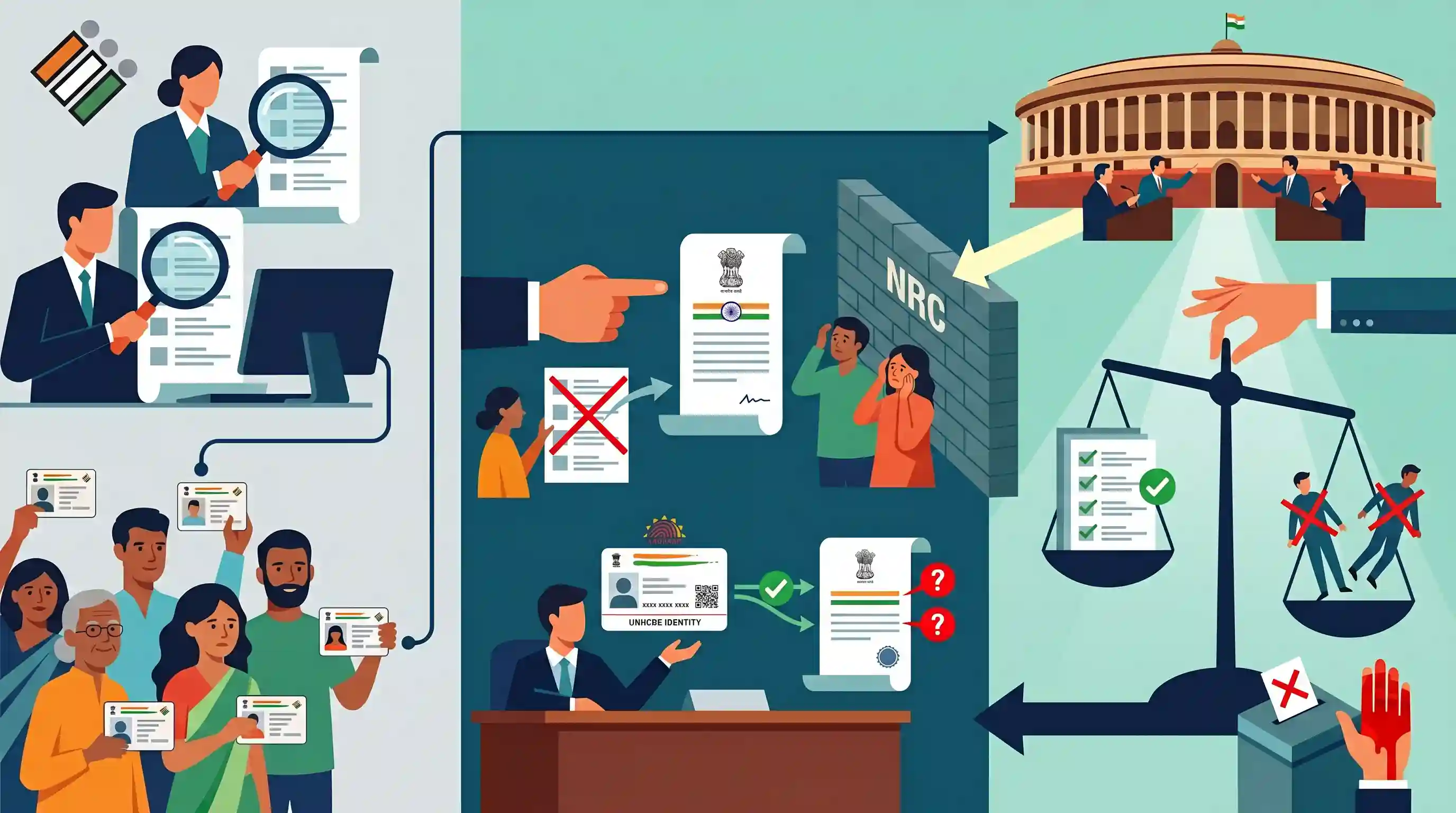
The editorial examines the debate over the Election Commission of India's Special Intensive Revision (SIR) of electoral rolls. Opposition leaders have raised concerns that the exercise functions as a backdoor National Register of Citizens (NRC) by demanding proof of citizenship from voters when their inclusion is challenged. This shifts the burden of proof to the individual, increasing the risk of mass disenfranchisement. The piece notes the Supreme Court's stance that Aadhaar is proof of identity rather than citizenship, further highlighting the complexities of the ECI's verification process. The author concludes that parliamentary scrutiny and debate are essential to balance the integrity of electoral rolls with safeguarding the constitutional right to vote.
Key Points
- The Election Commission's Special Intensive Revision (SIR) of electoral rolls has sparked controversy over fears of mass voter disenfranchisement.
- Opposition MPs argue the process resembles a backdoor National Register of Citizens (NRC) by demanding additional citizenship proofs from voters facing objections.
- The current procedure shifts the burden of proof onto the voter, which is criticized as problematic and contrary to the presumption of citizenship.
- The Supreme Court has maintained that Aadhaar serves as proof of identity, not citizenship, complicating the ECI's verification demands.
- A comprehensive parliamentary debate is advocated to ensure the pursuit of clean electoral rolls does not infringe upon the constitutional right to vote.
Important Terms
Election Commission of India (ECI)

An autonomous constitutional authority established under Article 324 to conduct and supervise elections for Parliament, State Legislatures, and the offices of the President and Vice-President.
UPSC context
GS Paper II (Polity); essential for understanding constitutional bodies, the electoral process, and the integrity of democratic institutions.
Representation of the People Act (RPA)
The dual legislation (1950 and 1951 Acts) providing the legal framework for the allocation of seats, delimitation of constituencies, voter registration, and the actual conduct of elections in India.
UPSC context
GS Paper II (Polity); a core syllabus topic testing knowledge of electoral laws, voter eligibility, and candidate qualifications.
National Register of Citizens (NRC)
An official record mandated by the 2003 amendment of the Citizenship Act, 1955, meant to document all legal citizens of India to identify illegal immigrants.
UPSC context
GS Paper II (Polity/Governance); tests understanding of citizenship, migration, and the impact of government policies on constitutional rights.
Special Intensive Revision (SIR)
A targeted ECI exercise involving house-to-house verification and document scrutiny to ensure the accuracy and integrity of electoral rolls, often focusing on identifying and removing ineligible or fraudulent entries.
UPSC context
GS Paper II (Polity/Elections); relevant for current affairs regarding electoral reforms and the ECI's administrative powers.
Aadhaar Act
A 2016 statute providing legal backing for the 12-digit unique ID; the Supreme Court (Puttaswamy case) clarified it as proof of identity/residence but not citizenship.
UPSC context
GS Paper II/III; crucial for discussions on digital governance, privacy rights, and the distinction between identity and citizenship.
Citizenship Act
The fundamental 1955 legislation enacted under Article 11 that prescribes the modes of acquiring (birth, descent, registration, etc.) and losing Indian citizenship.
UPSC context
GS Paper II (Polity); foundational for topics related to Part II of the Constitution and current legal debates on nationality.
Prelims Trap
Aadhaar serves as proof of citizenship for inclusion in the electoral roll under RPA 1950.
The Supreme Court and the Aadhaar Act explicitly state that Aadhaar is proof of identity and residence, never citizenship or domicile.
Static Concepts Connected
What is the core difference between RPA 1950 and RPA 1951?
- RPA 1950: Deals with the preparation of electoral rolls, voter qualifications, delimitation of constituencies, and allocation of seats.
- RPA 1951: Governs the actual conduct of elections, candidate qualifications, disqualifications, and corrupt electoral practices.
How is the burden of proof assigned under the Foreigners Act, 1946?
- Reverse Burden: Under Section 9, the burden of proving that a person is not a foreigner lies entirely on the individual accused, not the State.
- SIR Controversy: Applying this logic to electoral roll objections shifts the burden to marginalized voters to prove citizenship, risking mass disenfranchisement.
Cross-Topic Patterns
SIR overlapping with NRC anxieties
Administrative roll revisions (SIR) are increasingly conflated with citizenship determination, linking ECI's electoral mandate directly to the socio-political debates surrounding the NRC and Citizenship Act.
Aadhaar's limits and right to vote
The push to verify electoral rolls tests the limits of the Puttaswamy judgment, reiterating that Aadhaar validates identity, not the constitutional right to vote as an Indian citizen.

Expect a 2026 Prelims question mixing ECI's powers under RPA 1950, Right to Vote under Art 326, and Aadhaar's validity for citizenship.
Linked PYQs · 5
Linked PYQs · 5
- 2024MainsGS2
Examine the need for electoral reforms as suggested by various committees with particular reference to "one nation one election" principle.
- 2017MainsGS2
To enhance the quality of democracy in India the Election Commission of India has proposed electoral reforms in 2016. What are the suggested reforms and how far are they significant to make democracy successful?
- 2017PrelimsGS1
Right to vote and to be elected in India is a
- 2018PrelimsGS1
Consider the following statements: 1. Aadhaar card can be used as a proof of citizenship or domicile. 2. Once issued, Aadhaar number cannot be deactivated or omitted by the Issuing Authority. Which of the statements given above is/are correct?
- 2021PrelimsGS1
With reference to India, consider the following statements : 1. There is only one citizenship and one domicile. 2. A citizen by birth only can become the Head of State. 3. A foreigner once granted the citizenship cannot be deprived of it under any circumstances. Which of the statements given above is/are correct?
