Operation Sindoor Geopolitics and Strategic Autonomy
Source:Indian Express ↗
Why It Matters
This article is crucial for understanding the interplay between domestic internal security crises (terrorism in J&K) and global geopolitics. It illustrates how external actors like the US and China can influence India's military decisions and strategic autonomy, directly relating to GS2 (International Relations) and GS3 (Internal Security).
Summary
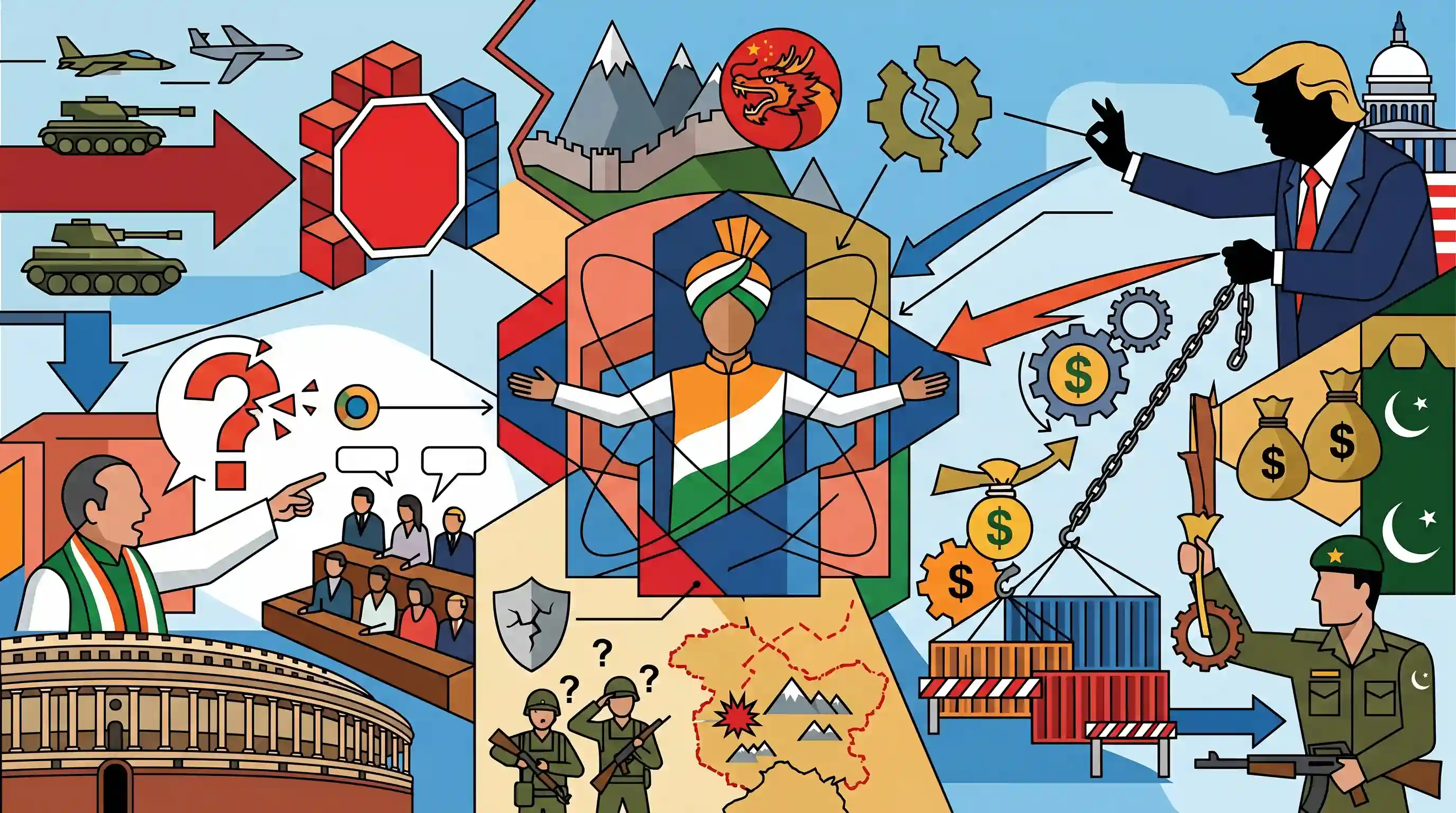
Following the controversial halting of 'Operation Sindoor', which was launched in retaliation for the Pahalgam terror attacks, the opposition Congress party demanded answers in Parliament. The debate underscores significant internal security lapses in Jammu and Kashmir and challenges facing military operations, including admitted tactical mistakes and friction with China. Compounding the issue is the geopolitical dimension, with US President Donald Trump claiming he halted the operation via trade threats, coinciding with renewed US support for the Pakistani military establishment, highlighting constraints on India's strategic autonomy.
Key Points
- The Congress party pressed for a debate in Parliament regarding 'Operation Sindoor', which was initiated following the April 22 Pahalgam terror attack.
- Opposition leaders flagged intelligence and security failures, noting the terrorists involved were also tied to earlier attacks in Poonch, Gangagir, and Gulmarg.
- Senior defense officials admitted to tactical mistakes, political interference hampering operations, and unexpected hardware/software engagements with China during the operation.
- US President Donald Trump claimed he forced the halt of Operation Sindoor by threatening to cut off trade with India, pointing to friction in Indo-US strategic autonomy.
- The US has concurrently been bolstering ties with Pakistan's military, with US officials referring to Pakistan as a 'phenomenal partner' in counter-terrorism.
Important Terms
Operation Sindoor

A May 2025 Indian military operation involving precision strikes against Pakistan-based terror infrastructure, launched in retaliation for the Pahalgam terror massacre.
UPSC context
GS III (Security); tests India's 'New Normal' retaliatory doctrine, surgical strike capabilities, and conflict escalation management.
Strategic Autonomy
The ability of a nation to pursue its sovereign interests and independent foreign policy without being structurally dependent on or coerced by external powers.
UPSC context
GS II (International Relations); critical for understanding India’s balancing act between the US, Russia, and China.
Cross-border Terrorism
State-sponsored or supported terrorist activities originating from one country to target another; a form of 'grey zone' conflict aimed at long-term destabilization.
UPSC context
GS III (Internal Security); essential for questions on border management, proxy wars, and national security challenges.
US Central Command (CENTCOM)
The US unified combatant command responsible for operations in the Middle East and Central Asia, including maintaining security ties with the Pakistani military.
UPSC context
GS II (International Relations); relevant to US-India-Pakistan 'de-hyphenation' and its impact on South Asian security architecture.
Civil-Military Relations
The hierarchy of authority where a state's elected political leadership exercises ultimate control over military policy and strategic operational decisions.
UPSC context
GS II (Governance/Polity); concerns constitutional oversight of the armed forces and accountability for military failures or successes.
Pakistan Army
The principal land warfare branch of Pakistan's military, frequently engaged in counter-terrorism (against ISIS-K) while being accused of supporting anti-India proxies.
UPSC context
GS III (Internal Security); central to understanding the security landscape of Jammu & Kashmir and cross-border hostility.
Prelims Trap
"Operation Sindoor is a bilateral military exercise between India and the United States."
It was a unilateral Indian counter-terror operation in J&K. The US was only involved externally, allegedly using trade threats to halt it.
Static Concepts Connected
What constitutes 'Strategic Autonomy' in India's foreign policy framework?
- Multi-alignment: Shifting from strict non-alignment to issue-based partnerships while retaining independent sovereign decision-making.
- Defense indigenization: Reducing reliance on foreign military hardware and technology to prevent external leverage during crises.
- Economic resilience: Diversifying trade and energy ties to mitigate vulnerabilities to sanctions, trade wars, or economic coercion.
How do non-kinetic engagements threaten traditional military counter-terror operations?
- Electronic Warfare: Jamming communications and radar systems to blind tactical operations and disrupt troop coordination.
- Cyber Espionage: Exploiting hardware backdoors and software vulnerabilities to extract strategic operational plans in real-time.
- C4ISR Vulnerability: Disrupting Command, Control, Communications, Computers, Intelligence, Surveillance, and Reconnaissance (C4ISR) systems.
Cross-Topic Patterns
Economic Coercion vs Strategic Autonomy
US trade threats halting Indian operations exposes how economic dependencies act as security vetoes, bridging GS-2 (International Relations) and GS-3 (Economy).
China's Non-Kinetic Two-Front Threat
Chinese software interference during a localized counter-terror op reveals that the 'two-front war' is already active in the digital and cyber warfare domains.

Expect a GS-3 Mains question linking cyber vulnerabilities (China) and economic reliance (US) as dual threats to India's strategic autonomy.
Linked PYQs · 4
Linked PYQs · 4
- 2019MainsGS2
‘What introduces friction into the ties between India and the United States is that Washington is still unable to find for India a position in its global strategy, which would satisfy India's national self-esteem and ambitions.’ Explain with suitable examples.
- 2024MainsGS3
India has a long and troubled border with China and Pakistan fraught with contentious issues. Examine the conflicting issues and security challenges along the border. Also give out the development being undertaken in these areas under the Border Area Development Programme (BADP) and Border Infrastructure and Management (BIM) Scheme.
- 2023MainsGS3
What are the internal security challenges being faced by India? Give out the role of Central Intelligence and Investigative Agencies tasked to counter such threats.
- 2025MainsGS3
Terrorism is a global scourge. How has it manifested in India? Elaborate with contemporary examples. What are the counter measures adopted by the State? Explain.
