Prime Minister Addresses Parliament on Economy and Foreign Policy
Source:Indian Express ↗
Why It Matters
The Prime Minister's address touches upon crucial GS2 and GS3 topics simultaneously, linking international trade achievements, structural banking reforms, and cooperative federalism via NITI Aayog. Furthermore, the persistent parliamentary disruptions offer a real-world case study on decorum and the Speaker's disciplinary powers.
Summary
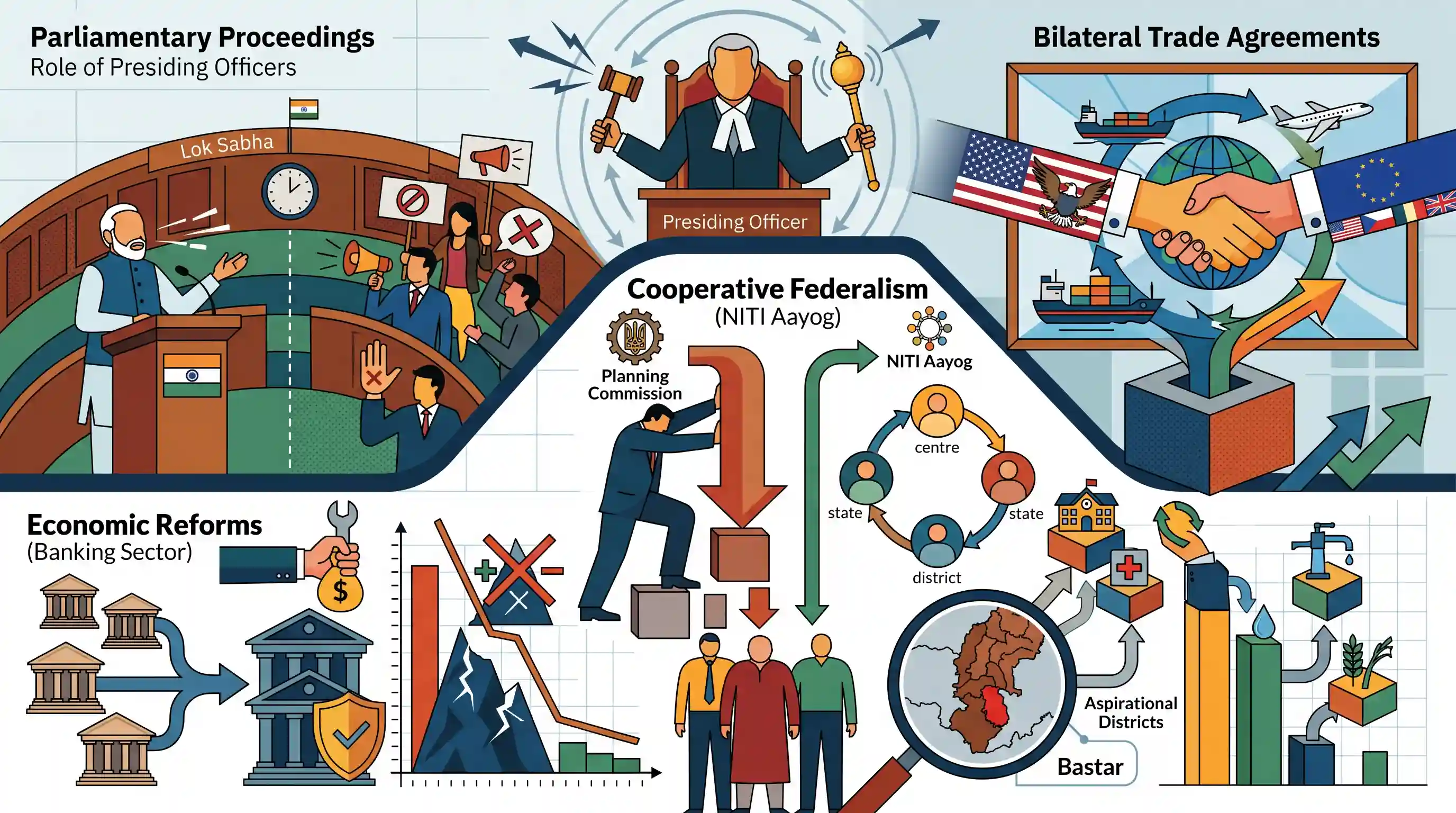
During the Parliament Budget Session, PM Modi replied to the Motion of Thanks on the President's Address amid Opposition protests, emphasizing the nation's political stability and recently concluded landmark trade agreements with the EU and the US. He outlined economic achievements including banking sector reforms (PSB mergers and NPA reduction) and contrasting NITI Aayog's approach with the Planning Commission, citing the Aspirational Districts programme's impact in areas like Bastar. The session also underscored challenges regarding parliamentary decorum and the Speaker's role in maintaining order.
Key Points
- PM Modi replied to the Motion of Thanks on the President's Address, emphasizing political stability and landmark trade deals recently signed with the EU and the US.
- The session underscored the distinction between NITI Aayog and the erstwhile Planning Commission, highlighting developmental interventions in marginalized areas like Bastar through the Aspirational Districts programme.
- The government's economic record was defended by citing successful reforms such as the merger of public sector banks to reduce Non-Performing Assets (NPAs).
- Opposition protests during the address brought focus to parliamentary decorum, the role of the Speaker in maintaining order, and the challenges of ensuring executive accountability in a polarized environment.
Important Terms
Motion of Thanks on the President's Address

A formal parliamentary procedure where members discuss the President's address (Article 87). It serves as a review of government policies and its passage is mandatory to prove legislative majority.
UPSC context
GS Paper II (Parliament). Tests knowledge of constitutional procedures, government accountability, and the executive-legislative relationship.
Aspirational Districts Programme
A NITI Aayog initiative launched in 2018 to transform 112 underdeveloped districts. It focuses on convergence, collaboration, and competition using monthly "delta rankings" across socio-economic sectors.
UPSC context
GS Paper II (Governance). Tests understanding of decentralized planning, data-driven governance, and efforts to address regional disparities.
NITI Aayog
National Institution for Transforming India; a policy think-tank established in 2015. It replaced the Planning Commission to promote "bottom-up" planning and cooperative federalism through its Governing Council.
UPSC context
GS Paper II (Constitutional/Statutory Bodies). Tests knowledge of institutional shifts in Indian governance and federal relations.
Planning Commission
A former extra-constitutional body (1950–2014) that formulated Five-Year Plans. It followed a "top-down" approach and possessed authority to allocate central funds to states.
UPSC context
GS Paper III (Economy). Tests historical understanding of India’s economic planning and the transition to market-oriented reforms.
Cooperative Federalism
A constitutional principle where Union and State governments work collaboratively on national agendas. It is a core pillar of NITI Aayog's functioning and resource-sharing framework.
UPSC context
GS Paper II (Federalism). Tests knowledge of evolving Centre-State relations and participatory governance models in India.
India-EU Free Trade Agreement (FTA)
A major economic agreement providing Indian manufacturers duty-free access to 27 European countries. It aims to boost exports, employment, and adherence to global quality standards.
UPSC context
GS Paper II (International Relations). Tests understanding of bilateral trade, economic diplomacy, and global market integration.
Prelims Trap
"The defeat of the Motion of Thanks in either House of Parliament leads to the resignation of the government."
The defeat of the Motion of Thanks amounts to a no-confidence vote only in the Lok Sabha. Its defeat in the Rajya Sabha does not mandate the government's resignation.
Static Concepts Connected
What is the constitutional significance of the Motion of Thanks?
- Article 87: Mandates the President to address both Houses assembled together at the commencement of the first session of each year and after general elections.
- Vote of Confidence: Its passage in the Lok Sabha is essential; defeat is treated as a loss of majority, implicitly leading to the fall of the government.
- Amendments allowed: MPs can move amendments to the Motion of Thanks, which are debated and put to vote, often serving to highlight specific omissions by the government.
How does the Aspirational Districts Programme (ADP) measure progress?
- Core Strategy: Operates on the 3Cs: Convergence (of Central & State Schemes), Collaboration (between Nodal Officers & Collectors), and Competition (among districts).
- Delta Ranking: Uses a real-time tracking dashboard to rank 112 districts based on progress across 49 indicators in 5 broad socio-economic themes.
- Key Focus Areas: Prioritizes Health & Nutrition (30% weightage), Education (30%), Agriculture & Water Resources (20%), Financial Inclusion & Skill Development (10%), and Basic Infrastructure (10%).
Cross-Topic Patterns
NITI Aayog + Competitive Federalism
The Aspirational Districts Programme shifts governance from traditional fund-allocation to data-driven 'competitive federalism', directly contrasting with the Planning Commission's centralized, top-down approach.
Parliamentary Rules + Executive Accountability
Frequent parliamentary disruptions test the Speaker's discretionary powers under Rules of Procedure, linking directly to the effectiveness of constitutional tools like the Motion of Thanks in ensuring executive accountability.

Expect a 2026 prelims multi-statement question linking the procedural rules of the Motion of Thanks with the Speaker's disciplinary powers.
Linked PYQs · 5
Linked PYQs · 5
- 2018MainsGS3
How are the principles followed by the NITI Aayog different from those followed by the erstwhile Planning Commission in India?
- 2000PrelimsGS1
The Speaker can ask a member of the House to stop speaking and let another member speak. This phenomenon is known as
- 2025PrelimsGS1
Consider the following statements : I. On the dissolution of the House of the People, the Speaker shall not vacate his/her office until immediately before the first meeting of the House of the People after the dissolution. II. According to the provisions of the Constitution of India, a Member of the House of the People on being elected as Speaker shall resign from his/her political party immediately. III. The Speaker of the House of the People may be removed from his/her office by a resolution of the House of the People passed by a majority of all the then Members of the House, provided that no resolution shall be moved unless at least fourteen days' notice has been given of the intention to move the resolution. Which of the statements given above are correct?
- 2021MainsGS2
To what extent, in your view, the Parliament is able to ensure accountability of the executive in India?
- 2023MainsGS2
Discuss the role of Presiding Officers of state legislatures in maintaining order and impartiality in conducting legislative work and in facilitating best democratic practices.
