Budget Session Debates on Energy Security and Corporate Laws
Source:The Hindu ↗
Why It Matters
The session highlights the intersection of global geopolitics with domestic energy security, the ongoing structural reforms in corporate governance, and the socio-economic impacts of FTAs and off-budget borrowings. Furthermore, the debate on transgender rights brings critical focus to the evolving constitutional perspective on gender justice and bodily autonomy.
Summary
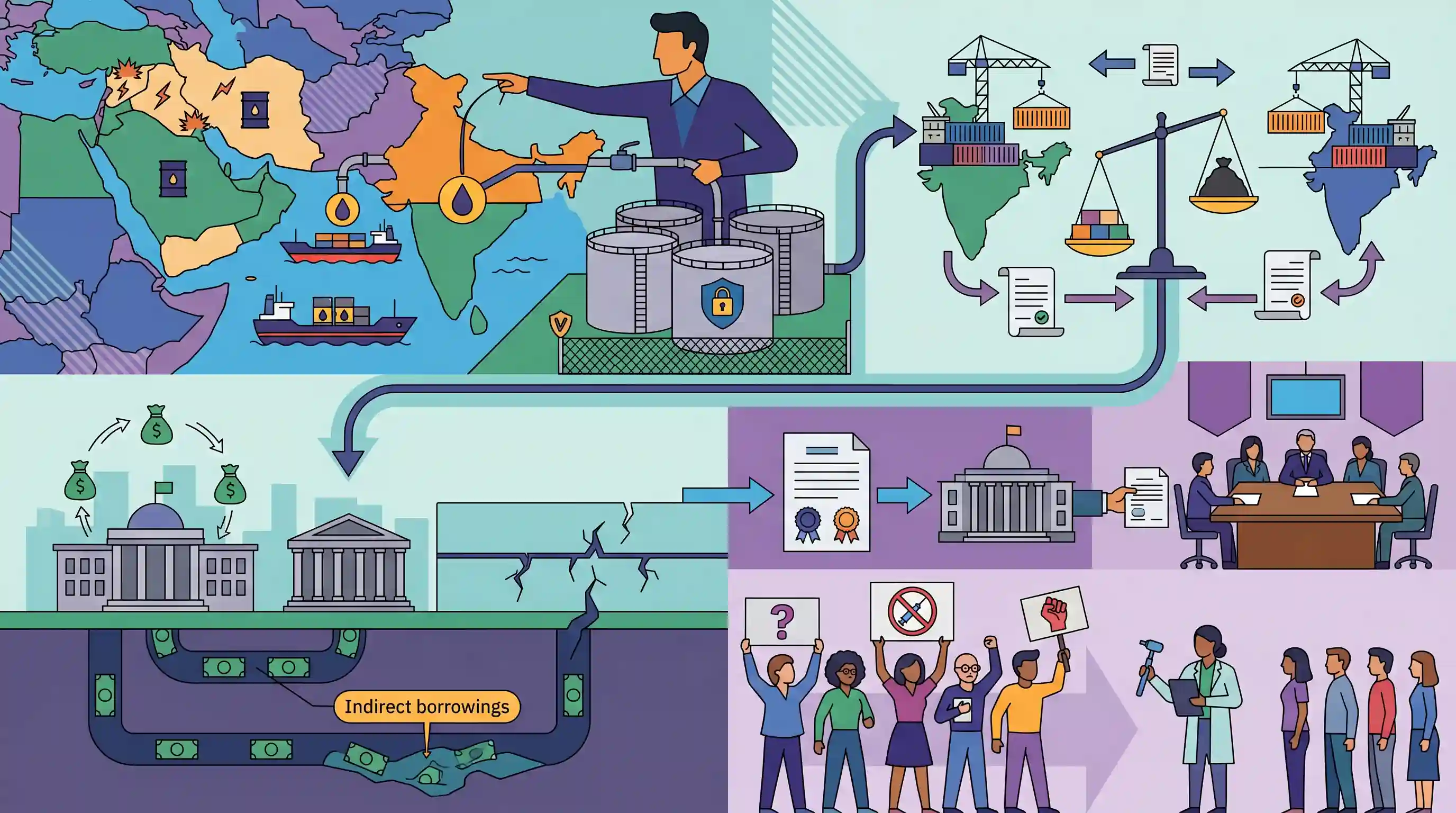
Parliament's Budget Session (Phase 2) witnessed discussions on the geopolitical and economic impact of the West Asia conflict, with PM Modi highlighting measures for energy security including Strategic Petroleum Reserves. The Corporate Laws (Amendment) Bill, 2026 was introduced and referred to a JPC, while concerns were raised over FTAs widening the trade deficit and indirect borrowing impacting fiscal discipline under the FRBM Act. Separately, opposition grew against proposed amendments to the Transgender Persons Act that mandate a medical board for gender identity determination.
Key Points
- Prime Minister Modi addressed the Lok Sabha on the West Asia conflict, noting its impact on cargo via the Strait of Hormuz and LPG supplies, while highlighting India's 53 lakh metric tonnes of strategic petroleum reserves.
- The Corporate Laws (Amendment) Bill, 2026, which seeks to amend the LLP Act, 2008, and Companies Act, 2013, was introduced and referred to a Joint Parliamentary Committee (JPC).
- Amendments to the Transgender Persons (Protection of Rights) Act, 2019 are facing opposition for proposing a medical board requirement in place of self-perceived gender identity.
- Concerns were raised in Parliament regarding India's Free Trade Agreements (FTAs) with ASEAN, UAE, Japan, and South Korea, which have increased the trade deficit.
- Off-budget borrowings by the Railways via leases were criticized as indirect debt that undermines the Fiscal Responsibility and Budget Management (FRBM) Act.
Important Terms
Corporate Laws (Amendment) Bill, 2026

2026 legislation amending the Companies Act 2013 and LLP Act 2008. It focuses on decriminalizing procedural defaults, raising CSR thresholds to ₹10 crore, and improving ease of doing business.
UPSC context
GS Paper 2 & 3: Tests understanding of legislative reforms for ease of doing business and corporate governance frameworks.
Transgender Persons (Protection of Rights) Amendment Bill, 2026
A 2026 amendment mandating medical board certification for gender identity, replacing self-determination. It narrows the transgender definition, impacting rights established by the 2014 NALSA judgment.
UPSC context
GS Paper 2: Tests knowledge of rights for vulnerable sections and judicial vs. legislative authority.
Fiscal Responsibility and Budget Management (FRBM) Act
A 2003 law mandating fiscal discipline. In 2026, targets shifted toward a 'Debt-to-GDP' glide path (50% by 2030-31) amidst debates on the transparency of off-budget borrowings.
UPSC context
GS Paper 3: Essential for fiscal policy, budgeting, and debt sustainability topics.
Strategic Petroleum Reserves (SPR)
Emergency crude oil stockpiles for energy security. In 2026, India planned to double capacity to ~11 MMT to mitigate supply risks from West Asian conflicts and maritime chokepoints.
UPSC context
GS Paper 3: Relevant for energy security and strategic responses to geopolitical volatility.
PM Vidyalaxmi Scheme
A 2024-launched central scheme providing collateral-free education loans up to ₹10 lakh for students in top-ranked institutions, featuring interest subventions for those with family incomes under ₹8 lakh.
UPSC context
GS Paper 2: Important for government welfare schemes and access to higher education.
Joint Parliamentary Committee (JPC)
An ad-hoc committee comprising members from both Lok Sabha and Rajya Sabha. In 2026, the Corporate Laws Bill was referred to a 31-member JPC for clause-by-clause scrutiny.
UPSC context
GS Paper 2: Tests knowledge of parliamentary oversight tools and bill scrutiny procedures.
Prelims Trap
"Certificates of transgender identity require mandatory medical board approval under current law."
Aspirants confuse the proposed 2026 amendment (which demands a medical board) with the existing 2019 Act, which fundamentally relies on self-perceived identity via a District Magistrate affidavit.
Static Concepts Connected
What is the structure of India's Strategic Petroleum Reserves (SPR)?
- Locations: Phase-I includes underground rock caverns in Visakhapatnam, Mangaluru, and Padur (5.33 MMT). Phase-II aims to add commercial-cum-strategic capacity at Chandikhol and Padur.
- Management: Managed by Indian Strategic Petroleum Reserves Limited (ISPRL), a wholly-owned subsidiary of the Oil Industry Development Board under the Ministry of Petroleum and Natural Gas.
- IEA Mandate: As an associate member, India works toward the IEA mandate of holding 90 days of net oil imports, combining SPR with commercial refinery storage.
How do off-budget borrowings bypass the FRBM Act?
- Mechanism: Loans taken by state/central entities (like PSU leases) where the principal and interest are paid from the government budget, circumventing official debt limits.
- FRBM Impact: They artificially deflate the reported fiscal deficit, making it appear that the government is adhering to FRBM Act targets while actual public debt obligations rise.
- CAG Scrutiny: The CAG frequently flags these 'extra-budgetary resources' as they compromise fiscal transparency and obscure the true macroeconomic liabilities of the state.
Cross-Topic Patterns
Chokepoints and macroeconomic stability
Disruptions in the Strait of Hormuz don't just threaten energy supply; they trigger freight cost surges, imported inflation, and current account deficit (CAD) widening, directly testing RBI's inflation targeting.
FTAs and inverted duty structures
Widening trade deficits with ASEAN, Japan, and South Korea highlight structural flaws, where tariff-free imports of finished goods outpace domestic exports, often conflicting with 'Make in India' objectives.
NALSA verdict vs Legislative intent
The tension between the Supreme Court's 2014 NALSA judgment protecting self-perceived gender identity and Parliament's proposed medical board mandates illustrates a classic judicial-legislative friction regarding fundamental rights.

A 2026 Prelims question mapping West Asian maritime chokepoints directly to India's Strategic Petroleum Reserve locations is highly likely.
Linked PYQs · 3
Linked PYQs · 3
- 2025MainsGS3
Why is maritime security vital to protect India's sea trade? Discuss maritime and coastal security challenges and the way forward.
- 2013MainsGS3
What were the reasons for the introduction of Fiscal Responsibility and Budget Management (FRBM) Act, 2003 ? Discuss critically its salient features and their effectiveness.
- 2023MainsGS2
Explain the constitutional perspectives of Gender Justice with the help of relevant Constitutional Provisions and case laws.
