Parliament Budget Session Schedule and Committee Scrutiny Timelines
Source:The Hindu ↗
Why It Matters
The Parliament's Budget session is a cornerstone of India's democratic and financial governance. For UPSC aspirants, understanding the timeline of sessions (summoning, prorogation, and recess), the constitutional provisions guiding the President's address (Article 87), and the crucial oversight role played by Department Related Standing Committees in reviewing budgetary allocations (Article 112) is fundamentally important for both Prelims and Mains.
Summary
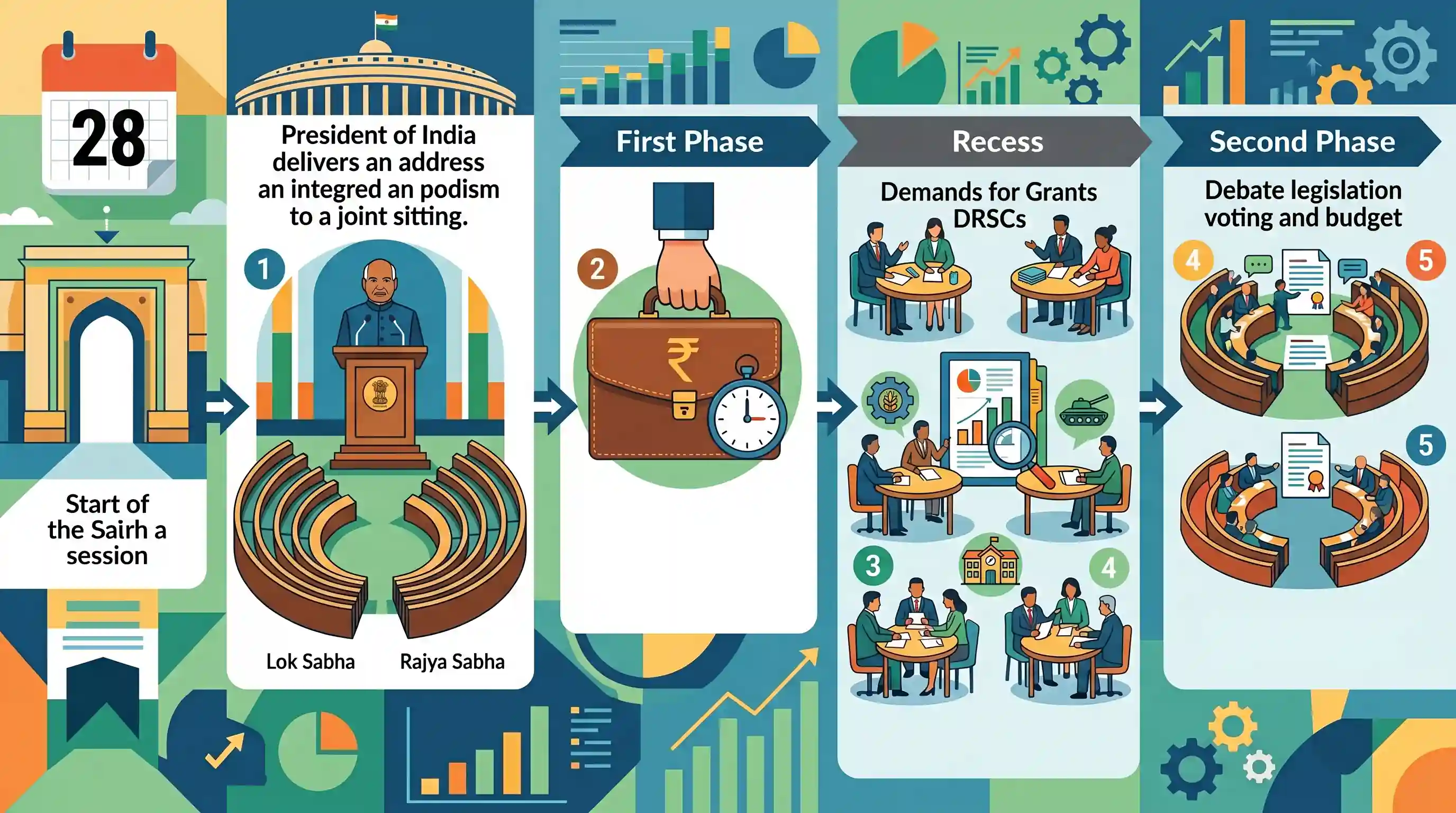
The Union Parliament's Budget session is set to commence on January 28, 2026, featuring the presentation of the Union Budget on February 1. The session is structured in two phases, separated by a standard recess period. The recess is designed to give Parliamentary Department Related Standing Committees (DRSCs) adequate time to scrutinize the detailed budgetary demands for grants of various Union ministries. The opening of the session will be marked by the President's address to a joint sitting of both Houses.
Key Points
- The Budget session of Parliament will commence on January 28, 2026, and the Union Budget will be presented on February 1.
- The session will be divided into two phases: the first from January 28 to February 13, and the second from March 9 to April 2.
- The session will begin with the President's customary address to the joint sitting of both Houses of Parliament.
- A recess between the two phases is provided to allow Parliamentary Department Related Standing Committees (DRSCs) to examine budgetary allocations for various ministries.
Important Terms
Union Budget (Annual Financial Statement)

Constitutional document (Article 112) detailing the government's estimated receipts and expenditures for a financial year (April 1 to March 31). It is presented by the Finance Minister on behalf of the President.
UPSC context
GS-III (Government Budgeting) and GS-II (Parliamentary financial procedures). Tests knowledge of fiscal policy and constitutional mandates.
Parliamentary Department Related Standing Committees (DRSC)
24 specialized committees (31 members: 21 Lok Sabha, 10 Rajya Sabha) that scrutinize ministry-wise demands for grants, bills, and annual reports to ensure executive accountability to Parliament.
UPSC context
GS-II (Functioning of Parliament, Oversight). Vital for understanding legislative control over the executive and the committee system.
President's Address
A mandatory address under Article 87(1) where the President addresses a joint sitting of both Houses at the commencement of the first session of each year, outlining government policy.
UPSC context
GS-II (Structure and Functioning of the Executive and Legislature). Tests constitutional provisions and the 'Motion of Thanks' procedure.
Demands for Grants
Formal requests for funds by Union ministries presented to the Lok Sabha under Article 113. Only the Lok Sabha has the power to vote on these demands.
UPSC context
GS-II (Powers and Privileges of Lok Sabha) and GS-III (Budgetary Process). Tests knowledge of financial accountability and constitutional requirements.
Parliamentary Recess
A scheduled break within a session (commonly the Budget session) intended to provide Standing Committees time to conduct in-depth scrutiny of budgetary proposals and ministry demands.
UPSC context
GS-II (Conduct of Business in Parliament). Important for understanding the workflow and efficiency of the legislative process.
Prelims Trap
DRSCs can propose cut motions while scrutinizing the Demands for Grants during the budget recess.
Only Lok Sabha members can move cut motions on the floor of the House. DRSCs merely examine the demands and submit reports; they have no power to vote or propose cuts.
Static Concepts Connected
What is the mandate and significance of the President's Special Address (Article 87)?
- Mandatory Nature: The President must address both Houses assembled together at the start of the first session each year and after every general election.
- Government Policy: Drafted by the Cabinet, it highlights the government's past achievements and lays out policy priorities and legislative business for the upcoming year.
- Motion of Thanks: It is followed by a 'Motion of Thanks'. Failure to pass this motion in the Lok Sabha amounts to a defeat of the government.
What is the exact role of DRSCs during the Budget Session?
- Recess Scrutiny: After general discussion, Parliament adjourns for a recess. During this time, the 24 DRSCs deeply examine the detailed Demands for Grants of various ministries.
- Advisory Nature: DRSCs submit reports to both Houses. Their recommendations are entirely persuasive in nature and they cannot alter the budget mathematically.
- No Voting Power: They strictly review the demands; they are constitutionally barred from voting on them or suggesting any cut motions.
Cross-Topic Patterns
Budget Passage + Executive Accountability
The passage of the Budget (voting on Demands for Grants) links financial control directly to the survival of the Council of Ministers, exemplifying the legislature's core check on the executive.
Decline of Parliament + Guillotine
The increasing use of the 'Guillotine' to pass Demands for Grants without discussion contrasts sharply with the deep scrutiny envisioned by DRSCs, a frequent theme in Mains questions on legislative decline.

Expect a multi-statement Prelims question testing the exact boundaries of DRSC scrutiny vs. Lok Sabha's exclusive voting/cut motion powers.
Linked PYQs · 3
Linked PYQs · 3
- 2020PrelimsGS1
Consider the following statements: 1. The President of India can summon a session of the Parliament at such place as he/she thinks fit. 2. The Constitution of India provides for three sessions of the Parliament in a year, but it is not mandatory to conduct all three sessions. 3. There is no minimum number of days that the Parliament is required to meet in a year. Which of the statements given above is/are correct?
- 2019PrelimsGS1
In India, which of the following review the independent regulators in sectors like telecommunications, insurance, electricity, etc.? 1. Ad Hoc Committees set up by the Parliament 2. Parliamentary Department Related Standing Committees 3. Finance Commission 4. Financial Sector Legislative Reforms Commission 5. NITI Aayog Select the correct answer using the code given below.
- 2024PrelimsGS1
With reference to the Indian Parliament, consider the following statements: 1. A bill pending in the Lok Sabha lapses on its dissolution. 2. A bill passed by the Lok Sabha and pending in the Rajya Sabha lapses on the dissolution of the Lok Sabha. 3. A bill in regard to which the President of India notified his/her intention to summon the Houses to a joint sitting lapses on the dissolution of the Lok Sabha. Which of the statements given above is/are correct?
