Finance Bill Approval and Fiscal Deficit Projections
Source:The Hindu ↗
Why It Matters
The article demonstrates the culmination of the legislative procedure for financial enactments in India while providing key macroeconomic data on borrowing, capital expenditure, and fiscal consolidation, serving as core material for Polity and Economy syllabi.
Summary
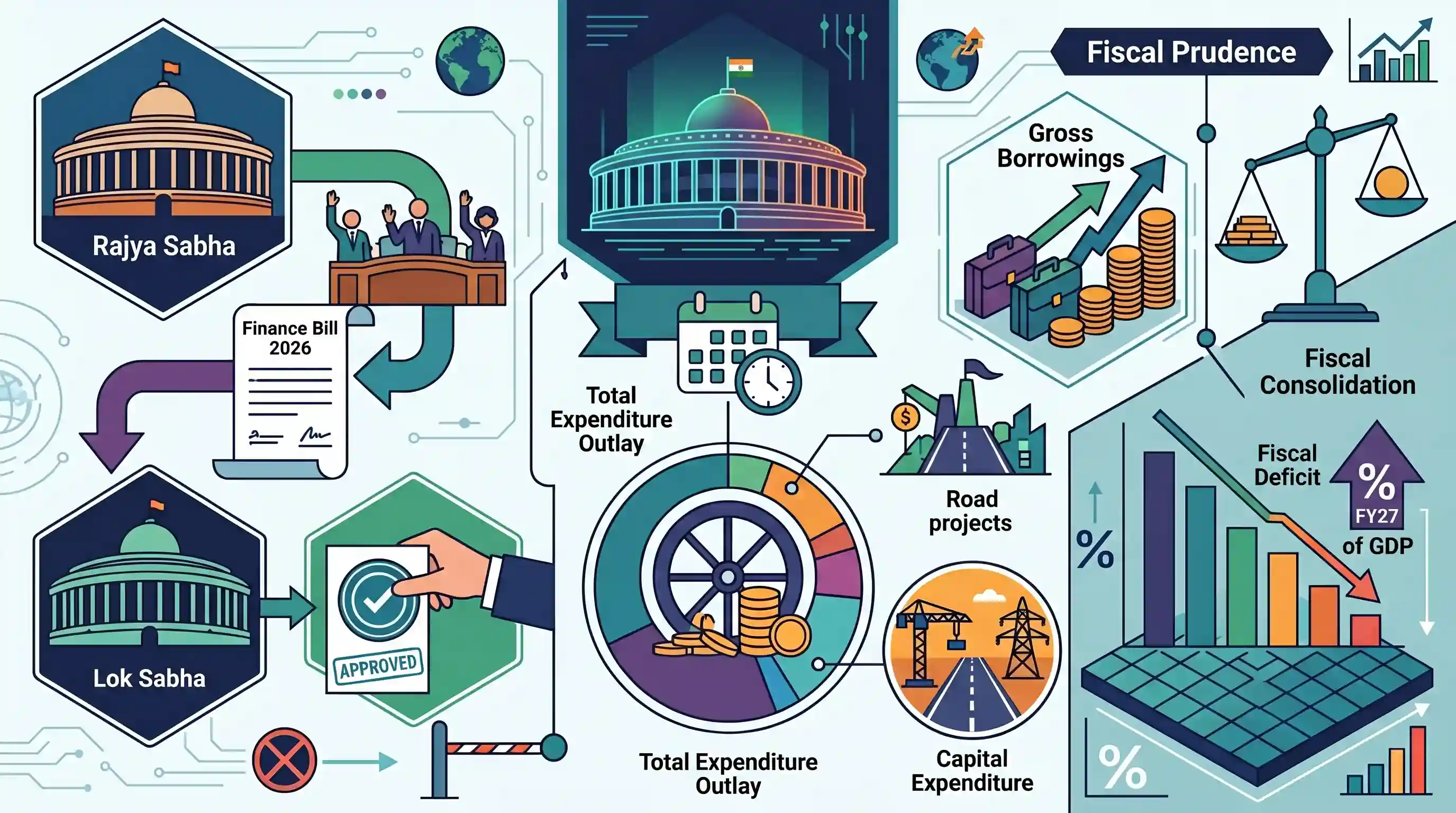
Parliament has granted its approval to the Finance Bill 2026, officially concluding the budgetary process for the fiscal year beginning April 1, 2026. The Bill was returned by the Rajya Sabha to the Lok Sabha via a voice vote. The Union Budget 2026-27 features a total expenditure outlay of ₹453.47 lakh crore, including ₹12.2 lakh crore for capital expenditure. Emphasizing fiscal prudence, the government has projected gross borrowings of ₹17.2 lakh crore and targeted a reduced fiscal deficit of 4.3% of GDP for FY27.
Key Points
- Parliament approved the Finance Bill 2026, finalizing the budgetary exercise for the upcoming fiscal year.
- The Rajya Sabha returned the Bill to the Lok Sabha with a voice vote, after the lower house had cleared it with 32 amendments.
- The total expenditure for FY 2026-27 is projected at ₹453.47 lakh crore, with capital expenditure set at ₹12.2 lakh crore.
- The fiscal deficit for FY 2026-27 is projected to narrow down to 4.3% of GDP, reflecting continued fiscal consolidation compared to 4.4% in the previous fiscal.
Important Terms
Finance Bill

An annual legislative measure introduced under Article 117 to implement the government's tax proposals. When dealing exclusively with taxation/borrowing per Article 110, it is certified as a Money Bill.
UPSC context
GS Paper 2 (Polity) and 3 (Economy). Tests understanding of financial legislation and the Speaker's certification power.
Fiscal Deficit
The difference between the government's total expenditure and its total non-borrowed receipts (Revenue Receipts + Non-debt Capital Receipts). It indicates the government's total borrowing requirements.
UPSC context
GS Paper 3 (Economy). A core indicator of macroeconomic stability and fiscal health tested in Prelims and Mains.
Capital Expenditure (Capex)
Government spending aimed at creating long-term physical or financial assets, such as infrastructure, schools, and hospitals, which generate future income or improve productive capacity.
UPSC context
GS Paper 3 (Economy). Critical for questions on growth drivers, investment-led development, and the 'multiplier effect' of spending.
Union Budget
Constitutally referred to as the 'Annual Financial Statement' under Article 112, it is the estimate of the government's receipts and expenditure for a specific financial year.
UPSC context
GS Paper 2 (Parliament) and GS Paper 3 (Budgeting). Tests knowledge of constitutional mandates and resource mobilization.
Money Bill
A specific type of financial bill defined under Article 110. It can only be introduced in the Lok Sabha, and the Rajya Sabha has limited, non-binding powers for 14 days.
UPSC context
GS Paper 2 (Polity). Frequently tested on the procedural differences between the Lok Sabha and Rajya Sabha.
Fiscal Consolidation
Policy measures aimed at reducing government deficits and debt accumulation to ensure long-term financial sustainability, often guided by the FRBM Act targets.
UPSC context
GS Paper 3 (Economy). Relevant for questions on fiscal prudence, debt-to-GDP ratios, and the FRBM Act.
Prelims Trap
The Rajya Sabha must pass the Annual Finance Bill within 14 days, failing which the Bill lapses.
The Annual Finance Bill is a Money Bill. If Rajya Sabha fails to return it within 14 days, it does not lapse; it is deemed passed by both Houses.
Static Concepts Connected
How does a Money Bill differ from Financial Bills (I and II)?
- Money Bill (Art 110): Contains exclusively matters listed in Art 110. Rajya Sabha has no power to amend or reject; it can only return it with recommendations within 14 days.
- Financial Bill I: Contains Art 110 matters plus other legislation. Must be introduced in Lok Sabha on President's recommendation, but Rajya Sabha holds equal power to amend/reject.
- Financial Bill II: Involves expenditure from the Consolidated Fund but no Art 110 matters. Treated entirely as an ordinary bill in both houses.
What constitutes the Fiscal Deficit and the post-COVID FRBM glide path?
- Fiscal Deficit Formula: Total Expenditure minus (Revenue Receipts + Non-debt Capital Receipts). It strictly indicates the government's total borrowing requirements for the fiscal year.
- FRBM Glide Path: Post-pandemic, the original N.K. Singh committee targets were relaxed. The revised glide path aimed to bring the fiscal deficit below 4.5% of GDP by FY26.
- Quality of Deficit: Borrowing to fund Capital Expenditure (Capex) is viewed favorably due to its macroeconomic multiplier effect (asset creation), unlike borrowing for recurring revenue expenditure.
Cross-Topic Patterns
Fiscal deficit + Crowding out effect
Massive gross government borrowings (₹17.2 lakh crore) can push up bond yields and absorb market liquidity, frequently tested by UPSC as the 'crowding out' effect on private investment.
Finance Bill vs Appropriation Bill
UPSC often tests this technical distinction: the Appropriation Bill (Article 114) authorizes spending from the Consolidated Fund, while the Annual Finance Bill legalizes the government's taxation proposals.

Expect a multi-statement Prelims question blending Constitutional provisions for Money Bills (Arts 110/114) with FRBM glide path targets.
Linked PYQs · 5
Linked PYQs · 5
- 2024PrelimsGS1
Which of the following statements are correct in respect of a Money Bill in the Parliament? 1. Article 109 mentions special procedure in respect of Money Bills. 2. A Money Bill shall not be introduced in the Council of States. 3. The Rajya Sabha can either approve the Bill or suggest changes but cannot reject it. 4. Amendments to a Money Bill suggested by the Rajya Sabha have to be accepted by the Lok Sabha. Select the answer using the code given below :
- 2023PrelimsGS1
With reference to Finance Bill and Money Bill in the Indian Parliament, consider the following statements: 1. When the Lok Sabha transmits Finance Bill to the Rajya Sabha, it can amend or reject the Bill. 2. When the Lok Sabha transmits Money Bill to the Rajya Sabha, it cannot amend or reject the Bill, it can only make recommendations. 3. In the case of disagreement between the Lok Sabha and the Rajya Sabha, there is no joint sitting for Money Bill, but a joint sitting becomes necessary for Finance Bill. How many of the above statements are correct?
- 2021MainsGS3
Distinguish between Capital Budget and Revenue Budget. Explain the components of both these Budgets.
- 2021PrelimsGS1
Which one of the following is likely to be the most inflationary in its effects?
- 2025PrelimsGS1
A country's fiscal deficit stands at ₹50,000 crores. It is receiving ₹10,000 crores through non-debt creating capital receipts. The country's interest liabilities are ₹1,500 crores. What is the gross primary deficit?
