Parliament Adjournment Sine Die and Legislative Procedure
Source:Indian Express ↗
Why It Matters
Understanding parliamentary instruments like adjournment sine die, prorogation, and session management is fundamental for Indian Polity and Governance questions in UPSC GS Paper 2.
Summary
The article discusses the adjournment sine die of Parliament following a legislative session, highlighting parliamentary procedures, sitting durations, and the constitutional context of adjournment versus prorogation.
Key Points
- Parliament was adjourned sine die following the conclusion of its session.
- The session witnessed significant legislative business and discussions on national issues.
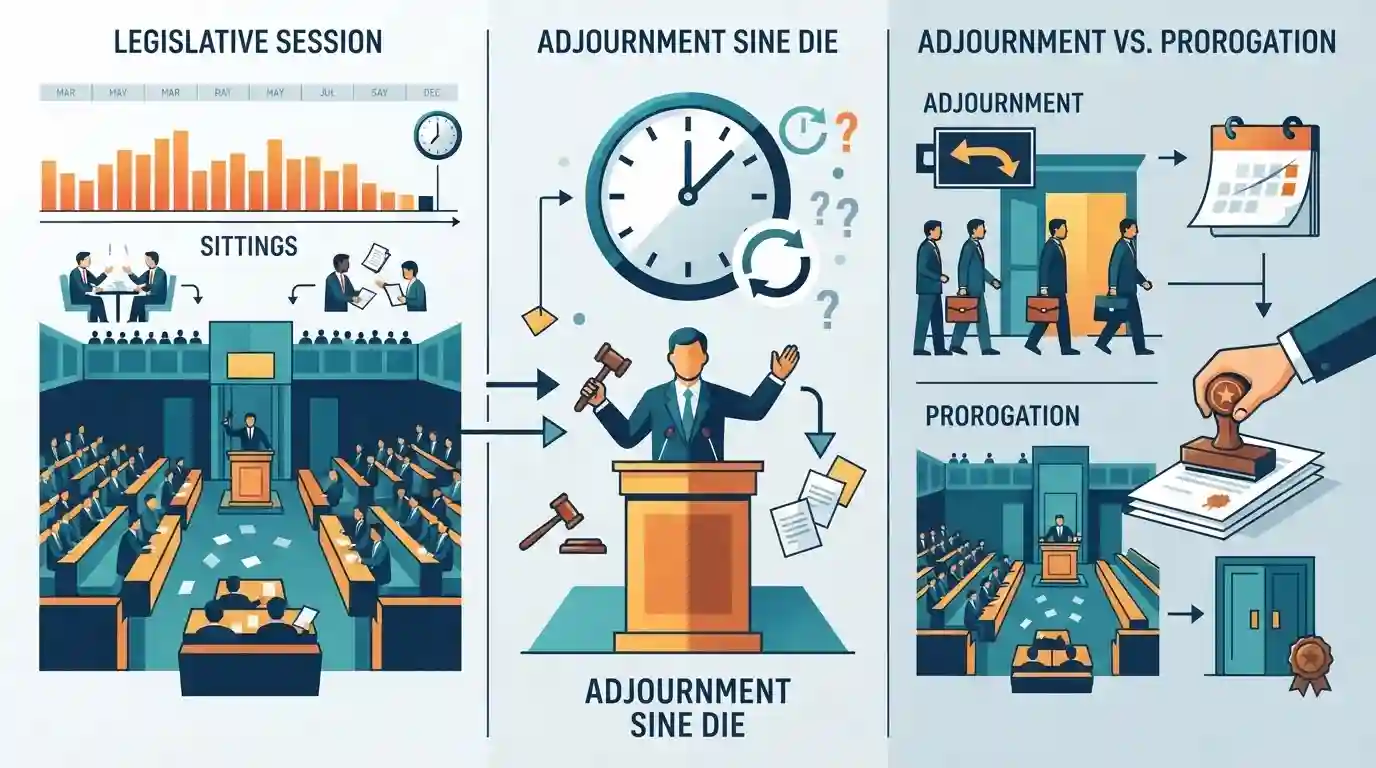
- Adjournment sine die implies terminating a sitting of Parliament for an indefinite period without naming a day for reassembly.
- The power of adjournment sine die rests with the presiding officer of the House (Speaker or Chairman).
Important Terms
Adjournment Sine Die

Adjournment sine die means terminating a sitting of Parliament for an indefinite period without naming a day for reassembly, ordered by the presiding officer (Speaker/Chairman).
UPSC context
GS Paper 2 (Indian Polity - Parliament structure, functioning, and conduct of business). Crucial to distinguish from prorogation under Article 85.
Prorogation
Prorogation is the formal termination of a session of Parliament by an order of the President, bringing all pending legislative business of that session to a close.
UPSC context
GS Paper 2 (Polity). Tests the constitutional powers of the President under Article 85 and differences between adjournment, prorogation, and dissolution.
Parliament
Parliament is India's supreme legislative body consisting of the President and the two Houses: the Rajya Sabha (Council of States) and the Lok Sabha (House of the People).
UPSC context
GS Paper 2 (Polity). Core foundational topic covering law-making procedures, parliamentary control over the executive, and bicameralism.
Prelims Trap
prorogation causes all pending bills to lapse
Unlike in the UK where prorogation causes all pending bills to lapse, in India, pending bills do not lapse upon prorogation.
Static Concepts Connected
What is the difference between adjournment, adjournment sine die, prorogation, and dissolution in Parliament?
- Adjournment: Suspends work within a sitting for hours or days; ordered by the Speaker/Chairman.
- Sine Die: Terminates a sitting for an indefinite period without naming a reassembly date; ordered by presiding officer.
- Prorogation: Terminates both the sitting and the session of Parliament; ordered by the President of India under Article 85.
- Dissolution: Ends the very life of the Lok Sabha; causes all pending bills originating in Lok Sabha to lapse.
Cross-Topic Patterns
Article 85 Prorogation vs British Parliamentary Practice
Both executive action under Article 85 and legislative procedure regarding bill lapsing are recurring themes in questions testing separation of powers.

Expect a 2-statement Prelims question contrasting the legal effects of adjournment sine die, prorogation, and dissolution on pending bills.
Linked PYQs · 3
Linked PYQs · 3
- 2023MainsGS2
Account for the legal and political factors responsible for the reduced frequency of using Article 356 by the Union Governments since mid 1990s.
- 2024PrelimsGS1
With reference to the Indian Parliament, consider the following statements: 1. A bill pending in the Lok Sabha lapses on its dissolution. 2. A bill passed by the Lok Sabha and pending in the Rajya Sabha lapses on the dissolution of the Lok Sabha. 3. A bill in regard to which the President of India notified his/her intention to summon the Houses to a joint sitting lapses on the dissolution of the Lok Sabha. Which of the statements given above is/are correct?
- 2021PrelimsGS1
We adopted parliamentary democracy based on the British model, but how does our model differ from that model? 1. As regards legislation, the British Parliament is supreme or sovereign but in India, the power of the Parliament to legislate is limited. 2. In India, matters related to the constitutionality of the Amendment of an Act of the Parliament are referred to the Constitution Bench by the Supreme Court. Select the correct answer using the code given below.
