Budget Session Conclusion and Defeat of Constitutional Amendment Bill
Source:The Hindu ↗
Why It Matters
The defeat of a constitutional amendment bill is a rare occurrence that directly tests the constitutional provisions of Article 368 (Special Majority). It also brings to the forefront critical themes like women\'s political representation, the upcoming delimitation exercise, and its impact on federalism. Additionally, the Prime Minister\'s statement ties the geopolitical conflict in West Asia directly to India\'s energy security strategy, a recurring theme in Mains.
Summary
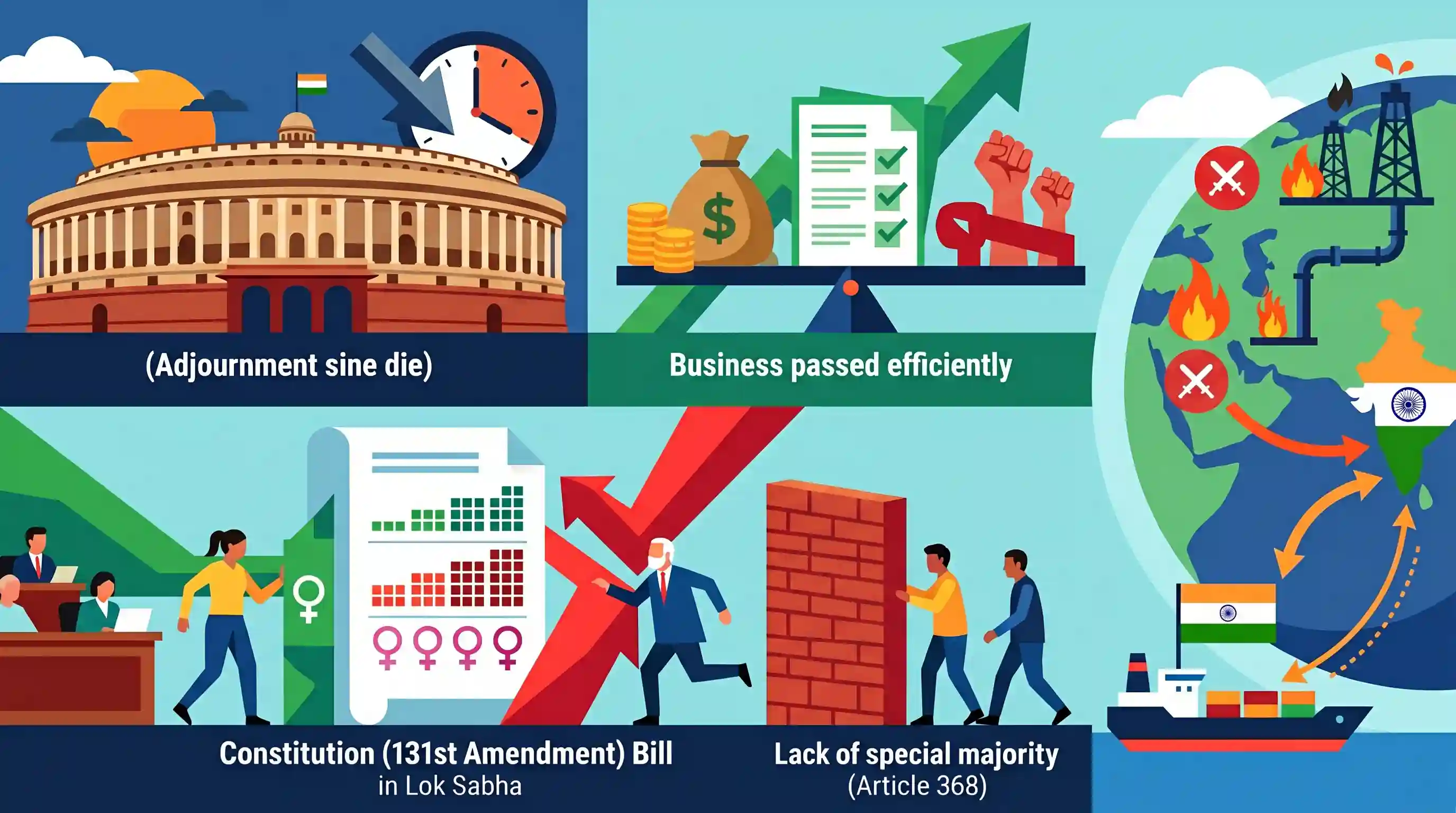
The extended Budget Session of Parliament concluded with an adjournment sine die, marked notably by the Opposition\'s defeat of the Constitution (131st Amendment) Bill in the Lok Sabha. The proposed legislation sought to expand the Lower House to 816 seats and implement a 33% quota for women by conducting a delimitation exercise based on the 2011 Census. Failing to secure the mandatory two-thirds special majority under Article 368, the defeat stands as a significant political hurdle for the government. Despite robust political clashes and opposition protests, both Houses reported high productivity—passing crucial financial business, including the Union Budget, and several other bills. The session was also highlighted by discussions on international geopolitics, particularly regarding the West Asia crisis and its strategic impact on India\'s energy security.
Key Points
- The extended Budget Session of Parliament was adjourned sine die shortly after the Opposition defeated the Constitution (131st Amendment) Bill in the Lok Sabha.
- The Constitution (131st Amendment) Bill aimed to increase the Lok Sabha\'s strength to 816 and provide 33% reservation for women, linked to a delimitation exercise based on the 2011 Census.
- The Bill failed to pass as it fell short of the required two-thirds special majority, securing 298 votes in favour and 230 against, marking a major legislative setback for the ruling government.
- Despite political confrontations, the session witnessed high productivity (110% in Rajya Sabha and 93% in Lok Sabha), clearing the Union Budget, the Jan Vishwas Bill, and other key legislations.
- Prime Minister Narendra Modi addressed the Parliament on the ongoing West Asia crisis (involving Israel, the U.S., and Iran) and its implications for India\'s energy security.
Important Terms
Constitution (131st Amendment) Bill, 2026

A 2026 proposal to expand the Lok Sabha to 850 seats and fast-track 33% women’s reservation by enabling delimitation based on 2011 Census data. It was defeated in the Lok Sabha.
UPSC context
GS Paper II: Constitutional Amendments. Tests knowledge of Article 368, seat expansion, federalism, and the political complexities of women's reservation.
Jan Vishwas (Amendment of Provisions) Bill, 2026
Legislation seeking to decriminalize minor procedural lapses and rationalize penalties across 79 central acts to reduce the compliance burden for businesses and promote "Ease of Doing Business."
UPSC context
GS Paper II/III: Governance/Economy. Relevant for regulatory reforms, trust-based governance, and reducing the "inspector raj" for MSMEs.
Central Armed Police Forces (General Administration) Bill, 2026
Legislation passed in 2026 to unify service rules for CAPFs (CRPF, BSF, etc.) and mandate specific leadership quotas for IPS officers on deputation at senior ranks.
UPSC context
GS Paper III: Internal Security. Tests understanding of security force command structures, cadre management, and inter-service coordination.
Adjournment Sine Die
The termination of a sitting of a House of Parliament for an indefinite period, without specifying a date for reassembly. The power lies with the presiding officer.
UPSC context
GS Paper II: Functioning of Parliament. Tests understanding of parliamentary terminology and the powers of the Speaker/Chairman versus the President.
Delimitation
The redrawing of constituency boundaries based on the latest census to ensure seats are proportional to population, governed by the "one person, one vote, one value" principle.
UPSC context
GS Paper II: Elections and Representation. Vital for debates on the "North-South divide" and the impact of constituency resizing on federal balance.
Union Budget
Annual financial statement (Article 112) detailing the government's estimated receipts and expenditure. The 2026-27 budget was passed despite the defeat of other constitutional legislation.
UPSC context
GS Paper III: Indian Economy/Budgeting. Covers the constitutional process of passing financial bills and parliamentary control over the consolidated fund.
Prelims Trap
"A joint sitting can be convened if a Constitutional Amendment Bill is defeated by the Opposition."
Joint sittings under Article 108 apply only to ordinary and financial bills. Constitutional Amendment Bills under Article 368 must be passed separately by each House.
Static Concepts Connected
Why are Lok Sabha seats currently frozen, and which amendments dictate this?
- 42nd Amendment (1976): Froze the state-wise allocation of Lok Sabha seats based on the 1971 census to ensure states controlling their population aren't politically penalized.
- 84th Amendment (2001): Extended the absolute freeze on the total number of Lok Sabha seats until the relevant figures for the first census published after 2026.
- 87th Amendment (2003): Permitted internal territorial readjustment of existing constituencies within states based on the 2001 census, without altering total state seat counts.
How does Adjournment sine die differ from Prorogation?
- Adjournment sine die: Terminates a sitting of Parliament for an indefinite period. It is declared by the Presiding Officer (Speaker or Chairman).
- Prorogation: Ends the parliamentary session entirely. It is formally notified by the President of India on the advice of the Council of Ministers.
- Impact on Bills: Neither action causes pending bills to lapse, though prorogation does lapse all pending notices (other than those for introducing bills).
Cross-Topic Patterns
Delimitation vs. Fiscal Federalism
Expanding Lok Sabha seats using newer census data intertwines with Finance Commission devolution formulas, raising concerns from southern states regarding political penalization for successful demographic control.
West Asia & Energy Security
Parliamentary debates on West Asia crises naturally link to India's strategic petroleum reserves, current account deficit pressures, and the push for renewable transition to mitigate import shocks.

The interplay between Article 368 special majorities and the 84th Amendment's delimitation freeze is prime for a 2026 Prelims multi-statement Q.
Linked PYQs · 5
Linked PYQs · 5
- 2019MainsGS2
“Parliament's power to amend the Constitution is a limited power and it cannot be enlarged into absolute power." In the light of this statement explain whether Parliament under Article 368 of the Constitution can destroy the Basic Structure of the Constitution by expanding its amending power?
- 2019MainsGS2
“The reservation of seats for women in the institutions of local self-government has had a limited impact on the patriarchal character of the Indian Political Process.” Comment.
- 2023MainsGS2
Discuss the contribution of civil society groups for women's effective and meaningful participation and representation in state legislatures in India.
- 2017MainsGS2
The question of India's Energy Security constitutes the most important part of India's economic progress. Analyze India's energy policy cooperation with West Asian countries.
- 2025MainsGS2
"Energy security constitutes the dominant kingpin of India's foreign policy, and is linked with India's overarching influence in Middle Eastern countries.” How would you integrate energy security with India's foreign policy trajectories in the coming years?
