Dalit land rights dispute resolution and state mediation
Source:The Hindu ↗
Why It Matters
This case illustrates the practical challenges faced by marginalized communities in securing land rights, and the crucial role of state mediation in achieving equitable socio-economic justice, even after judicial rulings mandate eviction.
Summary
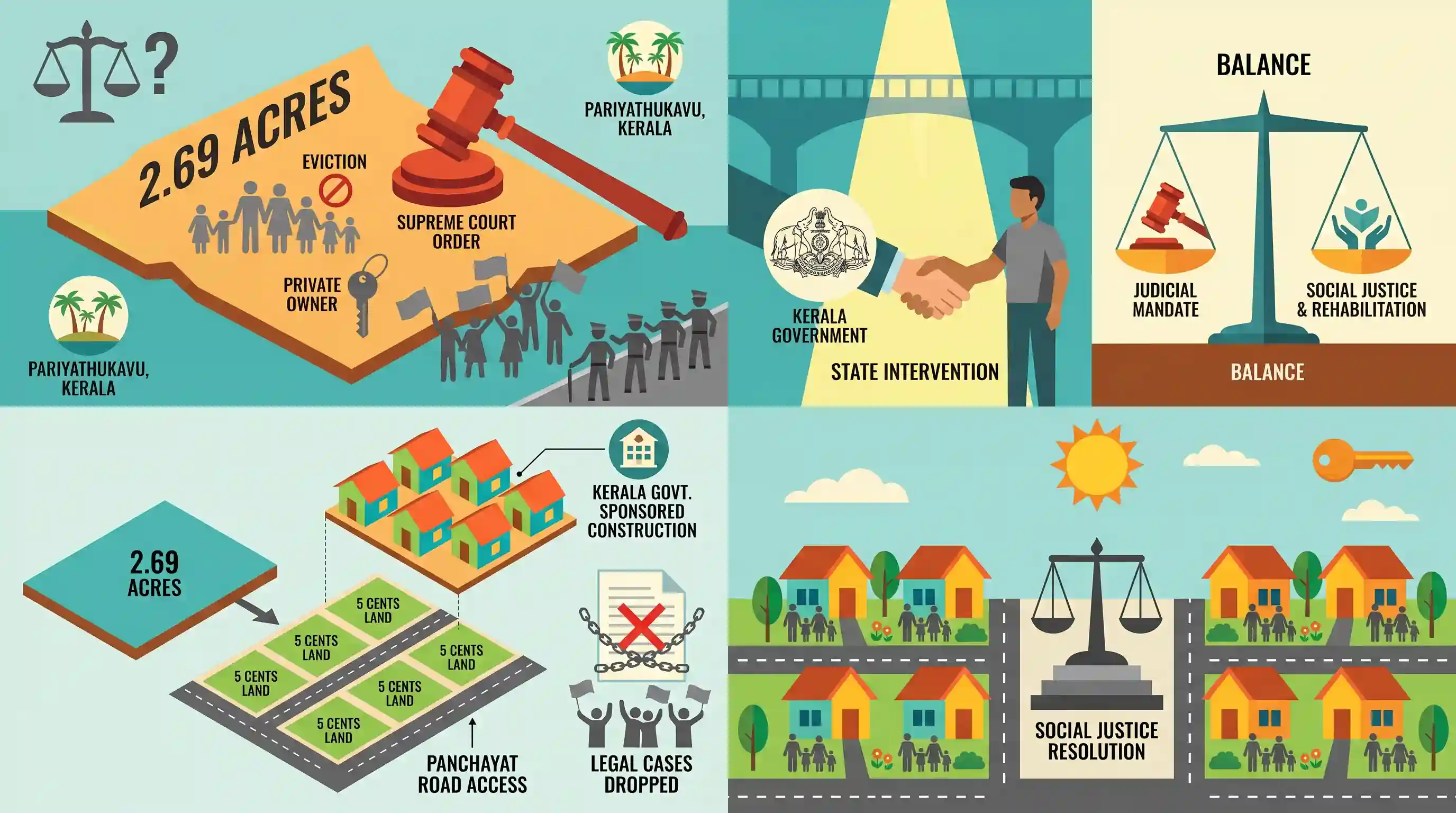
A prolonged land dispute in Pariyathukavu, Kerala, involving seven Dalit families facing eviction due to a Supreme Court order, has been resolved through state intervention. The settlement allocates 5 cents of land to each family within the disputed 2.69-acre property. The Kerala government will sponsor the construction of new houses for the families and drop all legal cases against those who protested the eviction, demonstrating a balance between judicial mandates and social justice.
Key Points
- The long-standing Pariyathukavu land dispute in Kerala has been resolved, providing secure housing for seven Dalit families.
- Despite a Supreme Court verdict awarding the 2.69-acre property to a private party, an agreement was mediated by the state government to allocate 5 cents of land to each Dalit family within the same property.
- The Kerala government will facilitate the construction of houses for the families through sponsorships, allowing them to remain in their current homes until completion.
- Criminal cases filed against activists and locals who protested the eviction of the Dalit families will be withdrawn by the government.
Important Terms
Supreme Court

India’s apex judicial authority. In land disputes, its rulings on property rights can trigger social tensions, often requiring executive mediation to balance strict legal mandates with human rights.
UPSC context
GS-II (Judiciary/Governance); tests understanding of the court’s role in balancing private rights against state-led social welfare policies.
Social Justice
The principle of fair resource distribution, ensuring marginalized groups receive equitable treatment. This case highlights balancing legal property ownership with the fundamental right to housing for vulnerable populations.
UPSC context
GS-II (Social Justice); critical for analyzing government interventions and welfare schemes for marginalized or vulnerable communities.
Land Rights
The legal and customary right to own or occupy land. The Pariyathukavu dispute underscores the historical challenges and socio-economic vulnerability associated with landlessness among Dalit communities.
UPSC context
GS-I/III (Land Reforms/Society); examines historical land alienation and the effectiveness of redistribution policies for landless marginalized groups.
State Intervention
Proactive mediation by the government to resolve socio-economic crises. Here, the state bypassed literal eviction enforcement to facilitate a sponsored rehabilitation agreement for the affected families.
UPSC context
GS-II (Governance); tests the executive's role in mediation and its power to implement social policy during legal-administrative deadlocks.
Action Council
A local pressure group organized to protect residents from eviction. These informal associations influence public policy and executive action through mobilization and collective bargaining.
UPSC context
GS-II (Pressure Groups/Associations); focuses on how non-state actors influence administrative machinery to protect specific community interests.
Scheduled Castes (Dalit Families)
Social groups recognized by the Constitution for affirmative action. Their historical landlessness is a central theme in critiques of land reforms and developmental models.
UPSC context
GS-II (Vulnerable Sections); assesses knowledge of constitutional protections and socio-economic challenges faced by marginalized populations in India.
Prelims Trap
The Right to Adequate Housing/Shelter is explicitly enumerated as a Fundamental Right under the Constitution of India.
The Right to Shelter is an implied right derived from Article 21 (Right to Life) through judicial interpretations, not explicitly written in the Constitution.
Static Concepts Connected
How has the Supreme Court interpreted the Right to Shelter under Article 21?
- Implied Right: Established as a subset of the Right to Life in landmark cases like Chameli Singh v. State of U.P. and Olga Tellis.
- Adequate Living: Encompasses safe infrastructure, clean surroundings, and basic amenities, not merely physical shelter.
- Rehabilitation Mandate: Forced evictions of marginalized groups without proper rehabilitation frameworks are generally viewed as a violation of fundamental rights.
What were the key objectives of the Kerala Land Reforms Act (1963)?
- Abolishing Landlordism: Conferred ownership rights to cultivating tenants, effectively ending the traditional 'Janmi' agrarian structure.
- Protection of Dwellers: Granted 'Kudikidappukars' (hutment dwellers) the legal right to purchase the small plots of land around their dwellings.
- Ceiling on Holdings: Imposed maximum land limits to redistribute surplus land to the landless, though structural inequalities for Dalits often remained.
Cross-Topic Patterns
Judicial Mandates vs. Executive Mediation
The state's intervention to secure land for Dalits against a Supreme Court eviction order highlights the balance between enforcing private property rights and fulfilling Directive Principles (Article 39).
Unfinished Agenda of Land Reforms
Despite progressive historical acts, marginalized communities often remain confined to precarious homesteads, exposing structural gaps in post-independence land redistribution strategies.

The tension between private property enforcement and the fundamental Right to Shelter (Art 21) is a high-probability analytical theme for GS2 Mains.
Linked PYQs · 2
Linked PYQs · 2
- 2024MainsGS1
Despite comprehensive policies for equity and social justice, underprivileged sections are not yet getting the full benefits of affirmative action envisaged by the Constitution. Comment.
- 2025MainsGS2
Inequality in the ownership pattern of resources is one of the major causes of poverty. Discuss in the context of 'paradox of poverty'.
