Param science experience centre and stem education in bengaluru
Source:The Hindu ↗
Why It Matters
Demonstrates actionable steps being taken outside the formal school system to promote scientific temper, experiential learning, and innovation—essential components for India's transition to a knowledge-driven economy and demographic dividend utilization.
Summary
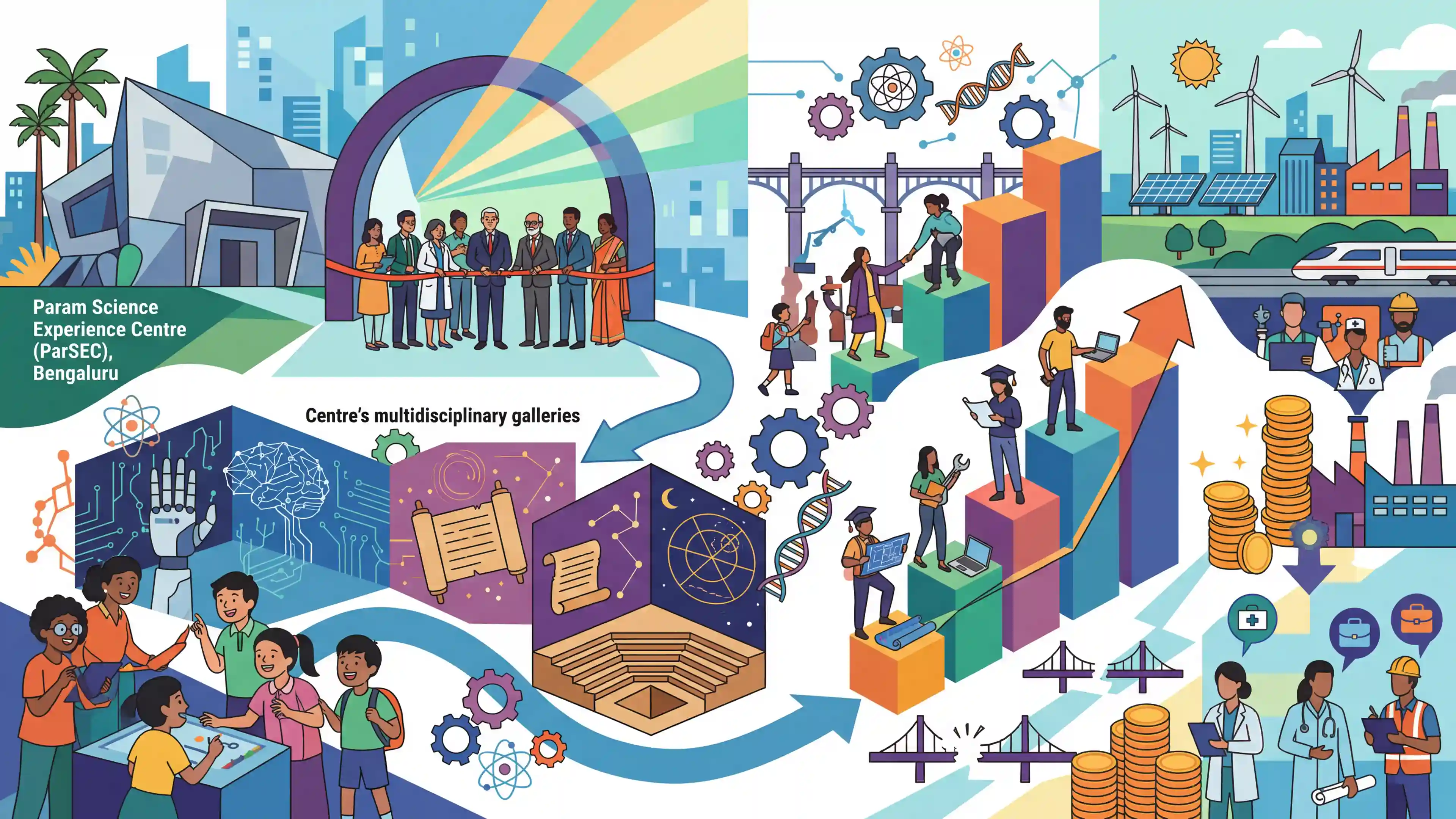
The inauguration of the Param Science Experience Centre (ParSEC) in Bengaluru highlights a crucial shift toward experiential learning and STEM education in India. By focusing on multi-disciplinary galleries—ranging from artificial intelligence and emerging technologies to ancient Indian scientific knowledge systems—the centre serves as a model for bridging gaps in human resource development. This development aligns with UPSC themes regarding the role of science and technology in driving socio-economic progress, wealth generation, and job creation, while addressing structural weaknesses in India's education and innovation ecosystem.
Key Points
- The Param Science Experience Centre (ParSEC), an initiative of the Param Foundation, has been inaugurated in Whitefield, Bengaluru, as a 30,000 sq. ft. "Living Laboratory."
- The centre is designed to accommodate over one lakh visitors annually and aims to shift science education from rote memorisation to experiential learning.
- It features a wide array of galleries covering artificial intelligence, emerging technologies, electromagnetism, design thinking, and ancient Indian scientific knowledge systems.
- Prominent figures like former ISRO chairman K. Radhakrishnan and Infosys co-founder Kris Gopalakrishnan emphasised the facility\'s multi-disciplinary strength and the role of scientific innovation as an engine for job creation and human progress.
Important Terms
STEM Education

Interdisciplinary curriculum focusing on Science, Technology, Engineering, and Mathematics to foster innovation and critical thinking.
UPSC context
GS Paper II (Education) and III (S&T); tests strategies for building a future-ready workforce.
Human Resource Development (HRD)
Strategic approach to nurturing individual skills and knowledge to drive national productivity and socio-economic progress.
UPSC context
GS Paper II (Social Sector/Education); critical for leveraging India's demographic dividend and inclusive growth.
Artificial Intelligence (AI)
Computational systems capable of performing tasks requiring human-like intelligence, such as reasoning and problem-solving.
UPSC context
GS Paper III (S&T); focuses on technology applications, ethics, and NITI Aayog's national AI strategy.
Ancient Indian Scientific Knowledge Systems
Indigenous scientific achievements in fields like astronomy, mathematics (zero/decimals), and metallurgy (Wootz steel) from ancient India.
UPSC context
GS Paper I (Culture) and III (S&T); tests knowledge of India's historical scientific heritage.
Indian Space Research Organisation (ISRO)
India's national space agency tasked with planetary exploration and space-based applications for societal benefit.
UPSC context
GS Paper III (S&T/Space); central to topics on indigenization of technology and space-sector achievements.
Param Foundation
A Bengaluru-based non-profit trust dedicated to promoting science, history, and innovation through interactive learning hubs.
UPSC context
GS Paper II (Role of NGOs/Stakeholders); represents the development industry's impact on public science engagement.
Experiential Learning
A pedagogical approach centered on 'learning by doing' and reflection, aimed at deepening conceptual understanding.
UPSC context
GS Paper II (Education); aligns with NEP 2020's shift from rote learning to skill-based schooling.
Prelims Trap
Param Science Experience Centre is a government facility under C-DAC related to the PARAM supercomputing mission.
It is a private initiative by the Param Foundation focused on STEM education, completely unrelated to C-DAC's National Supercomputing Mission (PARAM series).
Static Concepts Connected
What is the constitutional mandate for promoting 'scientific temper' in India?
- Article 51A(h): Mandates every citizen to develop the scientific temper, humanism, and the spirit of inquiry and reform as a Fundamental Duty.
- State Welfare Goals: Though not an explicit DPSP, developing human capital and inquiry aligns broadly with the State's welfare goals under Article 39(f) and 46.
How does NEP 2020 integrate Indian Knowledge Systems with modern STEM?
- Experiential Shift: Promotes multidisciplinary, experiential STEM learning over rote memorization, building crucial 21st-century problem-solving skills and career readiness.
- IKS Integration: Explicitly incorporates ancient Indian scientific contributions (e.g., mathematics, astronomy, metallurgy) into the curriculum to ensure cultural rootedness.
Cross-Topic Patterns
IKS intersecting with Artificial Intelligence
Fusing Ancient Indian Knowledge Systems (IKS) with modern tech galleries reflects a growing GS-1/GS-3 linkage trend, balancing civilizational heritage with future AI readiness.
Private Philanthropy in R&D and STEM
Private-led 'Living Laboratories' highlight the critical role of corporate philanthropy and non-state actors in bridging India's structural R&D and experiential education gaps.

Expect a 2026 Prelims multi-statement question linking 'Scientific Temper' (Art 51A) to NEP 2020's Indian Knowledge Systems.
Linked PYQs · 2
Linked PYQs · 2
- 2023MainsGS2
The crucial aspect of development process has been the inadequate attention paid to Human Resource Development in India. Suggest measures that can address this inadequacy.
- 2020MainsGS3
How is science interwoven deeply with our lives? What are the striking changes in agriculture triggered off by the science-based technologies?
