Decentralized Farm Level Solutions Needed for Crop Residue Management
Source:Indian Express ↗
ఇది ఎందుకు ముఖ్యం
Stubble burning is a critical recurring environmental and agricultural issue in India affecting air quality and soil health, making decentralized economic solutions vital for policy formulation.
సారాంశం
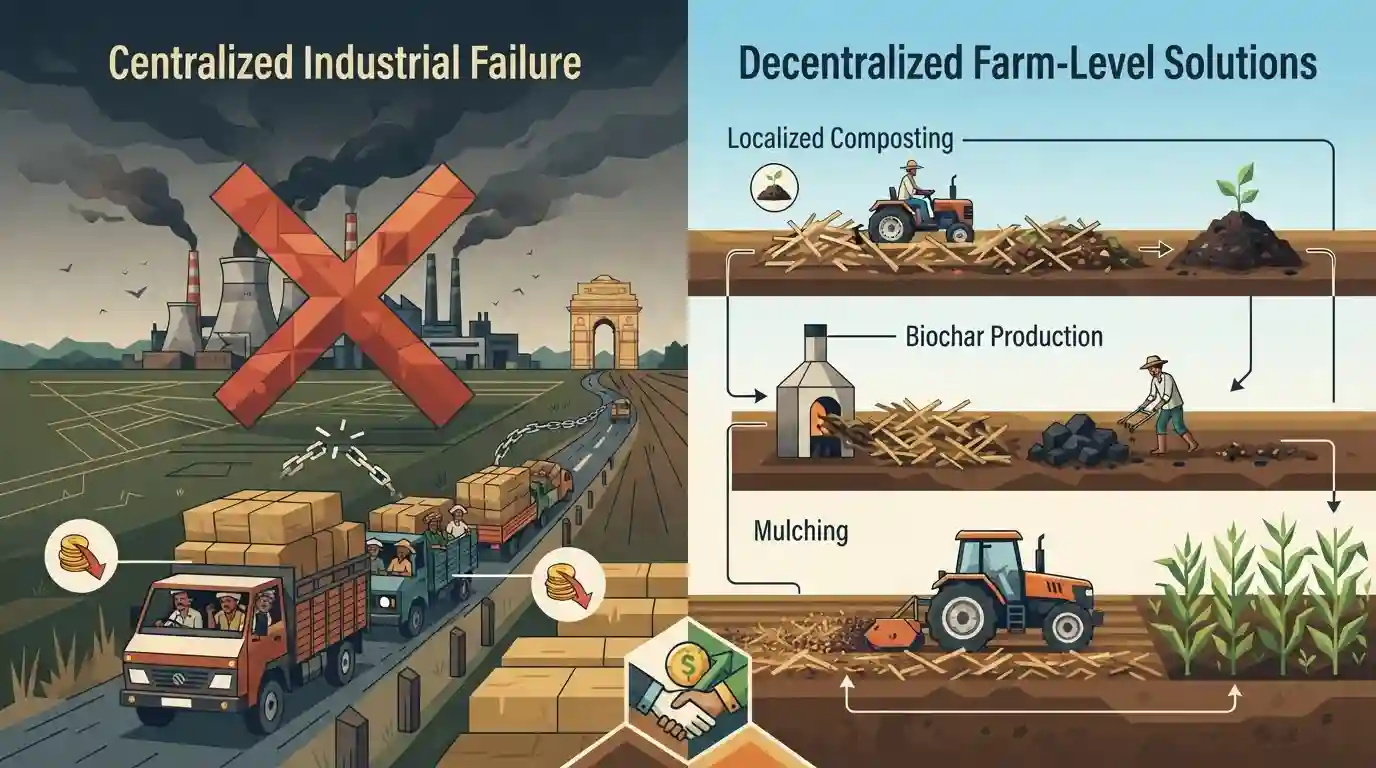
The article discusses the persistent problem of crop residue burning (parali) in northern India and argues that centralized industrial solutions often fail due to logistical and economic hurdles. Instead, it advocates for decentralized, farm-level interventions like localized composting, biochar, and mulching to make crop residue management sustainable and economically viable for farmers.
ముఖ్య అంశాలు
- Stubble burning (parali) continues to be an intractable environmental crisis during winter months in northern India, causing severe air pollution.
- Large-scale, centralized solutions like industrial ethanol plants, large bio-CNG units, or long-distance transport face heavy logistical hurdles, high capital costs, and collection inefficiencies.
- A decentralized approach closer to the farm—such as localized composting, in-situ mulching, small-scale biochar production, and localized fodder conversion—can offer more economically viable and sustainable alternatives.
- Empowering farmers and local micro-entrepreneurs through appropriate financial incentives and decentralized machinery can transform crop residue from a waste burden into a localized resource.
ప్రిలిమ్స్ ఉచ్చు
Centralized industrial solutions are the sole government-backed mechanism for eliminating stubble burning in northern India.
Aspirants often assume central schemes mandate only ex-situ industrial plants, overlooking that in-situ machinery subsidies form the core of current policy.
అనుసంధానమైన స్థిర భావనలు
What are the primary in-situ and ex-situ crop residue management strategies recommended in India?
- In-situ methods: In-situ management includes incorporating stubble back into the soil using machinery like Happy Seeder, Super Seeder, and Rotavator.
- Ex-situ methods: Ex-situ management involves removing straw from the field for industrial use, biomass power plants, or bio-CNG production.
- Biochar & Pyrolysis: Biochar conversion utilizes low-oxygen pyrolysis to transform agricultural waste into stable soil carbon, enhancing fertility and moisture retention.
అంతర-అంశ నమూనాలు
Agri-Pollution meets Fiscal Federalism & Rural Jobs
Crop residue management intersects with fiscal federalism as central/state subsidies for machinery compete with localized micro-composting initiatives and decentralized rural employment guarantees (MGNREGA).

Decentralized vs. centralized agri-waste models will feature in GS-3 questions contrasting technological fixes with ecological economics.
అనుసంధాన PYQలు · 3
అనుసంధాన PYQలు · 3
- 2023PrelimsGS1
'Wolbachia method' is sometimes talked about with reference to which one of the following?
- 2024PrelimsGS1
Recently, the term "pumped-storage hydropower" is actually and appropriately discussed in the context of which one of the following?
- 2022PrelimsGS1
"Biorock technology" is talked about in which one of the following situations?
