Parliamentary Uproar Over Bill to Remove Jailed Ministers
Source:Indian Express ↗
Why It Matters
The bill brings to the forefront the conflict between the presumption of innocence in criminal jurisprudence and the ethical requirement of probity in governance. The ensuing parliamentary disruption is a critical case study for UPSC aspirants on the conduct of MPs, the role of the Speaker, and potential reforms in legislative functioning.
Summary
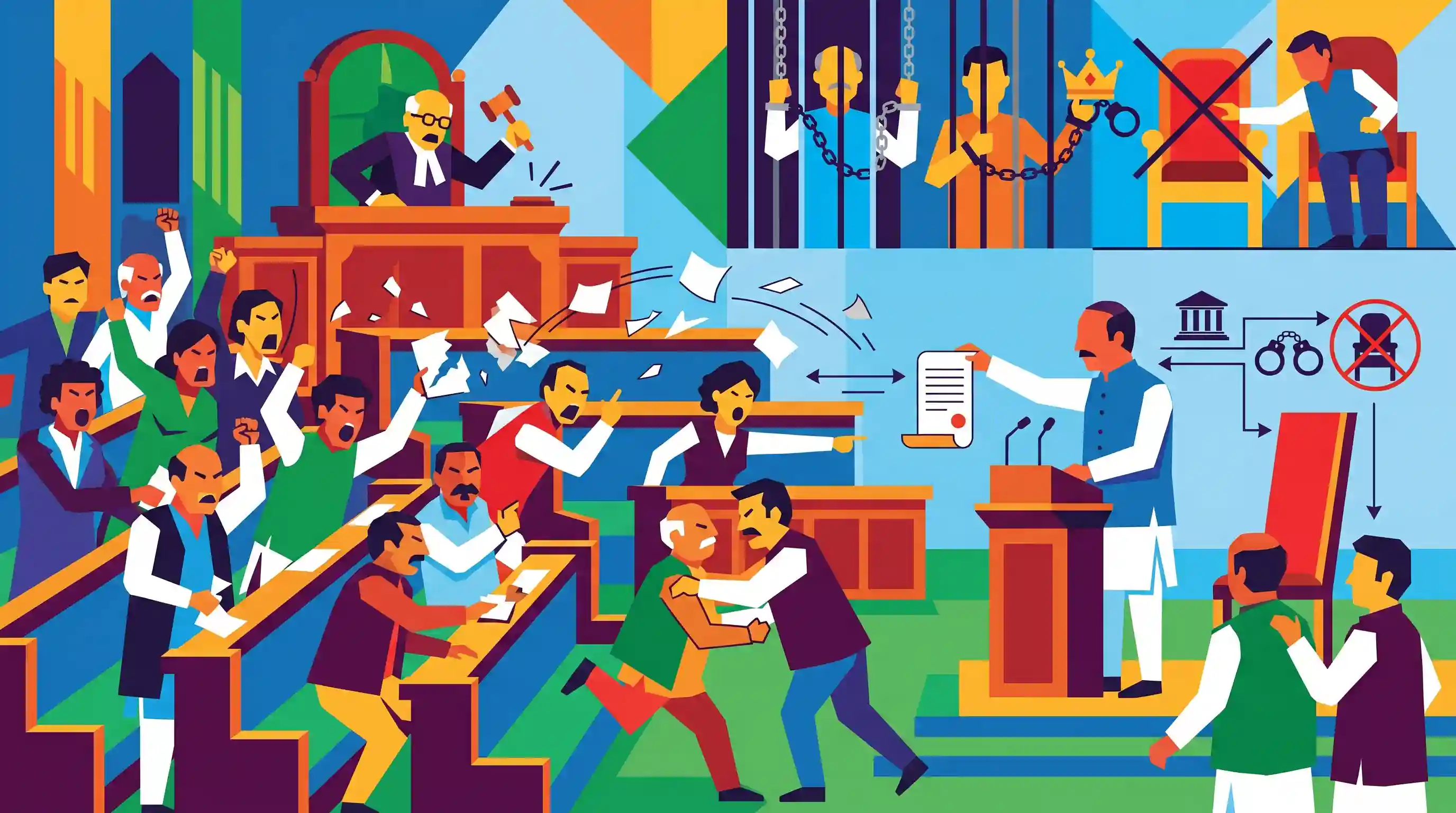
Union Home Minister Amit Shah introduced a bill in the Lok Sabha seeking to remove ministers detained on graft charges, which triggered severe protests from the Opposition. The session witnessed pandemonium, including MPs tearing papers and engaging in a scuffle. The legislative move aims to enforce probity in public office by barring jailed politicians from retaining executive posts, a debate recently fueled by leaders running governments from judicial custody. The incident also underscores the persistent challenges in maintaining parliamentary decorum and the effective functioning of legislative sessions.
Key Points
- Union Home Minister Amit Shah introduced a bill in the Lok Sabha aimed at removing ministers detained on graft or corruption charges.
- The introduction of the contentious legislation led to massive uproar, with Opposition MPs tearing papers and engaging in a scuffle.
- The bill addresses the legal and constitutional ambiguity surrounding the continuation of elected representatives in ministerial positions while in judicial custody.
- The incident highlights the deteriorating decorum in legislative bodies and raises questions about parliamentary privileges and the enforcement of discipline by presiding officers.
Important Terms
Representation of the People Act, 1951

A landmark parliamentary act regulating the conduct of elections, defining qualifications/disqualifications for members, and curbing corrupt practices in India's democratic process.
UPSC context
GS-2 (Polity); foundational for topics on electoral reforms, disqualification (Section 8), and maintaining the integrity of legislative bodies.
Constitution (130th Amendment) Bill, 2025
A proposed legislation to amend Articles 75, 164, and 239AA, mandating the removal of Ministers (including PM/CMs) detained for 30 consecutive days on serious criminal charges.
UPSC context
GS-2 (Executive/Parliament); critical for debates on ministerial accountability and the legal threshold for removal versus the 'presumption of innocence'.
Probity in Governance
The standard of absolute integrity and moral uprightness in public life, requiring transparency, accountability, and adherence to ethical codes by public officials.
UPSC context
GS-4 (Ethics); a core syllabus topic testing the philosophical and institutional framework for preventing corruption and maintaining public trust.
Section 8 of RPA, 1951
The specific statutory clause mandating disqualification of an MP/MLA if convicted of an offense and sentenced to imprisonment for two years or more.
UPSC context
GS-2 (Polity); essential for understanding judicial interventions like the 'Lily Thomas' case and the criminalization of politics.
Parliamentary Decorum
The set of rules and etiquette intended to maintain the dignity and efficiency of legislative proceedings, as governed by the Rules of Procedure and the Speaker.
UPSC context
GS-2 (Legislature); pertains to the 'Conduct of Business' and the powers of the Speaker to manage disruption and disorderly behavior.
Constitutional Morality
A judicial concept advocating for adherence to the core values and spirit of the Constitution, such as individual liberty, equality, and the rule of law.
UPSC context
GS-2/GS-4; used to evaluate laws based on whether they uphold the democratic spirit and fiduciary duties of public office.
Prelims Trap
"A minister is automatically disqualified under the Representation of the People Act, 1951 if detained on severe corruption charges."
Under Section 8 of the RPA 1951, disqualification strictly requires a formal conviction (and often a minimum 2-year sentence). Mere detention or framing of charges does not trigger disqualification.
Static Concepts Connected
How does MP suspension differ between Lok Sabha and Rajya Sabha?
- Lok Sabha: Under Rule 374A, the Speaker can automatically suspend an MP for 5 consecutive sittings or the remainder of the session for grave disorder, without needing a motion.
- Rajya Sabha: The Chairman lacks automatic suspension powers. Under Rule 256, a formal motion must be moved and adopted by the House to suspend a disruptive member.
Can a Governor independently dismiss a minister in judicial custody?
- Pleasure Doctrine: Under Article 164, ministers hold office during the "pleasure of the Governor."
- Binding Advice: Judicial interpretations clarify this pleasure is strictly bound by the Chief Minister's advice. A Governor cannot independently dismiss a jailed minister without the CM's recommendation.
Cross-Topic Patterns
Privileges vs Criminal Law
Parliamentary privilege (Sec 135A CPC) grants immunity from arrest 40 days around a session only in civil cases, offering no protection from criminal detention on graft charges.
Pre-trial removal vs Post-conviction disqualification
While RPA 1951 governs legislative disqualification post-conviction, this bill touches on the distinct administrative removal of executive ministers during the pre-trial (judicial custody) phase.

Differences between LS Rule 374A and RS Rule 256 for suspending MPs, paired with RPA Section 8 limits, is a prime 2026 Prelims target.
Linked PYQs · 5
Linked PYQs · 5
- 2020MainsGS2
There is a need for simplification of procedure for disqualification of persons found guilty of corrupt practices under the Representation of Peoples Act". Comment.
- 2025MainsGS2
Discuss the 'corrupt practices' for the purpose of the Representation of the People Act, 1951. Analyze whether the increase in the assets of the legislators and/or their associates, disproportionate to their known sources of income, would constitute 'undue influence' and consequently a corrupt practice.
- 2023MainsGS2
Discuss the role of Presiding Officers of state legislatures in maintaining order and impartiality in conducting legislative work and in facilitating best democratic practices.
- 2016MainsGS2
Discuss the essentials of the 69th Constitutional Amendment Act and anomalies, if any, that have led to recent reported conflicts between the elected representatives and the institution of the Lieutenant Governor in the administration of Delhi. Do you think that this will give rise to a new trend in the functioning of the Indian federal politics?
- 2018MainsGS2
Whether the Supreme Court Judgement (July 2018) can settle the political tussle between the Lt. Governor and elected government of Delhi? Examine.
