Green India Mission Implementation Gaps and Climate Goals
Source:The Hindu ↗
Why It Matters
Critically analyzes India's flagship afforestation scheme, addressing implementation bottlenecks, ecological integrity, and climate mitigation targets relevant for GS3 Environment and Governance.
Summary
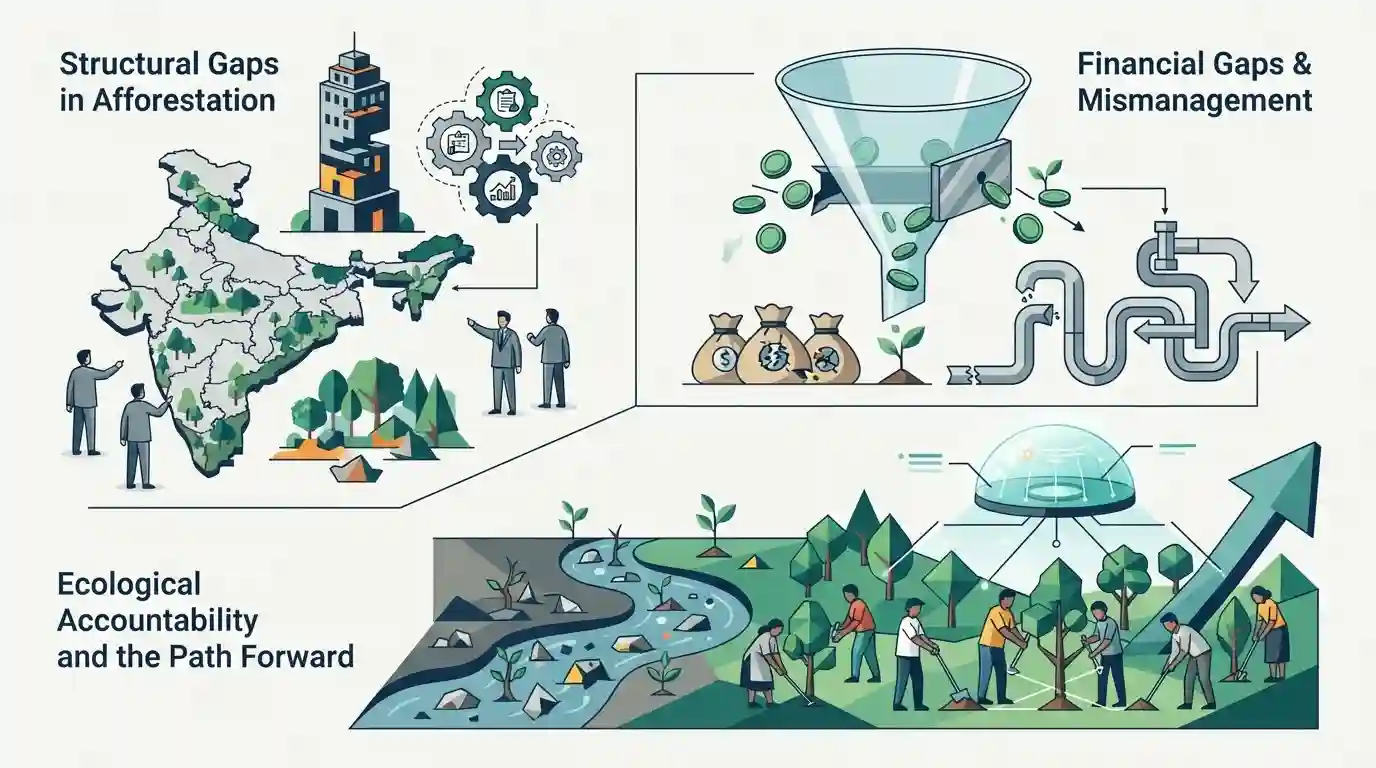
The article evaluates the shortcomings of the Green India Mission (GIM), highlighting structural and financial gaps in India's flagship afforestation programme under the National Action Plan on Climate Change, and emphasizes the need for ecological accountability.
Key Points
- The Green India Mission (GIM), a key component under the National Action Plan on Climate Change, has faced severe implementation bottlenecks and funding shortfalls.
- Evaluations show that afforestation targets have often been sub-optimally met, with poor survival rates of saplings and a mismatch between tree-planting targets and local ecological requirements.
- Criticisms highlight a over-reliance on monoculture plantations rather than reviving indigenous biodiverse forests, undermining ecosystem resilience.
- Strengthening climate governance requires rigorous scientific monitoring, community participation, and transparent fund allocation mechanisms.
Important Terms
National Action Plan on Climate Change

A comprehensive national strategy launched by India in 2008 comprising eight core missions to address climate change mitigation, adaptation, energy efficiency, and natural resource conservation.
UPSC context
UPSC Mains GS Paper III: Environment, Conservation, and Climate Change policy frameworks.
Green India Mission
A flagship mission under the NAPCC aiming to protect, restore, and enhance India's forest cover, improve ecosystem services, and expand carbon sinks through decentralized community forestry.
UPSC context
UPSC Mains GS Paper III: Environmental Pollution & Degradation, Conservation, and Government Policies.
Ministry of Environment, Forest and Climate Change
The nodal Union ministry in India responsible for planning, promoting, and coordinating environmental and forestry policies, including international climate negotiations and domestic conservation schemes.
UPSC context
UPSC Prelims & Mains GS Paper II/III: Institutional framework for environmental governance in India.
Prelims Trap
The Green India Mission is an independent afforestation programme launched outside the National Action Plan on Climate Change.
Aspirants often confuse GIM as a standalone Ministry scheme when it is specifically one of the eight core missions under the overarching NAPCC framework.
Static Concepts Connected
What are the eight core missions under India's National Action Plan on Climate Change (NAPCC)?
- Core Missions I-IV: National Solar Mission, National Mission for Enhanced Energy Efficiency, National Mission on Sustainable Habitat, and National Water Mission.
- Core Missions V-VIII: National Mission for Sustaining the Himalayan Ecosystem, National Mission for a Green India, National Mission for Sustainable Agriculture, and National Mission on Strategic Knowledge for Climate Change.
Cross-Topic Patterns
GIM Targets vs Paris Agreement NDCs
Afforestation targets under NAPCC intersect with international carbon sink commitments under the Paris Agreement's Article 6 market and non-market mechanisms.
Monoculture vs Wildlife Corridor Integrity
Monoculture plantations funded via CAMPA and GIM clash directly with Wildlife Protection Act mandates for biodiverse wildlife corridors.

NAPCC 8 missions + CAG audit findings on afforestation/CAMPA funds frequently appear as matching or statement-based questions.
Linked PYQs · 2
Linked PYQs · 2
- 2025MainsGS3
Write a review on India's climate commitments under the Paris Agreement (2015) and mention how these have been further strengthened in COP26 (2021). In this direction, how has the first Nationally Determined Contribution intended by India been updated in 2022?
- 2021MainsGS3
Describe the major outcomes of the 26th session of the Conference of the Parties (COP) to the United Nations Framework Convention on Climate Change (UNFCCC). What are the commitments made by India in this conference?
