Green India Mission Implementation Shortfalls and Climate Goals
Source:The Hindu ↗
Why It Matters
Evaluates the operational bottlenecks of a major national climate scheme under the NAPCC, offering crucial insights for GS3 questions on environmental policy, afforestation efficacy, and India's international climate commitments.
Summary
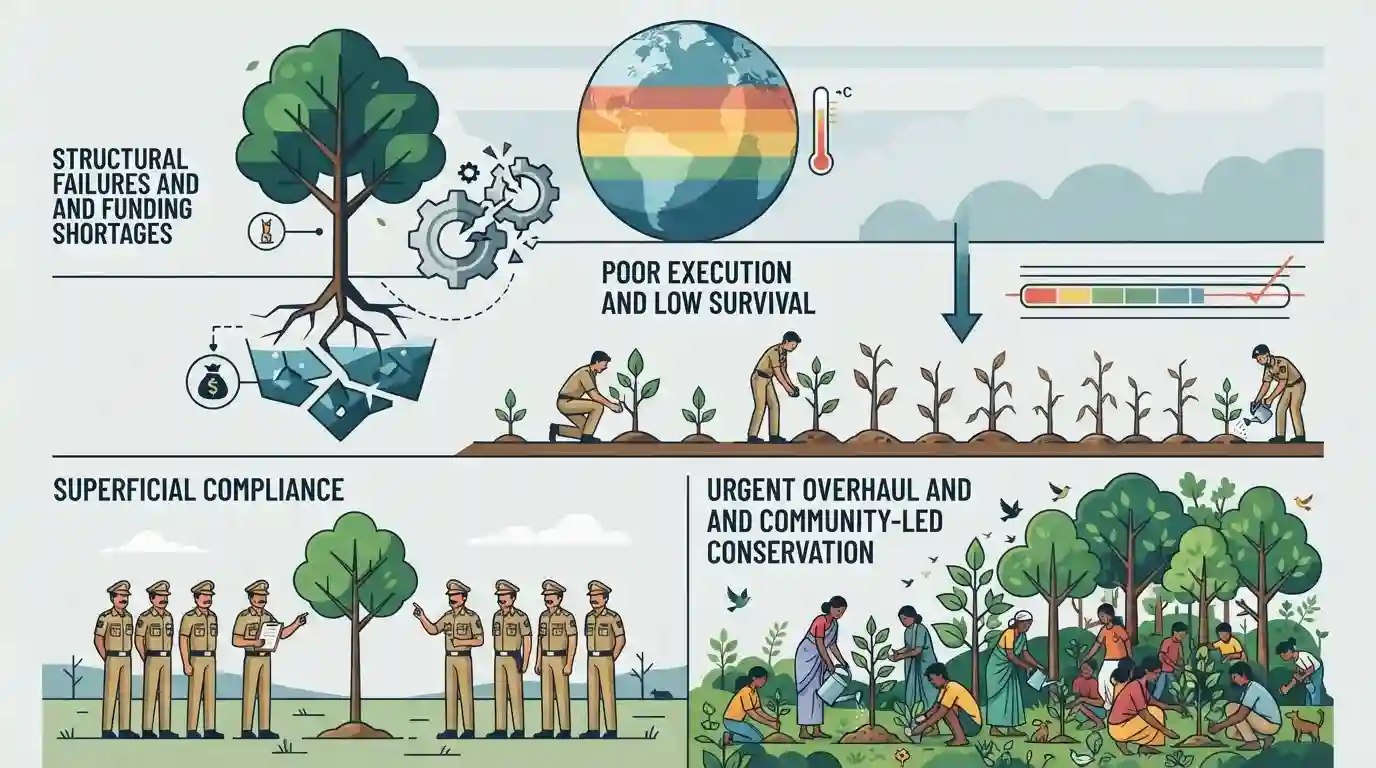
The editorial critiques the Green India Mission (GIM), examining its structural failures, systemic funding shortages, and poor execution on the ground. Despite its mandate under the National Action Plan on Climate Change to enhance forest cover and sequester carbon, the scheme suffers from low survival rates of plantations and targets falling short. The article emphasizes that meeting India's global climate commitments requires urgent administrative overhauls, rigorous tracking, and decentralized community-led conservation rather than superficial compliance.
Key Points
- The Green India Mission (GIM), a core component of the National Action Plan on Climate Change, faces severe implementation bottlenecks, funding deficits, and target shortfalls.
- Critiques highlight poor survival rates of saplings, administrative inefficiencies, and a mismatch between paper targets and ground realities in afforestation.
- India's international climate commitments, including carbon sink expansion under Nationally Determined Contributions (NDCs), are compromised by weak execution of domestic forestry programs.
- Reforming ecological restoration requires rigorous scientific monitoring, decentralized community involvement, and transparent auditing mechanisms.
Important Terms
Green India Mission

One of the eight core missions under the NAPCC, launched to protect, restore, and enhance India's forest cover, improve ecosystem services, and foster forest-based livelihoods.
UPSC context
GS Paper III (Conservation and Environment): Tests knowledge of government policies on climate change, afforestation targets, and ecological management.
National Action Plan on Climate Change
A comprehensive national framework launched in 2008 comprising eight core missions to guide India's mitigation and adaptation strategies against climate change.
UPSC context
GS Paper III (Environment and Climate Change): Evaluates India's overarching institutional mechanisms and climate mitigation policy architecture.
CAG
The supreme audit institution of India under Article 148, responsible for auditing government accounts, expenditures, and assessing public scheme efficiency and transparency.
UPSC context
GS Paper II (Polity and Governance): Important for questions on constitutional bodies, accountability, transparency, and executive oversight.
Ministry of Environment Forest and Climate Change
The nodal Union ministry responsible for implementing environmental and forestry legislations, climate change policies, and overseeing biodiversity conservation programs in India.
UPSC context
GS Paper III (Environment): Tests understanding of institutional mechanisms, policy formulation, and administrative jurisdictions in environmental governance.
Static Concepts Connected
What are the eight core missions under India's National Action Plan on Climate Change (NAPCC)?
- Core Four: National Solar Mission, National Mission for Enhanced Energy Efficiency, National Mission on Sustainable Habitat, and National Water Mission.
- Remaining Four: National Mission for Sustaining the Himalayan Ecosystem, National Mission for a Green India, National Mission for Sustainable Agriculture, and National Mission on Strategic Knowledge for Climate Change.
Cross-Topic Patterns
Climate NDCs vs. Domestic Forest Financing
India's NDC carbon sink target (2.5-3 billion tonnes CO2e) relies heavily on domestic forestry schemes like GIM, linking domestic fiscal federalism (CAMPA funds) with international climate diplomacy.
CAG Performance Audits in Environmental Governance
CAG audits repeatedly highlight execution gaps in centrally sponsored environmental schemes, connecting administrative accountability to federal forest governance under the Wild Life and Forest Acts.

GIM targets and NAPCC missions frequently feature in multi-statement prelims questions testing specific climate commitments and scheme mandates.
Linked PYQs · 2
Linked PYQs · 2
- 2025MainsGS3
Write a review on India's climate commitments under the Paris Agreement (2015) and mention how these have been further strengthened in COP26 (2021). In this direction, how has the first Nationally Determined Contribution intended by India been updated in 2022?
- 2021MainsGS3
Describe the major outcomes of the 26th session of the Conference of the Parties (COP) to the United Nations Framework Convention on Climate Change (UNFCCC). What are the commitments made by India in this conference?
